Pages

Saturday, 18 December 2021

Good & Gooder

A few minutes on the BBC News app this morning was enough to do my head in a bit, so I've been ferreting around in the world of bird stuff for something to relieve the pain. A few offerings...

I'll start with my own recent birdy joys. This past week I've had very little spare time, but spent maybe an hour with the Chiffchaffs at Colyton sewage works, and similar at Kilmington. A number of Chiffs, but still no Sibes. A few bonus Goldcrests and a Treecreeper were nice though. The Axe Estuary gulls have had a scan or three, but while I've yet to winkle out anything exciting, I photographed this yesterday...
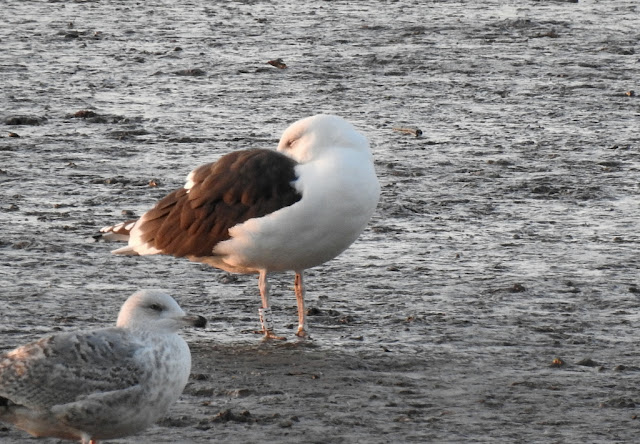
White L:CJ1 is from a Great Black-backed Gull project in Cornwall. Awaiting details.

Gulls are so cool. Their colour rings are often quite easy to read, and searching for them adds an extra level of interest to any flock of dross.

Talking of gulls...

Currently there is a 1st-winter Caspian Gull visiting Sutton Bingham Reservoir on the Somerset/Dorset border. I think it has turned up on something like six afternoons out of the last seven, so guess what? It has attracted a 'crowd'! According to reports on Twitter, birders and toggers blocked the road today; traffic jam, the lot*. Twitchers flocked, as the saying goes. I am always chuffed when a gull (those creatures which even many birders love to hate) pulls in a crowd. And when it's a subtle beastie like a Casp, I am pretty sure that quite a few trotting over to have a look will need a bit of reassurance that they're actually photographing the correct bird. But they still go. Such is the draw of Larid quality. I do love a crowd-pleasing gull.

There's another good gull in Weymouth right now. An Iceland Gull is making regular appearances on my Twitter feed, and again it's great to see a gull getting good press.

Also on Twitter today was a little video of a preening Med Gull, and a comment to the effect that Meds are always a treat to watch. And that from an experienced birder who sees many. Love it!

Please, please, always look at gulls. They have so much to offer...
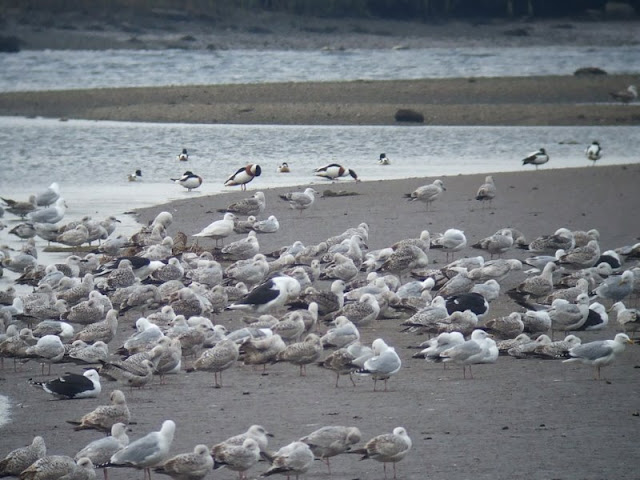
One of my favourite gull photos ever. Taken on the Axe Estuary in 2007. Even if the brown ones leave you cold, there's always the chance of something a bit easier...

Finally, this...


I've come across quite a few young birders on Twitter (that's 'young' as in 25 or under) and am pleased to say that at least some of them seem to have resisted the spurious and over-hyped glamour of rarity chasing. And when I see an initiative like this it does my cynical old heart good. And makes me smile for a nice reason.

Before I go, a quick thank-you to those who have in various ways said complimentary things about the recent series of NQS posts on the bird news saga. It has been very encouraging, and is much appreciated.

Finally finally, I had my COVID booster jab at 10:00 this morning. Jabs one and two hammered me somewhat, with around 36-48 hours of assorted nastiness, but thus far the booster has given me no more than a hefty punch on the arm. So I am hoping for a restful night. If I get one, today's goodness factor will go from 7/10 to almost 8...

* Example of hyperbole.

Monday, 13 December 2021

Bird News - Part 6: Filthy Lucre

Let's get one thing straight: the bird news industry was inevitable. Even before they had to pay for it, birders were already prepared to jump through at least modest hoops to get the latest gen. For example, the grapevine demanded communication skills. So the timid overcame shyness and talked to complete strangers; the naturally taciturn made an effort to be friendly with others; the selfish learned the need to reciprocate, and so on. If socially awkward birders were prepared to get out of their comfort zone for bird news, well yes, obviously there was money in it.

How much money?

Who knows? I certainly don't. I suppose I could reference the January 1993 Independent newspaper article mentioned in THIS post, which reports that Lee Evans was earning about £30k a year from Birdline (roughly £65k today) but I suspect this is the tip of an iceberg. In 2021 certainly, quite a few incomes must be funded by the bird news market.

In a sense I suppose the founders of Birdline invented that market. Once a group of individuals took it upon themselves effectively to centralise bird news and require payment for supplying it, that was that - bird news was now a commodity. There was absolutely no going back. And what a fascinating business model...

As Richard Millington wrote in A Twitcher's Diary:

Twitchers cannot exist without the goodwill of the birdwatchers who are the lucky finders of the more exciting birds. It is these generous and unselfish birdwatchers who start the telephone 'grapevine' working...

With the inception of Birdline a few years later, I doubt that much changed here. Most birders are 'generous and unselfish' when it comes to sharing their finds, and I am sure that such 'goodwill' continued. Though I am mildly curious to know if anyone ever phoned the Bird Information Service hotline and enquired how much their newly-discovered Desert Wheatear might be worth...

I imagine the answer was 'not much'. One way or another, the well-connected Birdline staff would soon get to hear about it anyway - for nothing I expect - and then sell it to anyone willing to dial 0898 700222.

Extreme rarities must have been especially welcome. And long stayers. And birds with long names. And those which entailed an elaborate set of directions. In fact, anything which induced you to ring the dreaded number in the first place, and then kept you on the phone! I came to despise the sound of that voice, and its almost cynically slow delivery.

As with any other market, once established, there were plenty of players wanting in. Two or three examples...

In 1988 I moved to Rickmansworth, Herts. At that time my birding zeal was minimal, yet I was still approached by one of the three founders of a new 'regional' bird news phone-line type service to check that I would give them first dibs on any news I had. Shortly afterwards I learned that this new service was now...er...'unable' to proceed in a fully independent fashion, and instead would become one of several regional birdlines in the Bird Information Service stable. Hmmm. No doubt there's an interesting story here.

A well-known twitcher who suddenly and unexpectedly found himself with a great deal of thinking time discovered that telecomms supplier Mercury offered a cheaper premium rate phone service than BT. Game on! For a while in the early 1990s my go-to birdline number was a little easier on the wallet. And the voice of Franko Maroevic made a nice change.

By 1990 loads of birders were basically skint. Bank loans for the third kitchen refurb in as many years were becoming harder to get. Birdline was simply a bottomless pit, into which bird news addicts poured money faster than they could earn it. Something had to be done. A delegation was dispatched to Norwich. Soft-hearted philanthropist Dick Filby was moved to tears by the plight of these hapless folk, and immediately founded Rare Bird Alert, a subscription-based pager service. Finally! A bird news service which you could budget for.

Anyway, a lot has happened in the intervening 30 years, and many players have have come and gone. In 2021 it seems perfectly normal to pay for bird news. Long gone are the dark days of Birdline, with its potentially addictive grip and limitless spend. And let's be honest, modern technology is simply amazing. If you discovered a drake Harlequin Duck tomorrow morning, within minutes your photos could be on Twitter, where they would be picked up by the ever-vigilant bods at RBA and BirdGuides, and the joyous news of your good fortune punted out to their vast army of subscribers. Great. Happy subscribers = money in the bank. You, meanwhile, will earn nothing. Well, no, not true actually. You will earn kudos. And that warm glow which rewards the 'generous and unselfish' spirit.

If, in any of the above, you have detected a hint of irony (or - heaven forbid - sarcasm) possibly that is because I am getting old. Old people have this tendency to look back at the days of yore through rose-tinted spectacles, and to have a Bah! Humbug! attitude to anything modern, slick and efficient. Well, there is little doubt that the modern bird news industry is slick and efficient. And yes, there is a rosy tint to my view of the grapevine days when bird news was free. But in truth, the rarity-obsessed numbers game which epitomises birding back then is just as prevalent today, if not more so. It might have seemed relatively innocent forty years ago, but it is exactly what spawned the whole bird news industry in the first place. And in a time when our understanding of what is happening to this planet tells us we ought to be throttling back massively, a number of individuals - friends and acquaintances of many of us - make their living from an industry which encourages us to do the opposite. Many today feel that the birding ethos which held sway back then - and still does now - needs to change. However, I cannot help thinking that when bird news became a commodity, the chances of instituting such a change dwindled away. A huge genie escaped the confines of its lamp, and I cannot see it climbing back in of its own accord.

Sunday, 12 December 2021

Fun Things

It has been a challenge to get much blog material out of the last couple of weeks' birding. But here goes...

After what was seemingly a good autumn for them I'm hopeful of a Siberian Chiffchaff or two, but efforts so far have drawn a blank. The closest I got was at Kilmington WTW last week. An elusive, pale and interesting bird in Thursday afternoon's drizzly murk failed to show at all the following day.

Gulls have been few, and desperately unremarkable. And that's all I have to say about gulls.

The one exception to this everyday-ness has been the West Bex bunting flock, with which I have spent a few interesting hours. But they're tricky. They come and go a lot, and I've yet to see more than 15-20 birds at any one time, frequently less. Clearly they have a few other feeding spots. I've really struggled to get any photos, but finally managed a handful this afternoon, despite the dull conditions...

Female Cirl Bunting with Yellowhammer

Female Cirl, with olive-grey rump on view

As above, following a quick twirl

At first glance it is hard to believe that the Cirl Bunting on the deck is the same as the one photographed in the hedge, but I think it is. Still, I cannot explain why it looks noticeably more yellow in those last two shots.

Last Friday week (3rd December) I had brief scope views of two females together, and have been hoping for a repeat performance ever since. So far, no deal. That same day - in two hours - I also had single females twice. And ever since, I've only managed single females. These birds ain't easy. In fact it has reached the stage where I'm beginning to ask searching questions about that sighting of two. Unfortunately the male which featured in THIS post has not been seen again.

Spot the Cirl Bunting

It has definitely been worth lugging the scope down there. The variability in Yellowhammer plumage is quite something, and well worth a proper grilling. For example, that bird on the left in the last pic has very little yellow in its plumage, but a scope quickly prevents any putative Pine Bunting-induced hyperventilation - the yellow fringes on the primaries are quite obvious.

All good fun.

Tuesday, 7 December 2021

Bird News - Part 5: Birdline

Some time in 1986, the recently-privatised BT (or British Telecom as it was then) introduced premium rate telephone services. Prior to this, the money you paid for a phone call went to BT*. A premium rate number was different. A percentage went to BT, but most of the revenue went to whomever the number was registered to, i.e., the service provider. The technology required to turn bird news into money was finally here.

Birdline was an early premium rate service. Its original number is etched indelibly in a dusty corner of my brain...

0898 700222

How did Birdline begin? Inevitably there is a story here, but it's not mine to tell. So, for the moment at least, I'm planning to concentrate on the fact that it did begin, rather than how. Having said that, there is one documented version I can offer...

You can find it in the Independant newspaper of 27th January 1993. A piece entitled 'Twitcher devotes his life to an obsessive flight of fancy' features the activities of one Mr Lee Evans, 32, of Little Chalfont, Bucks. The article reports that Mr Evans spent 11 years searching for a way to fund his passion for twitching, and then finally...

Inspiration came in 1986 when he quit his job as a design stylist at Vauxhall Motors to open an 0891** 'Birdline', recording up-to-the-minute sightings.

Obviously the usual caveats apply regarding what you read in newspapers.

Anyway, by early 1991 Birdline was in its fifth year, and milking me dry. I really wasn't a full-on twitcher, but even now I can hear Richard Millington's leaden drawl as he confirms that yes, I have reached Birdline, and that this is the mid-morning update of the exact day I think it is, before plodding laboriously through the rare bird news. Rare birds that are of no interest to me, or too far away, or have been present for a month already. A small fortune later, I can rest easy that I don't need to rush to Kent this afternoon. Still, it is September, and there's loads of stuff about, so probably I ought to check again in a couple of hours...

How much did it cost to phone the 'line?

In 1991 it was 33p/min cheap rate, and 44p/min peak/standard rate. Very roughly that's the equivalent of 75p/min and £1.00/min respectively in 2021.  The following year saw an increase to 36p/min and 48p/min. But that was fine, because you were paying for 'news you can trust, from the team you know', as the service's tagline put it.

In 1992 the 'team you know' apparently included six of the top twelve British life-list holders, three BBRC members and nine county recorders and committee members. Which demonstrates just how deeply the whole twitching, listing, rarity-centred ethos was embedded into the British birding establishment.

So, one minute we were just ringing our mates for bird news, or Nancy's, or accosting random birders with a cheery 'Anything about, mate?' and the next, paying through the nose for it. Looking back, there was little if any resistance to the switch. As someone commented on the previous post, it could be argued that Birdline brought order to chaos. Maybe. But it did other things too.

But that's for another post...


*  BT lost its monopoly in 1982, so theoretically your phone call might have been generating revenue for another telecomms provider from that point on.

**  Premium rate numbers changed from 0898 prefix to 0891 in the early 1990s.

Sunday, 5 December 2021

Bird News - Part 4: Ripe for the Plucking

I'll start with an apology, because I'm going to be a little untrue to the closing sentence of my last post; this one isn't quite going to be about Birdline. It struck me that I ought first to paint a picture of the early-1980s birding scene in order to demonstrate the inevitability of what was to follow. Obviously this is a personal take, so it's highly likely some of my contemporaries will have a different view. But for any younger readers, hopefully it will provide some insight, and maybe food for thought...

In 1981, when my enthusiasm for birding really took off, I was 22 years old. And I think it is fair to say that the vast majority of birders I met in the field back then were more or less of the same generation, i.e., predominantly young.

The vibrant grapevine and the very existence of the Nancy's hub illustrate the strength of that 'need to know' what's about - especially rarities - and speak volumes about the birding ethos of the day. Seeing 'new' birds was a massive thing. Listing, ticking and twitching were regular topics of conversation, and some popular contemporary literature basically encouraged it all. For example, I would say the three most influential books on me at that time were Discover Birds (1979) by Ian Wallace, Bill Oddie's Little Black Bird Book (1980) and A Twitcher's Diary (1981) by Richard Millington. I still have all three...

Discover Birds. While in no way promoting twitching, DIM Wallace's enthusiasm made me hungry for birdy drama. The book featured North Norfolk and its birds - reinforcing my desire to go there - and introduced me to Walberswick. And his thrilling account of 1st May 1978 at Flamborough Head effectively conveyed the excitement to be had from a hatful of rare and scarce birds.

Bill Oddie's LBBB. To the youthful me, this terrific little book basically said 'twitching is cool'. Rereading the relevant chapters now, it still does.

A Twitcher's Diary. The book is exactly that. Richard Millington's 1980 quest for 300 species in a year was an absolute inspiration. Full of birds I could only dream of, it revealed what was possible.

For me, this book was the new birder's equivalent of an Argos catalogue. Fatal.

So there you have it. My early influences. The birding clan was mostly young, and driven by an engine which had been steadily revving up through the 1970s: twitching. And I found myself very much up for the ride, along with loads of my contemporaries.

But, as I mentioned in the last post, bird news was still basically free. Despite the obviously massive demand for it (would 'aching need' be an exaggeration?) there was no obvious way to turn bird news into money. Well, not yet...

I don't know much about telecommunications technology, but I do know that all we had back then were landlines. By the early 1980s I would imagine most homes had a phone, but certainly not all. Otherwise you had to rely on public phone boxes, many of which were typically vandalised, or toilets, or both. In May 1985 I made my first ever calls from a car phone. A BMW-owning birder at Staines invited me to use his to phone out news of a couple of Temminck's Stints. I've not used one since, and they were incredibly rare even then. A few home phones had a facility for leaving a message. My memory pictures a tiny little cassette tape (on which you recorded your greeting, along with the sad news that you were currently out and therefore unable to do anything with the gripping gen the caller was about to share) plus a lot of flashing lights and unreliability.

So that's the technology side of things. Not quite ready...

Interestingly, A Twitcher's Diary contains a dedication. I quote:

Dedicated to-
The finders of rare birds - many whose names I do not know, but without whose unselfish attitude twitching could not exist and this book would not have been written. Thank you.

And the preface contains the following paragraph:

Twitchers cannot exist without the goodwill of the birdwatchers who are the lucky finders of the more exciting birds. It is these generous and unselfish birdwatchers who start the telephone 'grapevine' working, so that other people can come and enjoy the birds that they have found.

Ironically, the unstinting 'goodwill' of these 'generous and unselfish' folk was just about to become a vital element in a fascinating business model. Just as soon as the technology was ready...

Next: yes, definitely Birdline next.

Thursday, 2 December 2021

Bird News - Part 3: Nancy's

Nancy's Café was the oddest bird news hub that you could possibly imagine. I cannot do justice to its idiosyncratic excellence here, and recommend Mark Cocker's Birders - Tales of a Tribe, where it features prominently. Suffice to say, the telephone number of this modest, Cley-based emporium of cheap eats was once writ large in the front of every twitchy birder's notebook...

0263 740767

In the previous post I probably gave the impression that the grapevine was basically a network of individual birders. Mostly it was, but with one or two notable exceptions. For example, on occasion you might call a bird observatory and ask if there was much about. Fraught with danger though, especially if the phone was picked up by some twitcher-hating wind-up merchant.

'Yes mate, ten Golden Orioles in the trapping area, two Subalps and a Sardinian Warbler. Do drop by.'

And then there was Nancy's.

Next to the Nancy's Café telephone was a log, with all the latest bird news listed out. Anyone seated near the phone knew the score: answer the phone; read out the news. On the other hand, if fresh gen was being phoned in, make a note in the log and call it out to the room. Nancy's operated on a 'quid pro quo' basis. For example, if you successfully twitched the Wilson's Phalarope, you found a public call-box, coughed up ten pence and phoned an update through to Nancy's. At the same time of course, you would hear the latest gen.

Looking back, Nancy's Café strikes me simply as a serendipitous product of its time. Its location , Cley next the Sea, was already a focal point for birders, and those birders were inevitably attracted by the prospect of good-value grub. The proprietress, Nancy Gull, was happy to let the birders use the phone as a bird news hotline, and those birders were as eager for bird news as for beans on toast. Win-win.

The photo of this vintage clipping was kindly sent to me many years ago by Tom McKinney...

Nancy on the right. And look at that phone. It has a proper dial!

Thus far in the bird news saga there has been no real talk of money. Okay, yes, it cost a few pence to make a call, and every birder in those days had a small stock of 10p coins for the public call-box, whether that was to let your mates know about the Velvet Scoter you had just found on the reservoir, or to get a rarity update from Nancy's. But we are talking peanuts. And in the early 1980s, peanuts was just about all you could possibly spend on bird information. However, that was about to change. And change mightily.

Next: Mammon. Oops, I mean Birdline.

Wednesday, 1 December 2021

Bird News - Part 2: The Grapevine

In a cathartic act of heresy I ditched all my old notebooks several years ago, so can no longer view the list of names and telephone numbers at the beginning of each. They were my bird news contacts. My precious links to the grapevine.

Though I don't consciously recall it, there must have been a time when I had zero contacts, a blank page. But gradually, mainly through regular visits to the Staines area in West London, I began to meet other birders and acquire a few contacts. I guess this began to happen from autumn 1981 on. At this stage I wasn't much of a twitcher, but nevertheless keen to know what was about. 

As the months and years passed, and my interest in twitching grew, the grapevine became ever more vital. Like anyone else with a 'need to know' about the latest rarities, I was always on the lookout for those extra-special contacts, those birders with access to branches of the grapevine otherwise closed to me. In those pre-digital times it was all very well learning that there was a Stilt Sandpiper at some place called Frodsham, but where on earth was that? And even if you found it on a map, you still needed to know where to park, and where exactly the bird was. Enter Bob Eckersley of Leeds, my prized 'northern contact'. I don't recall us ever meeting, but there were plenty of telephone conversations. Ditto Paul, my excellent Lea Valley and East London contact. Back then there was an unhappy disconnect between West and East London for some reason, but our telephone link bridged it quite well.

It all sounds rather clunky and primitive doesn't it? And it was. But it worked.

So, here is a real-life example of the grapevine in action...

Staines Res in the early 1980s. North basin on the left.

It is 14th October 1982, a Thursday. The north basin of Staines Res has been slowly emptying over the past two or three months, and looks amazing, like a massive inland estuary. I notice that the Dunlin flock is unusually close to the causeway this afternoon, so have a go at counting them...

Thirty-five, thirty-six... Hello, what's this?

Long story short: it's a Baird's Sandpiper!

Present on the causeway were myself, Sandra, Jon Herbert and Gordon Richards. We took a while to settle confidently on the identification, but it helped that Sandra and I had seen our first Baird's as recently as August - an adult at Salthouse in Norfolk - so the diagnostic features were pretty fresh in our minds. But obviously we were still very cautious. This was a serious London rarity!

In 2021 it is easy to predict what would happen next. There would be photos taken and uploaded straight from camera to smartphone, then punted out via WhatsApp, Twitter, etc. The first twitchers would be there within the hour.

In 1982, this is what happened... 

That evening I phoned Pete Naylor. Pete is sadly no longer with us, but back then he was one of the London area recorders and, along with Andrew Moon, pretty much a Staines Res fixture. He seemed the obvious person to call. Apart from my description of the bird, I had nothing to offer in the way of evidence. From our few meetings in the field thus far, Pete would probably have known me as a keen young birder, but also a bit of a newbie. Could he trust me enough to widely broadcast news of a Baird's Sandpiper at Staines Res? Er...no.

Unbeknown to me, Pete passed the news to someone who could check it out the next day, which was a Friday. I have a feeling that that someone was Jeff Hazell. But whoever it was, the identity was confirmed, and on Saturday the causeway was rather busy.

In fact the causeway was busy all weekend. And how did all these Baird's twitchers become aware of its presence? The grapevine. That intricate web of telephone contacts.

However, one aspect of the grapevine that I've not really mentioned yet, and which no doubt had a role in disseminating news of that Baird's Sandpiper at Staines Res, was a tiny café in Cley, Norfolk.

Coming next: Nancy's.