Pages

Saturday, 18 June 2022

How It's Going...

How it started...

21:56 on 2nd June 2022. The first night.

How it's going...

Well. Fractionally more than two weeks later, there is no doubt that I am in big trouble.

Because moths have it all. I know that birds have it all of course, but moths - worryingly - even more so. For a start, some 2,500 species have been recorded in the UK, rather than 600-odd. And they range from dead easy to super-tricky, from dead common to mega-rare. A small minority are dead dull, but boy, wa-a-a-y too many are dead gorgeous. As I say, big trouble...

A few tasters from recent days, with Dorset status in brackets...

Mocha (scattered distribution; always local)

Small Elephant Hawkmoth in early morning sunshine (common on optimum sites, though I have no idea if our garden is close to one)

Lime-speck Pug (common along the coast)

I do not catch millions of moths. The best night so far was 15th/16th, with a catch comprising 46 individuals of 25 species. Though a few micros will have been 'let go' due to my current unwillingness to get too involved with the things. When I get down to adding up the number of species trapped so far, I wouldn't be surprised if it's pushing 100, or perhaps more. Still, quite often I read on Twitter about catches totalling several hundred moths (and well in excess of 100 species) in a single night! Our little corner of Bridport is small potatoes.

Moths look so good in a photo. Thus far I have not done justice to their appearance, with my mostly 'in the pot' pics. It seems de rigeur to have a 'moth plank', upon which the little beasties are posed for portrait shots, so I poked around in the garage for a suitable bit of scrap wood. Behold...


Not 100% on this one, but for the moment it's a Dusky Brocade (locally common to frequent)

Just WOW!!! I am in love! Scarce Silver-lines (local)

Shoulder-striped Wainscot (ubiquitous; frequent to common)

Burnished Brass (widespread and frequent) - the yellowy bits shine like polished metal!

L-album Wainscot (frequent along the West Dorset coast...)


I am much happier with the photos now, and hopefully will get better at it as time goes by.

All the above are so-called macro moths. As I say, mostly I have been avoiding micros. I have dabbled though, and when I spotted a little plume moth in this morning's catch, I potted it up for attention later. Sandra volunteered to check it out, and after a while handed me the book and just said, 'See what you think'. There weren't many candidates, and when I told Sandra what I thought, she replied, 'Me too.'

Unfortunately we surely had to be wrong, because the book said: 'Migrant...From southern Europe and North Africa.' And on the very helpful Dorset Moths website: 'In Dorset, up till 2010, there are just three records for this species. One of these was from the Isle of Portland; since then, a further seven individuals have been recorded on Portland, notably in 2019.'

Had we really caught a pucka immigrant from far, far away? Well, Friday did see a plume of warm air and Sahara dust waft across the south of England, so maybe...

And yes, it turns out we had.


This weird little thing is Oxyptilus laetus, the Scarce Light Plume.

I think it's quite funny that our rarest moth so far is a micro, one of those creatures I'm a bit scared of.

So, there we are. This blog will never be quite the same again.

This morning I was invited to join in the emptying of a whole bunch of moth traps which had been set out at Mapperton. Unfortunately I couldn't spare much time, but suffice to say the first trap took more than an hour to process. It was mayhem! But that's for another post...


Sunday, 12 June 2022

Time Well Spent

As I am leading a walk at Mapperton next Sunday it seemed sensible to acquaint myself with the current flora and fauna. Tom Brereton had already alerted me to the presence of a couple of interesting birds, so I was looking forward to my next visit. Which was this morning. It went better than I could have hoped...

Flora 

I am continuing to make an effort in this area. Today I realised that the stuff I was blithely calling Cow Parsley is actually Hogweed, and the Cow Parsley is largely over now. I had already got to grips with Pignut, but today added Corky-fruited Water Dropwort. Along with lush clumps of Hemlock Water Dropwort that I must under no circumstances be tempted to eat (and loads of Wild Carrot at Cogden) I now have a repertoire of at least five umbellifers. Oh, and Alexanders. Six. Also nailed this morning were Hedge Woundwort, Creeping Cinquefoil and Catsear, and why the knapweed was Common, not Greater. Baby steps.

Corky-fruited Water Dropwort...

...and the basal leaves which helped me clinch it.

One of many lovely Common Spotted Orchids

Fauna

Creep-crawlies...

Golden-ringed Dragonfly

Keeled Skimmer - female.

Mother Shipton

Large Skipper on...er...haven't started on thistles yet.

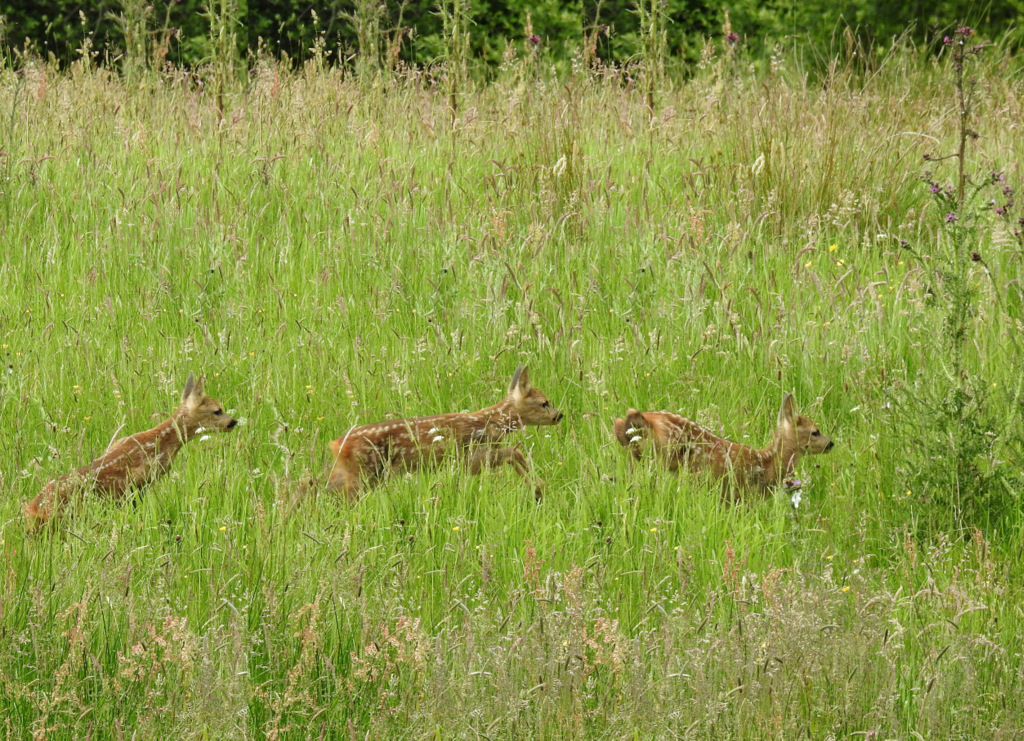
There is a good population of deer in the Mapperton area - too good probably. I saw several Roe and Fallow Deer, including a white Fallow and a spotty Roe fawn which I almost stepped on...

White Fallow legs it...

...then stops to check me out

Regular Fallow trying to work out whether I should be run away from.

I felt a bit guilty about disturbing the Roe Deer fawn. Hopefully mum was able to find it okay...

Composite of three shots. Tiny little thing.

This is where it had lain. A well-used spot.

The birdy highlights were even better. First, a 'mixed-singing' Chiffchaff thing. I cannot recall ever hearing one before, and I have to say it did sound weird. It sang from high in the canopy, and views were pretty rubbish. I recorded a couple of short videos though. Here is a sound clip...


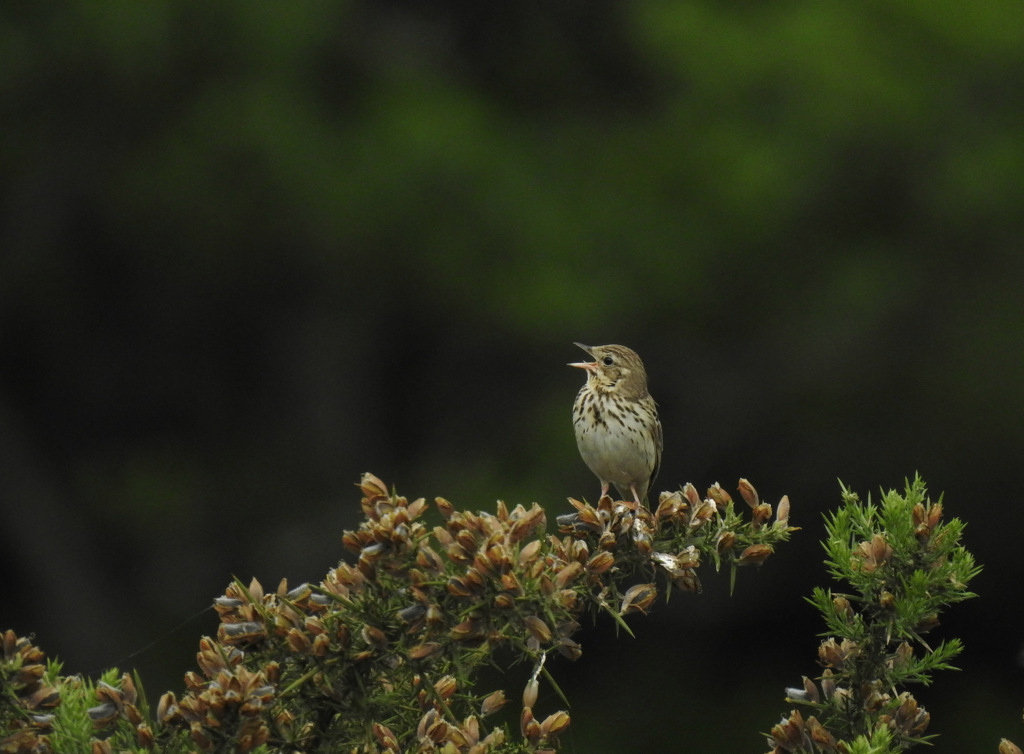
Best of all, a singing Tree Pipit holding territory. Tom found it a while back, and I was really chuffed to see it so settled. Hope it finds a mate. I have never seen a 'local' territorial Tree Pipit, either here in West Dorset or on the old Axe patch in East Devon. The song is exquisite, and I spent ages just listening, and trying to get some decent video. A great deal of patient creeping and crawling eventually secured me a lovely spot to view from, and the bird appeared perfectly relaxed. In the end I was with it an hour or more. Time well spent.

Image overload...


And finally, a short video. Warning: you will see the Tree Pipit appear to fly off, but don't stop the video. What it actually does is launch into a glorious song-flight, which is well worth a listen. Just before the finale, you briefly see it zip through the shot again as it swoops in to land out of view a few feet to the right...


Time just whizzed by. Just me, some amazing habitat and a few lovely creatures. Nothing rare, nothing even that scarce. As so often though, context is everything.

An unforgettable morning.

Thursday, 9 June 2022

Learning Curves

The natural world has fascinated me since childhood, and I have many clear memories involving assorted creatures and a very small me. In one of them I am shown a bat clinging to a wicker chair in a garden. I was probably four or five years old. I recall the wonder and thrill of it, but I definitely do not recall asking what kind of bat it was. It was a bat, and that was good enough for me.

The desire to be more specific, to put a name to things, came later. But even then I might not have been that bothered unless it meant points in an I-Spy book. Birds changed that. I made an effort with birds. And now here I am in my seventh decade, knowing quite a lot about how to put a name to almost any bird you might encounter in these islands. Terrific. However, the same cannot be said about butterflies, moths or dragonflies. Or plants. Or...well...a stack of other stuff...

On many occasions my ignorance has been a source of frustration. Last year I quite fancied trying to find Lulworth Skipper locally. I had never seen one but knew they were here somewhere. I guessed that the best places to look would be where its foodplant was abundant. The foodplant of Lulworth Skipper is Tor Grass, so I just needed to find a load of that. Except I had no idea what Tor Grass looked like. So I looked it up, found some, and scored with Lulworth Skipper at my second attempt.

My delight at discovering the wealth of orchids available at Cogden and West Bexington definitely stirred something, but I suspect my involvement with the Mapperton rewilding project is what finally woke it properly. I don't think I had ever appreciated quite how much plants can tell you about the local geology, habitat and potential invertebrate population, for example. Sure, I can identify a few plants, but have decided - at the ripe old age of 63 - to turn that into 'a lot of plants'. I asked plant buff and fellow blogger Steve Gale for a bit of advice, and as a result now own this...


It fits nicely in the outer pocket of my camera bag, and on several occasions has been open on the ground beside me as I have knelt to grapple with a new plant. Like this one...

Mouse-ear Hawkweed at Cogden

Its paler, more primrosey shade of yellow made it stand out from its myriad mates (which I'll tackle some other time) and clinching the identification was quite pleasing.

And then of course, moths. Partially that is Sandra's doing, but I didn't need much prodding. What a world of super-subtle trickiness it is. And I thought gulls were hard. Yes, there are plenty of obvious ones. We've had one specimen of the most-photographed moth on the planet - Buff Tip - and this corker...

A pristine Poplar Hawkmoth

But there have been several that, while distinctive, are less 'instant'. A couple of examples...

May Highflyer

Brussels Lace - what a great name!

 And then there are those which look different, but might not be...

L: Marbled Minor...or maybe Rufous Minor or Tawny Marbled Minor.
R: Tawny Marbled Minor...or maybe Marbled Minor or Rufous Minor.

Apparently the three species can reliably be identified only by examining their genitalia. I shan't be inflicting that indignity upon them. And anyway, all are common.

And then there are the plain weird...

Below: Heart and Dart.
Above: er...

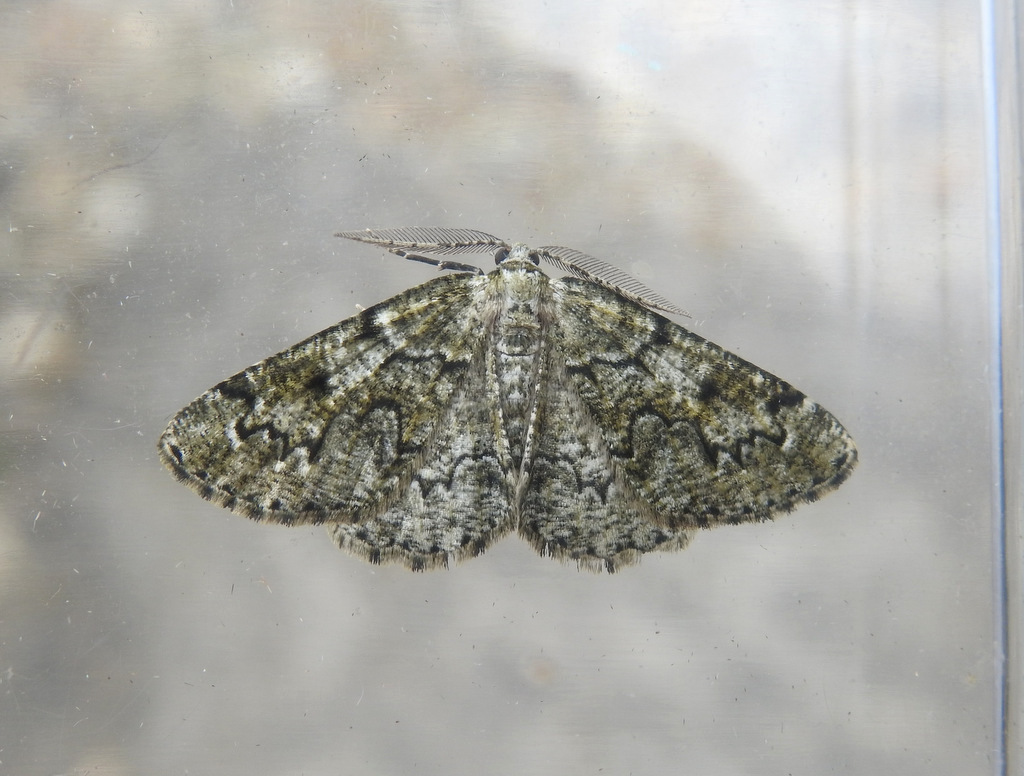
Sandra and I spent ages trawling through the books for a moth with those distinctive 'saw tooth' markings. Nothing matched, not even slightly. Finally we realised that the dark, shallow V on its collar (visible between the front legs) looked exactly like a Heart and Dart. Conclusion? Aberrant Heart and Dart. Strewth! It's hard enough without all that kind of nonsense!

There's even been a bit of dabbling with micros. It was impossible to ignore one with antennae a mile long...

Buff Long-horn (Nematopogon metaxella)

There are a couple of potential confusion species (surprise, surprise!) but I think the identification is pretty safe. And it's not a rarity, so no big deal really.

Two things have struck me since embarking on these two fascinating - but eno-o-o-o-o-rmous - learning curves:

  1. There are not enough hours in the day
  2. There are not enough remaining years in my life

Lesson? Don't be like Gavin. Start young. Sleep rarely.

Monday, 6 June 2022

Ribbit

Two weeks ago I deliberately went searching for a plant that I have never seen before: Frog Orchid. I was acting on a tip-off, but knew it was probably too early and predictably failed. Still, at least I got a feel for the site. Back again this evening.

Many more orchids in flower than a fortnight back...

A good few Common Spotted Orchids, mostly in the early stages, like this one

The pretty little Heath Spotted Orchids seemed more advanced

There were also some Marsh Orchids (presumably Southern Marsh) but I didn't come across them until the light was too poor for pics.

I'm not quite sure how I managed to spot it, but somehow this utterly inconspicuous green thing caught my eye...

That plant in the middle there.

Maybe it was the strappy leaf that I picked up on? Whatever, a close look revealed a tight little bunch of flower buds, and some more strappy leaves lower down. Could this be a Frog Orchid? I took some more photos...

A little bit of purpleness coming through on those buds...

I'll be honest, I was well impressed with my plant-spotting skills. I was pretty sure this must be a Frog Orchid, so made a mental note of its location and pressed on, scanning back and forth intently for another. With nothing more to show for my efforts fifteen minutes later, I felt the need for another dose of self-congratulation, so returned to the scene of triumph. Crouching to look at my prize, I suddenly noticed a plant less than a foot away....

Frog Orchid!

How on earth had I failed to see it earlier? I must have spent at least a couple of minutes taking photos of the diddy little green one, yet here was a pukka Frog Orchid flower spike barely a hand's breadth away.

A bit more obvious from this angle.

Just for fun, the photo below illustrates the view from my eye level. Frog Orchids are not obvious! Well done if you spot them both. Skip to the end of this post for the big reveal.

Both Frog Orchids are in this pic

So, that was it. An evening spent in the quest for a local plant tick. Not so long ago, if you had suggested that June 2022 would see me indulging in this kind of behaviour, I would have laughed at such a preposterous notion. And yet here we are.

And I fear it is going to get worse...


Saturday, 4 June 2022

Feeling Old...

Here are a few quotes from The Birds of London (2014) by Andrew Self. See if you can work out which species they refer to:

'By the mid-1930s they were still a common and widespread breeding resident in the rural areas but had been pushed out of the inner suburbs...in December 1947 a flock of more than 40 was seen on Barnes Common...On Hampstead Heath there were five territorial males in 1954...The population began to decrease from the 1970s onwards...on Wimbledon Common they declined from 10 pairs in 1976 to just one pair by 1984 when breeding was last recorded...The closest breeding birds to central London were at Barn Hill, near Wembley, where two pairs bred in the mid-1970s...The species continued to decrease during the 1990s with some populations going into a terminal decline...At least 148 pairs/singing males were located across the London Area in 1998.'

The 2016 London Bird Report states that '...there were 54 territories/singing males...' in that year, apparently from 21 sites. I do not know how things stand right now, but I can guess.

Singing males...

It is fair to say that the song of this species is iconic, and the first time I consciously registered it was in the very early 1970s, at one of the locations mentioned above - Barn Hill, near Wembley. I must have been 11 or 12, but had no idea there were none closer to central London, or indeed of the species' wider status. To me they were simply the prize birds of Barn Hill, my nearest bit of 'countryside'.

Mostly I visited Barn Hill to fish the pond, but once I had crossed the railway footbridge and adjacent field, and passed through the line of trees which skirted the foot of the hill, the path climbed a grassy slope studded with the odd scrubby little Oak, and maybe Hawthorn. Here is where they lived. And probably you have guessed the bird by now. Yellowhammer.

According to the BTO website, Yellowhammer is experiencing a 'rapid decline'. That is putting it mildly. Basically, for every three breeding pairs back when I first recall seeing them, there is now one. Why? Again according to the BTO website, primarily the causes are 'decreased survival' and 'agricultural intensification', the two presumably not mutually exclusive.

By chance I came across some aerial shots* of Barn Hill which date from 1947...

In the very early 1970s I would appear over the railway footbridge at top left, head SE across the field, through the line of trees, then puff eagerly up the slope to the pond.

A closer view...

In 1947 the slope down from the pond to the north looks almost entirely open grassland. Twenty-odd years later there were a number of scrubby little trees.

And this is what it looks like now...

This is as close a match to the above pic as I could manage.

And zooming out a bit...

Looks quite nice I guess. No Yellowhammers though.

I last visited Barn Hill in 2017. That walk up the grassy hillside, so vivid in my memory, now passes through a dense woodland ringing with the screech of parakeets. It is part of Fryent Country Park, a dedicated nature reserve.

I am fortunate to have Yellowhammers local to me. They are a familiar sight in some places, but definitely not all. Just three territories in the Bridport recording area during 2021, and nowhere locally would I call it common. The species is slipping through our fingers...

As I began this post I wondered why I was bothering, what its point was exactly. I'm still not sure. I suppose it sometimes bothers me that we get all excited about the successes - the Spoonbills, Red Kites, Bitterns etc, etc - and the rarities which have us rushing all over the place, while so many less spectacular birds are quietly being throttled into oblivion. Am I saying we shouldn't get excited about stuff? No, not really. So what am I saying? Goodness knows...

Anyway, I do now understand why elderly birders tut and shake their heads so much, and witter on about the 'old days'.

Male Yellowhammer at Mapperton. Good choice, Mr Yellowhammer.

* Historic England Aerial Photos

Friday, 3 June 2022

Moffs

Well, that all happened rather quickly...

It must have been all of two days ago, and a chat about garden wildlife had Sandra and me reminiscing about the early years living in Rickmansworth, Herts, and attempts to identify the moths which our on-all-night porch light pulled in. We bought what was probably the book back then - Bernard Skinner's Colour Identification Guide to Moths of the British Isles - and got pretty good at visualising the photos of pinned specimens as real live moths. We even kept a list. Our enthusiasm was a bit up and down, but for at least a year or two we kept at it. The porch light was eventually replaced with a PIR job, and the catch rate shrank accordingly. That hand-written list still resides in the back of Skinner...

Warning: there may be string, and possibly duplication!

I notice we revived the list after moving to Devon, but not for long. I also notice that most of the entries were written by Sandra, and a couple by one of the boys - it was definitely a family affair.

So anyway, I casually asked if we ought to get a proper moth trap. 'Yes', came the reply. As I say, that was two days ago. Last night...


Within hours, a Twitter enquiry yesterday morning re second-hand moth traps had me nipping over to Weymouth to collect the actinic trap pictured above. For a very modest sum I received not just the trap, but three spare tubes as well. Also, knowing that I was just starting out down this path to the Dark Side, the vendor very kindly threw in a pile of egg trays, a dozen little plastic specimen boxes and a well-thumbed copy of Field Guide to the Moths of Great Britain and Ireland by Waring, Townsend and Lewington. Wow! I was very touched by such generosity, which illustrates beautifully the positive side of Twitter.

Last night's catch was quite small, and got smaller still when we removed the lid this morning. Strewth! Is there a trick to getting them to stay put for a while? As there were only a couple which we recognised, virtually every moth needed potting. At the top of my new shopping list is 'round pots'. Collecting moths off an egg box is clearly a dark art, and I suspect round pots are involved somehow. 

Some which didn't get away...

Willow Beauty (I hope!)

As suspected, this is a 'micro': Bee Moth.

Common Pug

Also: Buff Ermine, Clouded Border, Clouded-bordered Brindle, Common Marbled Carpet, Red-green Carpet, and a few Heart and Darts. One little moth belonged to a group which can only be separated by surgical examination. We shan't be doing any of that, so 'Marbled Minor agg' is what we called it.

A few micros were given instant freedom. Their time will come, but it isn't now.

The Common Pug pictured above was the better-marked of two. Pugs are mostly hard, a fact I recall from previous dabbling, and we couldn't nail it. Enter Twitter again, and the excellent UK Moth Identification, overseen by Sean Foote. ID sorted.

I'm glad we didn't get anything scarce. That would have felt wrong. If (when?) a scarce one eventually comes along, chances are it will be after many, many hours of page-turning and furrowed brow. Judging by how long it took to process last night's catch, at least then we'll feel like it was earned!

In the next installment of this birding blog: Plants.

Wednesday, 1 June 2022

#LocalBigYear - May

May began with a nocmig bonanza. Seven species of wader flew over on the first night of the month, some of them multiple times. There was a Lesser Whitethroat on the 8th, Tree Pipit on the 10th. Then a Nightjar on the 15th. Nocmig gold! However, from the 22nd, nine blanks in a row. Nine! But you just keep putting the recorder out, hoping. And then last night, a very unexpected Little Ringed Plover, my first this year. Bingo!

And that is how May has mostly been. Patchy, with some stand-out highlights. The numbers tell me that I've added eight species to the #LocalBigYear tally, clocking up 150 now. But really that figure should be 155, because my nocturnal 'sound trap' has caught the calls of Avocet, Tree Pipit, Nightjar, Spotted Flycatcher and LRP, for my ears to hear the following morning, just as effectively as a nocturnal moth trap catches moths for the eyes to see. And I have always been happy to add 'heard only' records to a year list.

Bird of the month? Woodchat Shrike.

Find of the month? Quail.

Beast of the month? Glaucous Gull.

Disappointment of the month? Nil Poms.

Long range, late evening, May Whimbrels on Cogden Beach

June beckons, with her big bag of non-avian distractions...