Pages

Friday, 9 June 2023

The Gift That Keeps on Giving

Many times, over the years, various friends suggested I get into mothing. As recently as spring 2022 in fact. My reply was always the same: 'Maybe in another life.' Knowing my own nature, I was convinced it would be impossible to dabble at moths. Mothing would not be some pleasant summertime diversion. No, it would be full-on, all-consuming, and I would become its slave.

I was not wrong.

Last year was bad enough, but this year is even worse. Or do I mean better? Last June I would have to look up almost every single moth I caught. Initially I had to ignore most micros - there just wasn't the time. One year on, and I can identify most macros I catch, and micros get the attention they deserve. I've taken to photographing many of them, and annotating each pic with the moth's systematic classification, name (scientific and vernacular) and larval food. It's a bit of a chore, but with a purpose - slowly I am beginning to memorise a few.

The garden list is growing - 13 new in the last three nights - and the year list is now on 162, plus five aggregates. Lots of rarity buzz too, with some very decent records. And I now realise the blog is going to be my illustrated mothing diary. So here we go...

Tuesday night

First Maiden's Blush of the year. Delicate and pristine.

Though its left forewing is a bit deformed, this Scalloped Hazel is a first for the garden, so gets a well-deserved mugshot.

Small White Wave - another garden first.

Sharp-angled Peacock. First of the year.

First for the garden.

Wednesday night

Sycamore. Not rare, but nice. Caught three last year.

The garden's second Cream Wave. More strongly marked than the first, which featured in the previous post.

Just a single Bridport area dot on the Living Record map, but have caught this moth two nights on the trot now, with two individuals last night.

This outrageous micro was a very unexpected turn-up two nights ago. I have seen countless photos on Twitter, but all from daytime encounters. I didn't know it came to light as well, but it does. In fact, three did last night! Affectionately known as Geoff.

Second Freyer's Pug of the year. Always look at pugs.

Another garden first, and seemingly quite a scarce moth in the county.

Side view, showing the little scale tufts.

Living Record map of Luquetia lobella. A good record for West Dorset.

Typical mothy 'little brown job', with beautifully intricate markings when you look closely. Had a handful of these last year. This one is the first of 2023.

Wednesday night's other Geoff.

Thursday night

First of the year. Caught a couple in 2022.

What a beauty! This Silver-ground Carpet is another garden first.

This moth - another garden first - was netted by our wildlife hedge. There don't appear to be that many Dorset records. Apparently it doesn't come to light, though will come to pheremone lures designed to attract its congener Grapholita funebrana, the Plum Fruit Moth. The two species look very similar, but I am given to understand that the pale, off-white palps separate tenebrosana from funebrana.

No recent Bridport area records of G. tenebrosana, and only a total of nine elsewhere.

First of the year. A cracking little micro.

Straw Dot. First of the year, and a nice, fresh example of this common moth. It is about the same size and shape as Anania crocealis pictured above. Yet this one is a so-called 'macro-moth', and the other a 'micro'. Moths are tricky.

To the naked eye this looks like a speckly little red-brown job. But through a lens it is STUNNING! First for the garden.

This little cracker is only about 4.5mm long, and in almost perpetual motion. No way could I let it out of the pot! A great story with this moth too. See below...


So, Lyonetia prunifoliella. I knew it was a moth I hadn't seen before, but it reminded me of Lyonetia clerkella, a miniscule silvery splinter that I've encountered quite a few times now. Very quickly I located a good candidate in my copy of Manley. But hang on, that can't be the one - it says Lyonetia prunifoliella is categorised RDB1 (Red Data Book 1), i.e. endangered. Well, it was. Apparently not reliably recorded in the UK since 1900, it suddenly reappeared around 2017 and now several counties have recorded it a few times, including Dorset, with around ten records. Still a great catch though!

Perhaps it is obvious why I am hooked on this fascinating pastime.

Tuesday, 6 June 2023

The Rarity Buzz

There are many ways that time spent birding can be elevated from 'a nice walk with bins' to another level entirely. Brilliant views of a favourite species can do it; some engaging and unusual behaviour perhaps, or a lively bit of passage. And for me, chancing upon a scarce or rare bird is always a winner. Mmmm...the rarity buzz. Heady stuff.

I've discovered that mothing is similar. And when it comes to the rarity buzz, the sheer number of moth species inevitably increases the potential opportunities to experience it. What is more, you are not limited only to migrant species. For example, let me introduce you to the rarest moth I've caught in a while...

This unspectacular little micro is less than 6mm long. Caught on Saturday evening.

The Dorset Moth Group uses a facility called Living Record to collate the county's moth records. By accessing the distribution map for any given species you instantly get an idea of its status within the county. Here is the Living Record map for Lampronia morosa in Dorset...

That colourful dot near West Lulworth represents a single record!

As far as I am aware, Living Record only goes back around 20 years or so (and I doubt it's an exhaustive representation even then) but it certainly provides an excellent overview. So, Lampronia morosa is definitely a rare moth in Dorset. Even better, a quick trawl through several other county moth group websites suggests that it is pretty rare everywhere. In fact the species is officially designated 'Nationally Scarce'. On top of this, the larvae feed on roses (wild and cultivated) and I caught it with a net (that's another story for another post!) next to the garden's new wildlife hedge, which contains Dog Rose. So it is quite feasible that this rare moth is breeding in our garden!

Later that same evening I spotted a small geometrid moth dive into the trap shortly after dark, and in the morning extracted this...

Grass Rivulet

I didn't recognise it, but soon worked out the ID. Imagine my surprise when I checked the Living Record map and saw a big blank space around Bridport...

No Bridport area records at all, and those blue dots at nearby Charmouth and Beaminster represent a single record each; the Portland dot represents three.

There are some extremely keen, active moth folk in the Bridport area, so I know this is a very decent record indeed. The larvae feed on Yellow Rattle seeds, a plant which is apparently having a good year locally, so perhaps Grass Rivulet will benefit too. In the meantime I shall luxuriate in the rarity buzz.

Finally, the last four days' mothing in pictures...

First Brussels Lace of the year. A beautiful moth.

Left to right: slightly abberrant Heart & Dart, Heart & Club, standard Heart & Dart.

The delicate Cream Wave - new for the garden.

Common Swift. Perhaps surprisingly, new for the garden.

Freyer's Pug. Caught just one of these last year, also in June.

Mottled Pug. New for the garden. Pugs are notoriously tricky, and I'm pretty sure I recently misidentified a couple of these as very worn Oak-tree Pugs. I know better now!

A nice, easy micro.

Not so easy. Another garden first, and very similar to Notocelia rosaecolana, which featured a couple of posts back. Hopefully I've got it right.

There is a look-alike, but the coppery fringes clinch this one.

New for the garden. Caught last night. What a cracker!

Common, but striking.

Blair's Mocha #3 for 2023.

Shoulder-striped Wainscot. Caught just one last year. A beautifully-marked moth.

Another one netted from our hedge. A couple of days ago I caught two, but they just would not keep still for a photo. Amazingly this one cooperated brilliantly, though I dared not tap it out of the pot! This is about the best my camera can do with 3.5mm of moth!

Needless to say, the trap will be out again tonight, and so will the net! I am up to at least 139 species for the year so far (including 5 aggregates) and am confident of one or two more by morning. It is fair to say that birds have taken a back seat for the moment...

Monday, 5 June 2023

In the Absence of Data

It is hard to argue with good data. Exactly what that data means might be up for discussion, but numbers alone can usually tell you something at least. For example, Barn Owl has been a regular feature of my nocmig activities here in sunny Bridport. I didn't keep accurate records in 2020 (my first year) but Barn Owl featured 'often', let's say. However, I do know that the species occured 125 times in 2021 and 81 times in 2022. This year I have been recording at a similar effort level, and have thus far tallied ZERO Barn Owls.

I don't know what that data means exactly, but I do not sense a success story.

Two weeks on Jersey in the latter half of May would not have been my choice of holiday, but it was a family affair, not a birding trip. We were based in the north east of the island, and I did manage to squeeze in a fair bit of local birding by just walking from our cottage. But honestly, I have never been more disappointed. It was dire. There were strikingly few birds, especially away from the coast. Worse still, it was a struggle to find insects, and looking for them became a bit of a thing. Scanning hedgerows, clumps of umbellifers; bashing bushes to see what might be dislodged; anything to try and stir up some life. The farmland was decorated with loads of nice-looking hedges, mature trees, lush verges...but depressingly few creepy-crawlies. Was the cold, late spring responsible? Or something more sinister?

A visit to the west side of the island, including the wetland reserve at St Ouen's Pond, was better...
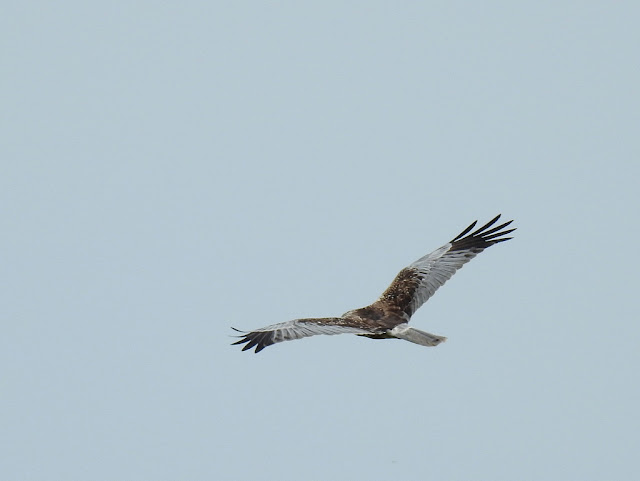
Marsh Harriers were a constant presence. Always nice.

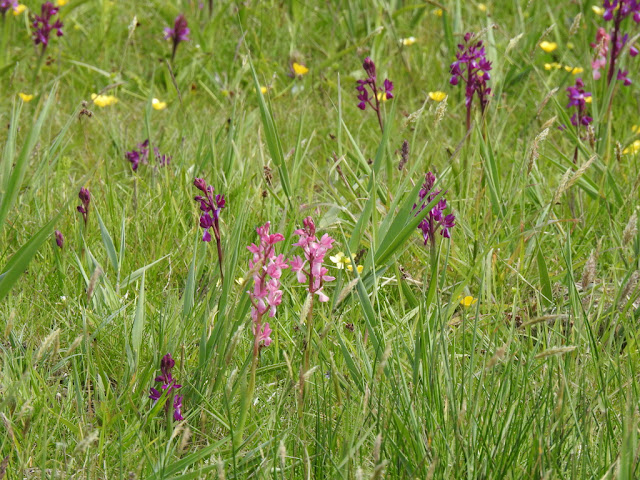
Loose-flowered Orchid was an unexpected plant tick

A couple of pink ones

Main highlight of the jaunt out west was a splendid reptile tick...

Western Green Lizard, a surprisingly hefty beast.


Prior to the trip I had done no research re the Channel Islands Nat Hist, and to my shame had been unaware even that Short-toed Treecreepers live there (didn't see any!) so the orchid and lizard ticks were a nice bonus. Neither made up for the lack of life elsewhere though...
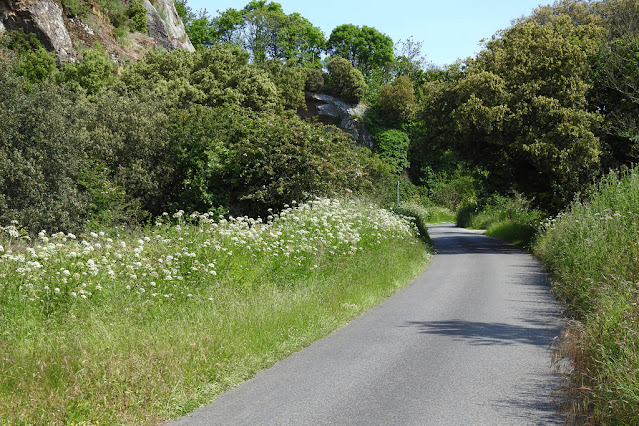
Very lush, but pathetically few insects...

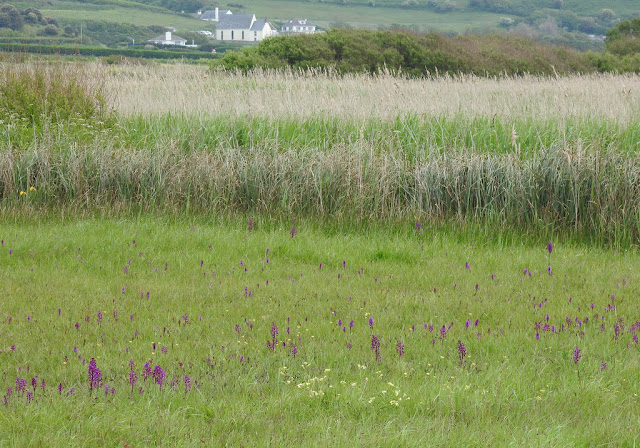
Spent a few minutes scanning this pretty meadow. A couple of bees and a hoverfly sp was about it...


St Catherine's Wood was a short walk away, and four visits in search of Short-toed Treecreeper and Red Squirrel produced neither, but I did see a Firecrest...

Firecrest in St Catherine's Wood, Jersey.

All the above opinions about dearth and direness are based on no data at all, just a gut feeling. I have no numbers, and therefore no real evidence. All I can say is that I will never choose Jersey for a birding holiday!

A Black-headed Wagtail was discovered at St Ouen's Pond shortly after our visit to it, and it struck me that this little oasis of life, with its plentiful insects, breeding Lapwings and flashy flava, would give a very misleading impression of Jersey birding if it was the only place you visited. It made me wonder if a similarly distorted view of the state of our countryside might be possible if you only go to the 'good' bits?

There are a lot of 'good' bits where I live, and I continue to stumble across unexpected surprises from time to time. A couple of days ago I wandered up the river valley from home, as I have many times before. A recently-cut field (silage?) had been deliberately left unshorn on one side. The reason? These, I guess...
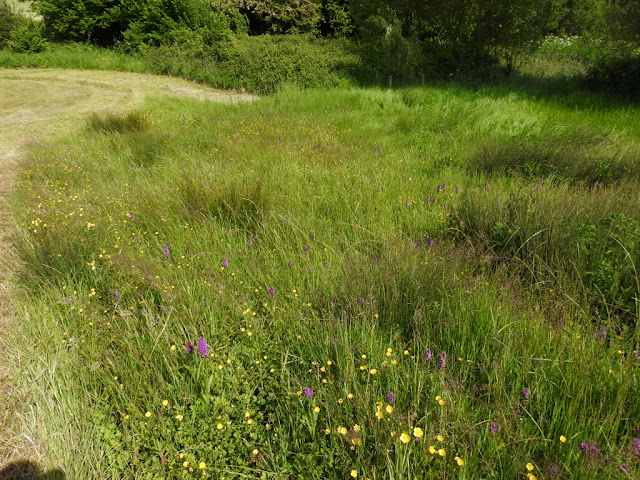
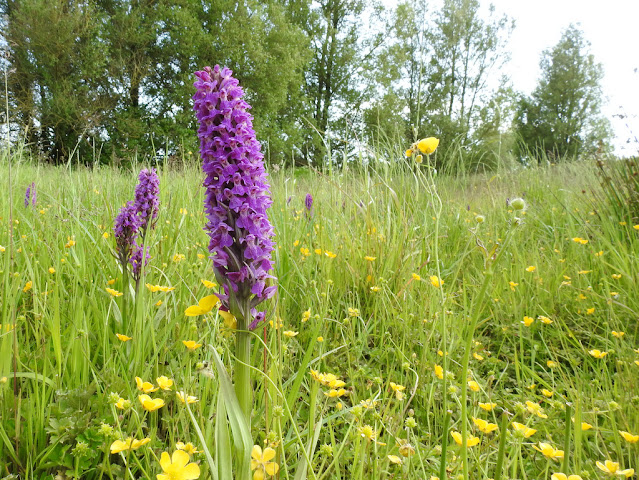
Hundreds and hundreds of orchids - Southern Marsh I think...

...including some whoppers.

I had no idea this beautiful display of orchids was on my doorstep. Of course, such delights do make you wonder just what the countryside would be like if less of it was in such a dreadful state...

My Twitter feed is a depressing litany of ecological vandalism, declining populations of this and that, and so on. Lovely - albeit insignificant - discoveries like the one above do cheer me up a bit, but there is no doubt in my mind where it's all headed, data or not...