Pages

Friday, 15 April 2022

I Very Nearly Missed It...

I very nearly missed it. Scooting through last night's nocmig, a handful of tiny, sharp marks just about caught my eye. This is exactly as they appeared on the sonogram...

Just enough to look interesting

Playing it back I had a strong suspicion what the bird was. Enlarging and enhancing the blips convinced me - they looked very, very familiar, if not quite so strong as my one and only previous example. Still, for confirmation I posted the recording on the nocmig WhatsApp group.

And yes, it was my second Avocet!

I know...they still look pretty feeble, don't they?

Nocmig really is an education. Not only am I getting better at [some] bird calls, I am also learning a whole new load of stuff about bird vocalisations generally. For example, I am now quite convinced that some nocturnally migrating warblers sing as the go. I cannot remember all the details, but there was some WhatsApp group discussion on this topic a year or two back, with nocmiggers recording the likes of Lesser Whitethroat singing in the middle of the night, in urban, treeless habitat. Surely singing as they flew, rather than while paused briefly on some handy perch?

No Lesser Whitethroats for me personally, but I have recorded several nocturnal Blackcaps, just a single song-phrase each time. I was sure they were in flight at the time, but found it hard to prove to my satisfaction, especially as there is some suitable Blackcap habitat not far away.

However, I have often noticed that local birds which are definitely singing from a low-level perch sound quite different to birds recorded flying over. In what way? Local birds sound like they are singing in a bathroom, with lots of 'reverb' type echo (presumably due to the sound bouncing off buildings etc, en route to the mic) whereas overhead birds always give crisp, clean notes. Which brings me to last night...

I recorded a Blackcap at 03:57, but not just a single song-phrase this time. Rather, four rather stilted phrases over about 40 seconds, the first and last being quieter, suggesting the bird was flying over. A local Robin was singing at the same time, at a roughly similar volume. Here they both are, with all the gaps cut down. Note how the Robin has that 'singing in a bathroom' kind of tone, versus the 'clean' notes of the Blackcap...


And here is what some of those notes look like on a sonogram...


So there we go. If that Blackcap was over in the trees somewhere, I have absolutely no doubt that there would be similar 'shadows' and fuzziness - I get it from all the local birds that sing at (or before) first light. This is enough to convince me that those occasional nocturnal bursts of Blackcap song are given by migrating birds as they fly over. Why only Blackcaps? Yes, another interesting question...

I shall close with a bit of Oystercatcher action from last night. Probably my favourite nocmig recording of Oystercatcher yet. It is well worth a listen. I wonder if I will ever cease to be amazed at the birds which fly over at night? I hope not.

Wednesday, 13 April 2022

Drip, Drip, Drip...

A short seawatch yesterday morning was surprisingly eventful, with a really close (for here) female Eider just of the prom for a while, almost 200 Manxies counted, and my first Artic Terns of the year - two with a single Common Tern - providing the highlights.

Lovely female Eider in the rain

A late pm walk at Cogden was good too, with a steady trickle of Sandwich Terns mainly heading east. I counted 50 but must have missed loads when I wasn't looking. A nice light-phase Arctic Skua was interested in them as well, chasing at least two as it went by. Also my first Sedge Warbler of the year in quiet subsong - a species I didn't see at all last spring.

My car was out of action most of today, so instead of work this afternoon I did a big circuit of Cogden and West Bex, hoping for a hatful of migrants. Well, that didn't happen! In 8-10 miles walking the tally was four Swallows, a Whimbrel, one or two White Wags, 19 Chiffs, 11 Blackcaps, zero Willow Warblers, one Wheatear, two Whitethroats and a Reed Warbler. Most of the warblers were probably on territory too, and one of the Swallows. The sea was amazingly quiet compared with yesterday. Barely anything moving at all.

I found myself looking at plants...

If this is Glaucous Sedge, I've learned a new plant. If not, well...

And again

Bad photo of White Wagtail with rump out

Because of where it is, this could well be Green-winged Orchid, but I will have to come back when it is open

My second Whitethroat of the year. This one at West Bex; the first was at Cogden

Whimbrel on the Mere field

I suspect this is the same Wheatear that was on Cogden Beach yesterday.

The migrants are arriving, but no flood as yet. Drip, drip, drip, more like.

Monday, 11 April 2022

An Interesting Day

This morning's West Bay seawatch was so good that I ended up having to pay for parking. I started a bit later than planned (about 06:45) and within ten minutes picked up a distant flock of seven Velvet Scoters, almost immediately followed by a dark-phase Arctic Skua. I really hoped it was a statement of intent. It was...

Tom Brereton joined me later, and it made a nice change to have another pair of eyes on the case. Tally as follows:

Velvet Scoter 9 (7+2)

Common Scoter 98 (Lots of small flocks, twos and threes)

Shoveler 10

Gadwall 8 (unusual on seawatch)

Pintail 16 (single flock)

Teal 15

Tufted Duck 3 (unusual on seawatch)

Eider 15 (single flock)

Oystercatcher 3

Grey Plover 6 (3+3)

Ringed Plover 2

Whimbrel 57 (managed to miss a couple of Curlews in with the Whimbrel flocks)

Sanderling 3

Dunlin 6

Arctic Skua 6 (1, pale, 1 intermediate, 4 dark)

Kittiwake 9 (single flock)

Sandwich Tern 154 (undercounted for sure)

'Commic' Tern 2

Red-throated Diver 6

Manx Shearwater 12

Gannet 200+ (probably a lot more than that)

By my standards that is a seriously red-letter seawatch, and the species list is exceptional.

The Eider flock, photographed by Mike Morse as it went past West Bex

Judging by Mike's photos, the Eider were a fair bit closer in at Bex, and at one point strung themselves out neatly for an accurate count. Which was kind of them, because the best that Tom and I had managed was 14...

15 Eider. A very special sight in Lyme Bay (photo Mike Morse)

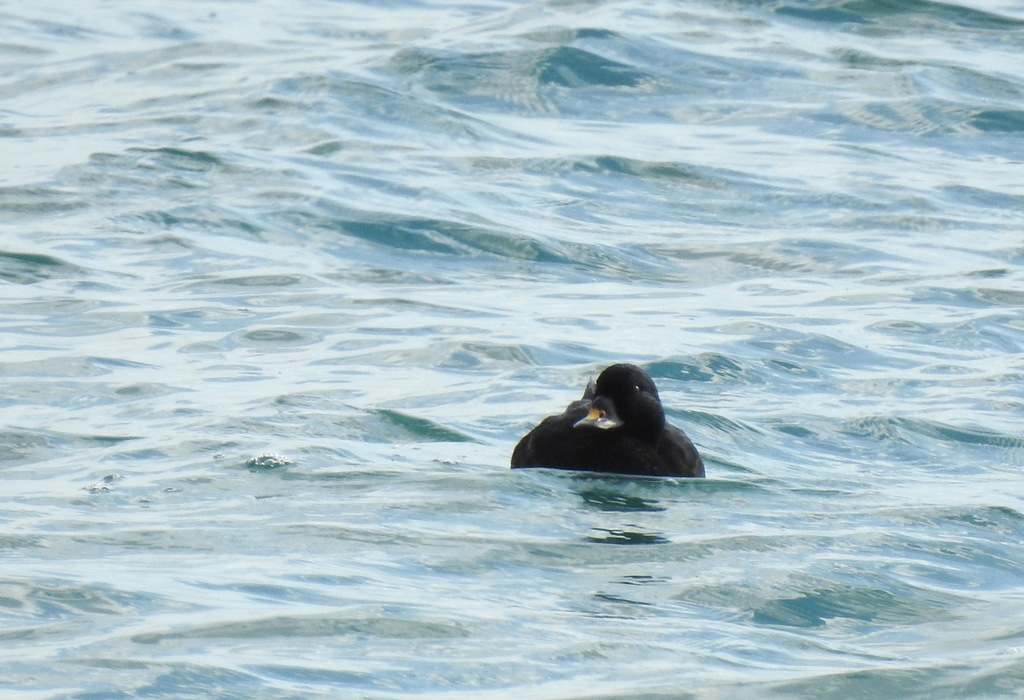
Despite the very long range usually involved, I did have a couple of attempts at photography. I won't be bothering you with the Arctic Skua dot, but have these two Velvet Scoters...

Velvet Scoters. Just.

Late this afternoon I popped over to West Bex for a short walk. Hearing a Coal Tit singing, I decided to hang about and see if I could get some photos. I have very few pics of Coal Tit. When it finally appeared in the branches above me, I was somewhat taken aback. It looked awfully grey...

First views. Even from this angle I thought it looked remarkably monochrome.

I can probably count on one hand the number of steely-grey Continental Coal Tits (P. a. ater) I've seen, and all of them in autumn. Yet here I was, in April, confronted with a Coal Tit which seemingly lacked any of the olive tinge to the upper parts typical of the British race, P. a. brittanicus. A few more shots...


Has my imagination got the better of me? I'm not getting my hopes up, but have punted out some pics to one or two birders who have some in-the-hand experience with the species. It seems unlikely that a Continental Coal Tit would be singing away in perfectly good Coal Tit habbo in West Dorset right now, but stranger things...etc...

Definitely an interesting day.

Sunday, 10 April 2022

The Fiery Gem

If silver-halide film photography was still a thing, yesterday evening's efforts to get a passable shot of an in-flight hirundine would have bankrupted me. I was at Bride Valley Fish Farm again, still hoping for my first Sand Martin of the year. Pleasingly there were two, plus a bonus House Martin and about seven Swallows. But could I get a flight shot?

No. No I could not.

This morning I had a date at Mapperton Wildlands again, accompanying Tom Brereton on a longer version of last weekend's rewilding tour. With about half an hour to play with beforehand, a quick visit to West Bay got the day off to a fine start with three newly arrived Wheatears on the harbour wall rocks...

Cracking little Wheatear, and its English seaside welcome

My word, they are so gorgeous...

A couple of the Mapperton cattle have just been fitted with Nofence collars, a technology which allows the herd to be controlled without the need for physical fences. Clever stuff...

One of the White Park girls with Nofence bling.

Bird-wise it was mostly quiet, though squidging through a marshy patch we were treated to single Jack and Common Snipe. Typically the Jack Snipe flushed silently and very late, and pitched down again not far away, while the Common Snipe complained loudly and made for the horizon.

Tom found us our first flowering orchids of 2022...

Early Purple Orchid getting pappage

After a slow lunch I sallied forth on a bit of a mission. I have never seen a Firecrest in potential breeding habitat, and today I hoped to do just that. It's not that I have never tried before, because I have. Once. It was in 1978, and the Royal Holloway College Ornithological Society arranged an outing to Wendover Woods with that exact aim. Firecrest was a pretty rare breeder back then, and I think Wendover Woods was a hotspot. Whatever, we didn't see any. I did tick Crossbill though, quite unsatisfactorily, as a little group flew over us, calling. Since that day, Firecrest has done very well, but this afternoon was still my first attempt to find potential breeders in 44 years!

There are many differences between the long-haired oaf of 1978 and the respectable author of this blog, but one of them is a really annoying function of age, and can be measured with depressing accuracy in decibels and kilohertz. I was quite worried that I wouldn't be able to hear a singing Firecrest any more. Well, very, very nearly, I can't...

I had generously been given the location of a bird which was singing in suitable habitat about ten days ago, so checked that out first. Success! Encouraged by this, I tried a few other nice-looking spots and found another singing male some 350m away in the same wood. Which made me wonder just how many might be out there undiscovered. Given a bit of time and effort, and much better ears than mine, who knows?

I guess a photographer migh be cursing those twigs? This is by far the best Firecrest photo I have ever taken, so I couldn't care less!

Firecrest belting it out, almost inaudibly...sadly

What a striking little beastie

On a sonogram you can see that Firecrest song is pitched roughly in the 7-8kHz band. Unfortunately it isn't going to be very long before a sonogram will be the only way I can enjoy it. That is, visually...

Wednesday, 6 April 2022

#LocalBigYear - March

At the end of March things were too busy to get this post written, but wallowing here in snotty self-pity I have plenty of time, so here it is.

I have been keeping a list (which I think was on 116 by 31st) but growing it has turned out to be way down the table of #LocalBigYear motivations. Rather, my boat is floated far more buoyantly by things like the littoralis Rock Pipit challenge. Not only has that been a source of genuinely local interest, but I've learned stuff I didn't know. And I've been reminded how generous the birding community can be, with unsolicited contributions of helpful literature from at least three different sources. The full challenge involved finding one in summer garb, and I haven't managed that so far. Even better though, I did find one that I'm 100% happy with (and I am fussy) despite its lack of pink bits...

Scandinavian Rock Pipit Anthus petrosus littoralis (and HERE is why)

There have been plenty of nocmig moments, though the best, an Avocet on 24th, wasn't clinched until April. Also, seven Oystercatchers and seven Curlews in the month were way more than I managed visually!

March would not seem complete without a Wheatear or two, so an early bird on 13th and a grand (and surprising) total of 65 by 31st was more than satisfying. As I type this, I am well aware that some birders won't have seen their first of the year yet. Some of those Wheatears were in Rockit Land too...

This sunny slope is one of my favourite spots in Rockit Land. At the back of the beach you can make out the hefty digger which is used to maintain the integrity of the shingle bank. There were six Wheatears loitering near it on March 30th, finding plenty to eat in the shelter of that rock armour...

...and even on the digger itself. I think I know what this Wheatear was looking at.

Full marks if you spot five Wheatears in this shot. No points for four - they're too easy

I would never have predicted seeing a Yellow-browed Warbler in March. Not only is it my first local bird, but definitely the first YBW ever that I have managed to see while pushing a buggy with a granddaughter in it. I have paid it several visits now. It is a very short walk from home, so how could I not?

Even with a good DSLR I should imagine this Yellow-browed Warbler is difficult to photograph, so I was pretty delighted to get this shot with my P900.

Apart from a couple of encounters with Adders there haven't been many wildlife photos which didn't feature birds, but a post like this one gives me a chance to air a couple...

My first beefly of the year turned out to be a [very unapproachable] Dotted Beefly (on 23rd)...

with this [almost comatose] Dark-edged Beefly seen on 30th

Both beeflies were close to the Yellow-browed spot, habitat quite rich in wildlife despite the constant presence of people, and countless dogs.

I could probably say a lot more, but don't want to rehash too much that I've already published, so I'll close with a couple of scenic-type photos...

West Bay at 06:50 on 27th. No sign of the Purple Sandpiper at the far end of the harbour wall that morning, but watching a crew launch this pilot's gig was about as 'Not Quite Scilly' as you can get. And the name 'Bucky-Doo' is about as Bridport as you can get.

Portrait of the author as a shadow on the West Bexington reeds. Amazing light.

Monday, 4 April 2022

Public Engagement

Waking a bit too early this morning, I felt rough. Not too rough to go out though, and almost an hour's seawatching from the West Bay shelter produced my first three Manxies of the year, 12 Common Scoter, 10 Sandwich Terns, and singles of Red-throated Diver and Med Gull. Home for breakfast and the resigned acceptance of yet another nasty bug. Sandra has it too, and one negative COVID test later we could lay the blame squarely at the feet of last Friday's snuffly granddaughters. Sigh...

I thought a day's rest might set me up for a late-afternoon outing somewhere, but I thought wrong. Grim. So the day has been frittered on various indoor stuff. Browsing Twitter earlier, I spotted this...


I urge you to click on this heart-warming little thread. It doesn't take long to read and, if you are remotely like me, it will make you smile.

When it comes to birding I have never been big on public engagement. And since living somewhere so sparsely populated, with such an abundance of locations where you might easily spend hours birding without meeting another soul, I have allowed myself to get worse. Just recently however, my little castle has been breached...

Strangely, some of that is down to a scarce bird on my doorstep. Our local Yellow-browed Warbler is a few minutes from my home, frequenting a pretty area much loved by dog-walkers, etc. It is impossible for a birder to stand around for long without arousing curiosity, and this has led to some positive conversations. One chap was able to see the bird with his naked eye, and vowed to look it up when he got home. I have been shown where Water Voles live, a creature I didn't even realise we had on the tiny River Asker. And apparently the (though not actually 'the' - there are at least two) local Little Egret has a name: Eddie!

Compound this with the uncannily persuasive powers of Tom Brereton getting me up in front of a room full of people to talk about nocmig a couple of weeks back, and I can feel the defences beginning to crumble. Interesting.

So yesterday I was out with a small tour group which Tom was leading at Coltleigh Farm, part of the two-thousand acre Mapperton Estate, which is in the early stages of a major rewilding project - details on the website Mapperton Wildlands. Such a stunning location, and just four miles from home.

Tom - with camera - utterly relaxed in the presence of many tons of White Park cattle, an ancient breed integral to the rewilding project.

Among the Primroses and Cowslips, this hybrid, or 'false' Oxlip. There were loads of orchid rosettes too. It is going to look amazing soon.

I am looking forward to seeing this in a few weeks, covered in lush vegetation and bouncing with butterflies...

Reading Mark Andrews' Twitter thread earlier, what really came across was not just the woman's delight at seeing her first Kingfisher, but the pleasure Mark derived from that exchange too. Yesterday I couldn't help noticing the enthusiastic appreciation shown by the tour participants. They loved it! One couple had recently moved in to a new-build and were really keen to inject maximum biodiversity potential into their blank canvas of a garden. Clearly they found the Mapperton project inspirational, and that was a real pleasure to see. I'll say no more about Mapperton just now, but I will be back...

Saturday, 2 April 2022

Extra Helping of Jam

The last spring Ring Ouzel I definitely recall seeing was found by Karen Woolley on Beer Head in 2011. And I'm pretty sure that is the only E Devon or W Dorset bird I have seen outside autumn. Arriving at West Bex this afternoon I certainly wasn't expecting to find one, but within 15 minutes that is exactly what happened. I always have a good look at fields with horses in them, and usually spend a couple of minutes grilling a load of birdless turf. But not this time...

Ring Ouzel. It might have been right at the back of the field, but boy, what a welcome sight!

Judging by the brownish tint and off-white gorget, presumably a female.

Thankfully Mike Morse was close by, and got to see it as well. As I strolled on up the lane I was well aware that I had peaked a bit early! Still, there were a few bits and bobs...

Rubbish light, but a very nice drake Common Scoter quite close to the beach.

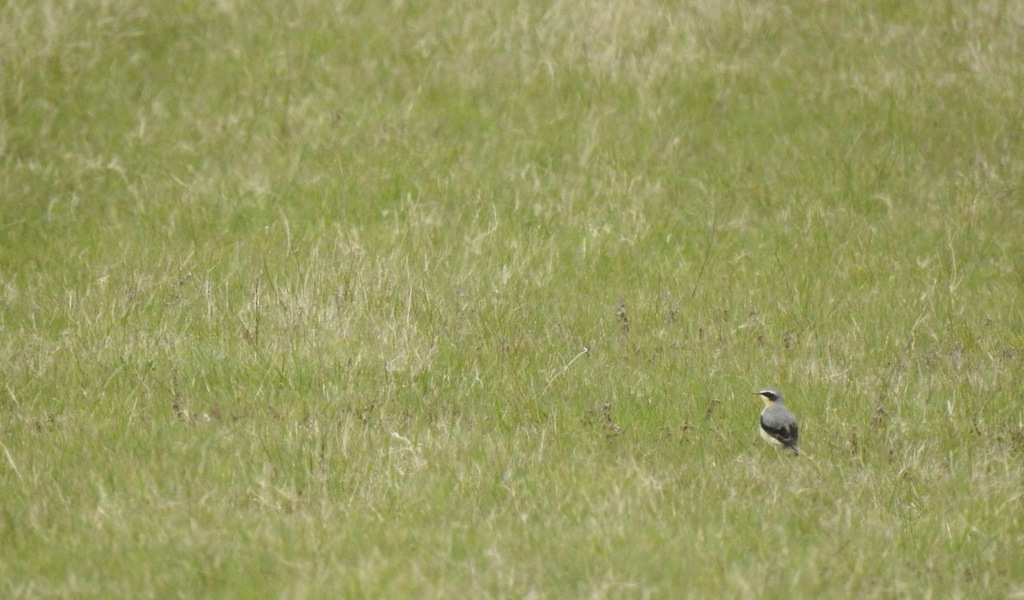
The only Wheatears were four distant birds together...

Small Wheatear, big field

On the way home I popped in to Bride Valley Fish Farm in the optimistic hope that I might finally see a Sand Martin this year. Nope. But four pristine Swallows were more than compensation...

Look at those immaculate tails!

To be honest, I didn't deserve the Ring Ouzel. Before even setting out for West Bex I had been handed what should by rights have been bird of the day. This is how it happened...

Last Friday week I sat down and worked through the previous night's nocmig recording. One sequence of calls had me stumped. I put it down as 'possible Wigeon', with a big question mark, and set it aside to review later. I did that last night, and immediately wondered why on earth I'd thought it might be a Wigeon. Could it be another duck that I wasn't familiar with? Pintail maybe? I checked Pintail on Xeno Canto. No, not Pintail. I tried a few other ducks (I won't embarrass myself by naming them) but drew a blank. Only one thing for it: ask the Nocmig WhatsApp group. I resolved to do so in the morning...

This is exactly how my mystery bird looked on the nocmig sonogram, those little blips at c2.0kHz

This is what those marks look like when stretched, cleaned up a bit, and enhanced...


So, this morning I posted the sonogram and recording on the Nocmig WhatsApp group. Literally within seconds (before I had even finished typing my question!) I had a diagnosis...

Avocet.

A couple of other group members said the same, and a quick visit to Xeno Canto confirmed the identification beyond any doubt. I hadn't even considered it might be a wader but, no question about it, at least one Avocet flew over my nocmig kit at 20:52 on Thursday 24th March! It is actually a really distinctive call, and my only excuse for not recognising it is that I never hear Avocets. They are seriously scarce (rare?) locally - certainly I have never seen one - and were just about annual on my old Axe patch. Needless to say, a bit of a nocmig mega for Bridport! Not super-loud, but this is what it sounds like...


Yes, I was already grinning from ear to ear as I stepped out of the door this afternoon. I didn't deserve a Ring Ouzel as well, but I'll take it. And very grateful I am too.