Pages

Tuesday, 10 May 2022

Small Things

Yesterday's long sit on Cogden Beach produced a couple of audio novelties. Seawatching normally involves a noisy sea and long range, and it has honestly never occurred to me that distant flocks of passing birds might be calling to one another as they go. I don't know why not, because closer birds like Sandwich Terns and Whimbrel are frequently vocal. Well, yesterday I added two new species to my 'heard while seawatching' list: Common Scoter and Kittiwake. The gentle 'shush' of the feeble surf was not enough to drown out the calls of a loitering Scoter flock which got up for a fly around, 'peep'-ing away like a nocmig recording! To the best of my knowledge this is the first time I've heard them in the flesh. Likewise, a passing flock of 15 Kitts was also perfectly audible. Brilliant stuff!

Small things, eh?

Talking of which, finally I have a much-desired addition to my nocmig collection. Two years ago fellow nocmigger Mark Pearson recorded one over his home in Filey, North Yorkshire - a single burst of song - and I've wanted one ever since. There was some WhatsApp discussion at the time, because it seems a bit incongruous that this species would sing while in active migratory flight. But it does...


Yes, now I have a lovely Lesser Whitethroat 'rattle' to go with my (so far) 16 clips of Blackcap song. Which raises the question: what about other warblers? I don't know. I've not yet heard of any other species featuring in nocmig recordings, and with the numbers involved you would expect them to, so perhaps other species are silent? Why do Blackcap and Lesser Whitethroat occasionally let rip then? I love how little we seem to know about birds sometimes.

I had another nocmig 'song' tick a few nights ago, from a species whose call I've recorded on 18 occasions. Only a snatch, but it will do...


That's a sound I would normally expect to hear from the margins of a pond or lake, and a pumped-up Little Grebe. It is so bizarre to know this bird was buzzing around the night sky instead. Once again, brilliant!

Small things. In the continued absence of Pomarine Skuas, absolutely essential...

Monday, 9 May 2022

Cogden Collection

One migrant which an early visit to Cogden pretty much guarantees right now is Wheatear; there were nine yesterday and 17 on Saturday. It has to be said though, other passerine migrants are at a premium, and I am still Whinchat-less. It's been good to see a few waders though, with Sanderling, Dunlin, Ringed Plover and Whimbrel over the weekend. On Saturday morning, nine Ringed Plovers and singles of Dunlin and Whimbrel came straight in off the sea and headed away inland. However, I was not expecting yesterday's top bird to be a gull...

Busily preening, the darker mantled bird in the foreground is a 2nd-summer Yellow-legged Gull.

Unfortunately the gulls all spooked before I could get better pics, but I found it again about a mile further east...

...where it sat offshore, looking very swish in the sunshine.

A very satisfying encounter, and my first local YLG of the year. It was not a large individual, so presumably a female. Quite a looker though, if you like that kind of thing...

YLG on the right, upstaging the dross

I was at Cogden again this afternoon, after work. The intention was simple: stare at the sea until it gives me a Pom. It is fair to say that Monday, 9th May 2022 has been a bit of a Pom day. Well, in Kent and Sussex anyway. Very, very few off Portland though, as far as I know, so I wasn't optimistic. I guess the winds have been too light to shift many this far west. Still, you've got to be in it...etc...

I walked to the far end of Cogden and set up shop...


That photo was taken at 18:45. I had already been there two-and-a-half hours, and didn't pack up until 20:15. For me that's a bit of a marathon session. Were there any skuas? Yes indeed, two immaculate light-phase Arctics past at 19:42, probably less than 300m out. Stunning birds. Not Poms, but it didn't seem to matter.

Despite the very light breeze there was a fair bit going on...

77 Gannets, 33 Black-headed Gulls, 10 Common Terns, 19 Common Scoter, a surprising 26 Med Gulls (all but one 1st-summer birds), 1 Red-throated Diver on the sea, 35 Sanderlings, 2 Sandwich Terns, 14 Guillemots, 9 Razorbills, 1 Swallow, 74 Manxies, 42 Kittiwakes and 3 Whimbrel. 

I was way too slow with the camera to stand a chance with the Arctic Skuas, but this flock of Manx Shearwaters was suitably slow and close...

15 of 18

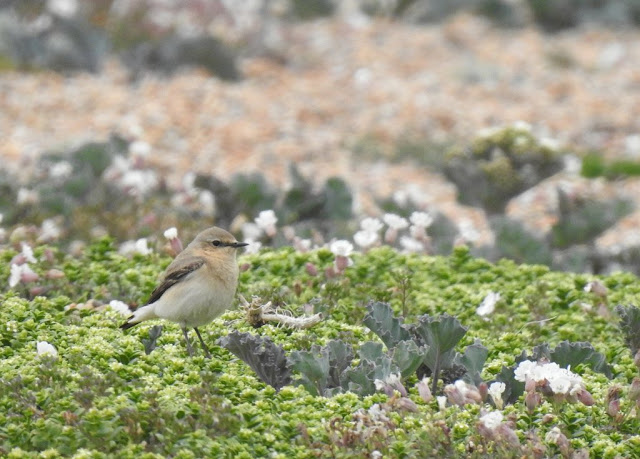
Finally, one of Saturday morning's Wheatears...

'Wheatear in Thrift' is always a winner.

Thursday, 5 May 2022

Odds, Ends, and a Barwit

At roughly 06:15 on May 1st I arrived at Cogden Beach from Burton Bradstock, and was greeted by this welcome sight...

Bar-tailed Godwit on Cogden Beach.

If you look closely you can see a little flag poking out from its upper left leg. Barwits on the deck are unusual enough anyway, so a ringed bird is rather special. As I endeavoured to get closer, it hooked up with a flock of five jittery Oystercatchers. I got one chance at a photo before they all flew...


I sent the photo to a Barwit ringing project in Holland, and heard back today. Details at the end of this post.

But first, a few odds and ends from recent days...


A rare chance of a nice Gannet pic. Cogden Beach again, May 1st.

A local spot has been attracting good numbers of hirundines on occasion, with several hundred present on Sunday evening. If anywhere close to home is likely to attract a Red-rumped Swallow one day, I would say this place is as good as any...

There might not have been any Red-rumped Swallows, but...

...there was this nice rosy-breasted job.

This may or may not have been the same bird as above. Note how that rosy tint is evident on the underwing coverts too. Lovely.

A few Sand Martins also present...

...and my first two Swifts of the year.

On Tuesday, a mammal tick at Cogden...

My first Sika...

...was quickly joined by a second.


Both young males, they were pretty impressive beasts, much bigger than I would have guessed. Apparently there have been a few records at Cogden and West Bexington over the years. I do find it amazing how deer seem to get about okay, despite the dense web of barbed wire smothering the countryside.

A close Red-throated Diver yesterday

My first Small Copper of 2022 at Cogden yesterday morning.

His and hers beach concrete

And finally, that Barwit again...

Ringed in May 2021, my sighting is the first report since then.

The dropped pin marks its ringing location: Texel, in the Wadden Sea; the red blob is me.

This evening I went for a stroll around Cogden. Migrant-wise there were four Wheatears on the beach and a few Swallows passing, but little else, if anything. Yet here we are in early May, theoretically a time of urgent birdy action. Ah well...

Maybe tomorrow.

Wednesday, 4 May 2022

Shooting For the Record

In recent years a camera has become such a vital piece of my birding kit that I would feel naked without it. One obvious benefit is illustrated by the recent Hoopoe post; photos and video make for a nice memento of a special bird. And sometimes everyday birds pose well enough to give you a really pleasing image, which will look terrific on the blog, and in that calendar you never get around to making. But there is more, so much more...

You can record sound with the video function. Witness the recent Cogden Cuckoo, or last year's first-for-Dorset Tree Crickets at West Bex. Useful.

And you can take photos of a distant, unidentifiable dot, enlarge it on the camera's monitor, then relax because it's just a Common Scoter after all. Seriously though, here lies the camera's most exciting aspect: its ability to convert nothing into something. A 'record shot' is often the difference between letting a bird go and a solid ID. Also, on a more prosaic note, record shots confer a measure of authenticity to your claims, helping avoid the danger of becoming a birder who 'sees too much'.

Speaking for myself, I need record shots on a regular basis, otherwise this blog would look pretty bare. For example...
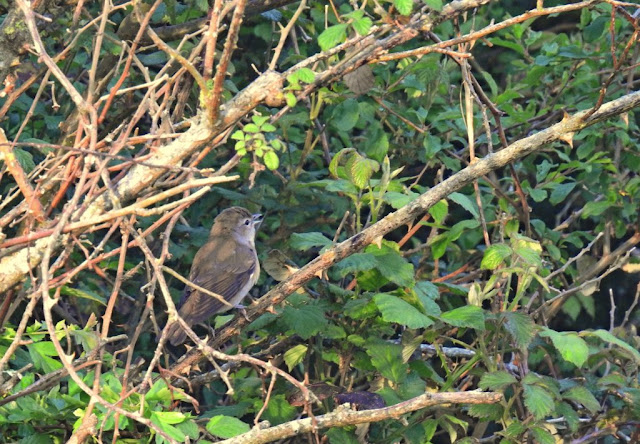
Record shot of a singing Garden Warbler at Cogden this morning.

No spring Garden Warblers at all in 2021, but both this year's Cogden birds immortalised in pixellated ropiness on NQS, thanks to my beloved camera.

But there is yet more it can do...

Yesterday evening the camera saved me from all sorts of embarrassing scenarios. A late visit to Cogden had been very quiet, despite my first ever sighting of Sika (two young males), and by the time I reached the shingle I was not my usual hyper-alert self. So the female Wheatear which popped up on to some beach concrete caught me unawares. It was head-on, at an angle, then turned slightly more side-on, at which point something in my head finally cranked into life...

'Oof! That's pale!'

It also looked rather small. The bird immediately dropped on to the beach and scurried out of view. There followed an almighty to-ing and fro-ing as I struggled to stay with it. The 'small and pale' feeling persisted, but its regularly upright stance seemed wrong for the species I had not dared to say out loud. Surely this was just a Northern Wheatear? Then it would scuttle out, looking horribly rare again. I can tell you, there was panic.

For quite some time I had been desperately trying to get a look at the tail pattern. NOT easy! Eventually I confirmed that it had a solid black terminal bar, but not very deep. What I could not confirm was whether the black extended up the outer tail feathers at all. Throughout all this I had been taking photos when I could. It seemed sensible now to stop all this chasing about, sit down and look at the pics, and finally decide if I ought to make any phone calls. Because the 'phone calls' thing had been worrying me. If this bird really was a candidate for Black-eared Wheatear (there, I said it) - a species with which I have very little experience (three birds, all in the UK) - I needed to make some calls. It was almost 6:30 pm, and the light was already atrocious.

So I did sit down, and I did look at the photos. And I decided that it was a Northern Wheatear. All that fretting over the tail pattern. If I had simply stopped panicking and thought about checking those early photos, I would have seen straight away that the wings were too long. The wings of a Northern Wheatear in fact.

So, a lot of unneccessary cardiac overload. And here is the culprit...

Actually, first, this is what recent female Wheatears have looked like. I have photographed very few this year, so the collage is compiled from 2020 birds...
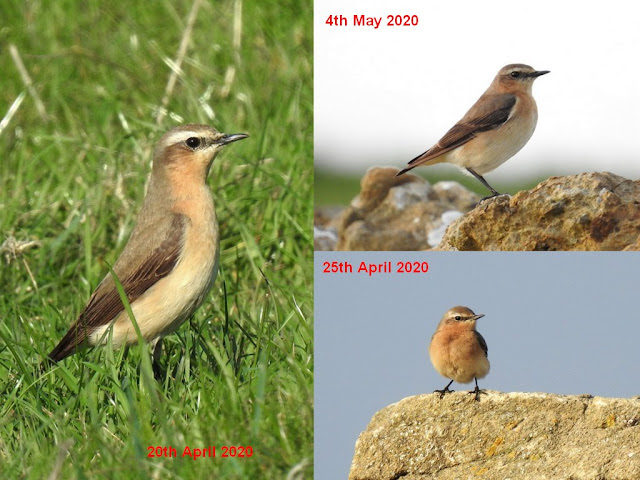
Quite richly coloured below, strong supercilium, etc...

Here she is, the little tinker!

I hope I'm not the only birder who would have been provoked to panic by this bird. If anyone looks at that photo and goes, 'Can't see what all the fuss was about', well, I truly wish I had such skills!

Some more pics...
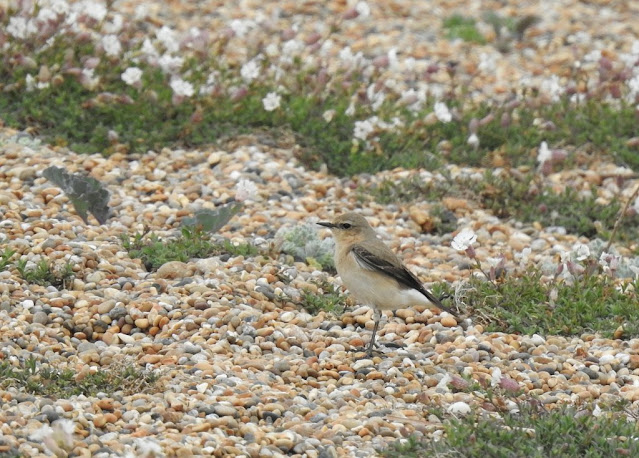
Thank goodness it displayed this upright stance early on, otherwise I might well have been tricked into some embarrassing over-reaction.


Looking at these photos now, it is easy to see that the bird is just a pale Northern Wheatear. And perhaps not even especially pale. Late-spring birds are typically bound for Iceland and Greenland, and mostly display the rich colours evident in the collage above. But would last night's bird look so out of place in March? Possibly not.

However, all I can say is that yesterday evening it had me going. Binocular views, never close, gloomy light, etc. Yes, anxious field views of a flighty bird are a very different matter to sitting down quietly with a bunch of photos in which the bird is frozen in time. You can study, analyse, and think about what you are looking at. And - without haste - come to an objective conclusion.

Which is why I would feel naked without the camera.

Monday, 2 May 2022

#LocalBigYear - April

April is a busy month for birds, with lots of coming and going, and predictably the year list grew a bit. By the end of the month my tally stood at 142, with a fabulous Hoopoe at West Bexington the stand-out highlight...

Cherry on the April cake

Of the more regular (but not guaranteed) spring migrants, the West Bex Ring Ouzel provided a sweet moment. And Redstarts have been kind. Of the [probably] six I've seen, only one was a male though. Normally I would be saying at this point how a male Redstart is just about the smartest bird you can reasonably expect to encounter in spring. And that's true, unless it can't be bothered to dress properly...

Male Redstart at Cogden on 28th.

Presumably a 1st-summer bird, a blackish chin is about all he could manage.

Other migrants which have been seen (or heard) locally include Whinchat, Grasshopper Warbler, Garden Warbler (I think?) and Pied Flycatcher, but all have avoided me so far. To be honest, out of that lot I would only expect Whinchat to be more-or-less guaranteed in spring; the others - especially Pied Fly - not so much.

Cuckoo is another April highlight. There have been two. One (on 23rd) has already featured in THIS post, but there was another - also at Cogden, and found by Mike and Alan - on 28th. I heard it briefly, then was dead fortunate to get a flight view. It was very distant, but...

Cuckoo dot.

Although I realise that no one for a second doubts my integrity, and that the above photo is unequivocal proof of the existence of a flying Cuckoo that day, ju-u-u-u-st in case...

There we go. Clincher.

Apart from the extravaganza of 11th, seawatching has been so-so or worse. Often, a lot worse. And the imminent future isn't looking great either. Unless the weather does something interesting soon, Pom Skua might be tricky.

Nocmig has been fun as always. Another Avocet, on 14th, was an unexpected pleasure. In fact waders are my favourite thing about nocmig and, as the month progressed, each day has seen me increasingly eager to analyse the previous night's recording. Why? Well, for one thing I expect more waders as the spring advances. But the main reason is Stone-curlew. Having recorded two now, in consecutive years, late April has assumed an inflated significance that it does not deserve. My daft, unrealistic optimism is responsible for that, but a Stone-curlew-less month has finally let some of the air out.

However, this disappointment has been mitigated by three records of Bar-tailed Godwit, my first in spring and presumably a result of late April's north-easterlies. It is well known that spring Barwits frequently migrate in large flocks, and one of my recordings demonstrates that fact quite amazingly. Apart from their 'kek' notes, Barwits also make a harsh, chattering sound, evident in the following recording. Although the flock is not close, I cannot help wondering exactly how big it is. Definitely a lot of birds...

Meanwhile, down below in Bridport, everyone is oblivious to the flock of super-smart, migrating waders piling overhead en route to the Arctic somewhere. For some reason I find this aspect of the event utterly compelling.

More has happened in April than I can do justice to in a single post, so I'll close with a couple of random pics...

The West Bay Purple Sandpiper on 28th. The first time I've seen it since January. Seriously elusive!

And of course, a Wheatear. West Bay again, on 27th.

Friday, 29 April 2022

Upupa epops

The day started well. Barely a breeze, the sun low in a clear sky; it didn't feel that birdy, but a beautiful spring morning can be reward enough in itself. As I approached the beach at Cogden an Oystercatcher flew in calling and landed out of view below the shingle ridge. A careful bit of creeping...

Think I've been sussed.

You don't see Oycs on the deck here every day, so already I was nicely chuffed. The beach itself yielded 5 Wheatears as I plodded east...

The current crop of male Wheatears tend to look a lot different to most March birds. Much browner on the mantle and extensive rusty tones below.

This female was quite obliging.

And thus I ended up about as far east as you can get and still call it 'Cogden'...at which point my phone rang. Certain areas within West Bex and Cogden are notoriously bad for mobile signal, and it took three attempts for Mike and Alan to get through properly. I am very glad they persevered, because 'a Hoopoe at the Manor House Hotel, West Bex' was just about to make my day.

The hurried walk back to my car was not without incident though...

Female Redstart record shot. The small version...

...and the larger one

Surprisingly this is my fifth Redstart of the spring, but that's for another post. Anyway, it slowed me down a bit. Some 40 minutes after the first phone call though...

West Bexington Hoopoe. Initial views were dreadfully backlit.

Down the hatch!

Eventually managed to get the sun in a favourable place.

What. A. Stunner!


After about 15 minutes it flew to this sunlit roof and settled down for a good preen...


This is my second local Hoopoe. The first was five years ago, almost to the day, and at the time a significant bird for a variety of reasons, not least as my first self-found. I thoroughly enjoyed this morning's little twitch, and am jolly glad I was able to record the bird on something a bit more up to the job than a weedy phone camera.

And the spring is yet young(ish)!

This afternoon Sandra and I ambled in to town for a spot of lunch, via the River Asker. Since learning that we have a small population of Water Voles literally yards from the door, we've been pretty keen to see one. Today was the day...

Water Vole! It was only on view for seconds, and I completely botched the photo opportunity, but that furry blur is a pukka River Asker Water Vole.

The River Asker also supports a head of Brown Trout. Most are very small, but we did see this one of roughly half a pound or so...

River Asker Brownie

While we were standing on a bridge and peering into the water, an elderly chap approached us. His mobility was very poor, and aided by two sticks, but he shuffled slowly over and in a broad Dorset accent asked if we'd seen any trout. Yes, we answered, a few tiddlers. He replied that he was glad, because some years ago a farmer upstream at Powerstock had suffered a slurry spill* which had 'killed the lot of 'em'. We guessed this old guy's rheumy eyes might have struggled to spot the little Brownies, which are quite hard to see. Hopefully he wasn't able to see the state of the river bed either though. Covered in brown, slimy-looking gank, it was not a picture of aquatic health. Let him be happy that the trout are here still...

* 'Slurry spill' = euphemism for act of ecological vandalism that kills rivers.

Saturday, 23 April 2022

Sights & Sounds

Until quite late in the day I thought this post would likely be all about sounds rather than sights. And then this happened at Cogden...

Perpetual motion in yellow

I am happy to live somewhere that Yellow Wagtails are fairly scarce in spring, because their value just goes through the roof. A male Yellow Wag is an eye-poppingly bright little creature, and fully deserves the audible 'Oh wow!' that accompanies its appearance. Unfortunately they can be a pig to photograph. Today's bird was dead flighty and never stopped moving. Neither the above photo nor the one below would normally pass muster, but they are all I have. And lemon yellow is still a joyous colour, even when it's badly posed and blurry...

Male Yellow Wagtail. A few minutes later it was over the coast road and away.

Within a hundred metres of the Yellow Wag I was failing once again to photograph a really smart bird, having inadvertantly flushed my first Redstart of the year. It was a female, which then proceeded to make sure it was on the wrong side of every bush in the neighbourhood, and I didn't get a single shot.

A long time before this little excitement I had been on the coast path, just inland of the beach. It was very breezy, with a brisk north-easterly blowing almost straight offshore, but a distant sound had briefly cut through the wind noise and stopped me in my tracks. A Cuckoo, surely? Only four or five notes, but I was 90% sure. I waited, but nothing. I walked on. Ten minutes later it happened again, clearer this time. Definitely a Cuckoo, but way up near the coastal ridge by the sound of it. With nothing better do I decided to track it down...

I got very close, but never did see the bird. It was roughly 650m from where I first heard it, but buried in a dense thicket and calling briefly every few minutes. I recorded half a dozen short videos, just to capture that wonderful sound. Here is an mp3 file lifted from one of them...


It is a cool five years since I last heard a Cuckoo, also at Cogden, so that was the undoubted highlight of this afternoon's outing. However, there were plenty of other bits and bobs: 7 Wheatears, 3 Lesser Whitethroats, a handful of Willow Warblers and assorted hirundines.

Having spotted a couple of small Scoter flocks going by, and a Whimbrel, I sat on the beach for a while to see if there was much else moving past. After a few minutes I spied a very distant group of five small white birds flying straight towards the shore it seemed, but a long way west of me, and well out. Small gulls, I thought. They appeared to have that white/black/white/black thing going on as they flapped, which in some lights can make very distant Black-headed Gulls look annoyingly like Little Gulls, and get you all excited over nothing. They were drifting even further west in the wind, and I had no scope, so grudgingly let them go and tried to forget all about them. Unfortunately they came to mind again as I sat down to write this post.

The Cuckoo wasn't the only audio thrill of the day. Last night's nocmig recording captured a spring sound I've been hoping for since I first began this lark two years ago: a little flock of Bar-tailed Godwits. At least, I think it's a flock. I'm sure the NE wind had some influence, and hopefully there will be more to come. They are not close, but that jittery, wickering noise they make is just brilliant all the same...


Finally, another 'Wheatear in habitat' shot to close...

It is 11:51 on a Saturday morning, and the Wheatear and I are at the western end of Cogden Beach. The West Bexington houses are some 2.3 miles away. Look how few people there are! Magic.