Pages

Tuesday, 8 November 2022

Beside the Seaside

For a few days now, West Bay has been hosting a Wigeon flock...

The West Bay Wigeon flock yesterday.

Any non-Mallard is a novelty here, and very welcome. The other day I actually counted the Mallards (51) which is something I may well never have done anywhere else, ever. I'm not sure it's a good sign. Is Mallard counting normal?

The weather has been bad lately. Bad to the extent that seawatching has frequently been the most obvious birding option. However, apart from the recent once-in-a-blue-moon Leach's Petrel bonanza, there has really been nothing to get thrilled about. Some Gannets and Kittiwakes, a few auks, blah, blah... And then yesterday the weather got really bad...

By the afternoon we had a SSW gusting at 40-50+mph, which persisted all night. This morning I was very optimistic. So were a bunch of other Lyme Bay birders, and soon the local WhatsApp message board stuttered into life as little nuggets of quality were dug out here and there. The West Bay bits as follows...

Leach's Petrel

Three in total. The first, at 07:30, popped briefly into view with two Black-headed Gulls before vanishing behind a wave forever. I have no idea which way it was travelling. The next, at 13:55, went east quite rapidly, close and well above the surf. It gained height and drifted in over the harbour. Despite facing into the wind it was steadily going backwards. I soon lost it, but quickly packed up and hurried round to see if it was in the harbour, or even on the river. No sign. The way it was going, I can guarantee it never made it back to the sea. So where is it now, I wonder? The last one passed steadily east at 14:29, but not close.

I imagine that's my lot for local Leach's. A minimum of 13 in total. They'll probably have to last me a long, long time!

Pomarine Skua

Good story this. Great binocular views of a light-phase adult skua bombing west. A powerful-looking bird. I thought I glimpsed a breast band, the uppers looked quite blackish, and I was thinking Pom. As I tried to pick it up in the scope I realised it was piling into the flock of small gulls feeding in the surf at the end of the prom. A fleeting view told me it had no spoons, then suddenly my eyepiece was filled with a bloke walking along the prom! I never saw it again. I put a message on WhatsApp, to the effect that I hadn't clinched it. A bit later it passed Richard P at Charmouth and James M at Lyme, who confirmed it was indeed a Pom.

I'm not precious about who identifies my birds if I fail to, so I'll have it thanks. I cannot remember the last autumn Pom I saw locally. Definitely more years ago than I want to think about.

Little Gull

An adult flew east at 13:00. The range and light were such that any other age would probably have slipped through the net, but the black underwing nailed it.

Kittiwake

A common species, even here, but sheer numbers and lots of close views made for a special day. Combining morning and afternoon watches gives me a total of 420+, but this will be a massive undercount. Nonetheless, I am pretty sure that's the most I've ever recorded in a day locally.

6 Kitts, 3 BHGs and a Med Gull in this shot.

The photo above shows just a tiny fraction of the flock which spent all day at the far western end of the prom. Lots of coming and going, but probably 150+ gulls most of the time, and they were scopeable from the shelter. A passing Sabine's Gull would surely not be able to resist...

Presumably none passed.

So, a pleasing collection of birds, but honestly, it was slo-o-o-w going. Patience and persistence paid off in the end though.

Following my quick hunt around the harbour for the errant Leach's, I couldn't help but notice how the Wigeon flock was flaunting it...

Close and sunlit. Lovely...

Wednesday, 2 November 2022

Thank You, the Sea

A tediously regular feature of this blog is me moaning about the direness of our local seawatching. Once in a blue moon though, I have to eat my words...

But not this morning. This morning was typically rubbish. Despite a big sea and strong wind, very few birds. Low numbers of Gannets and Med Gulls, a couple each of auk sp and Kittiwake. I managed an hour.

Late morning there was heartening news though. Two (or possibly three) Leach's Petrels past West Bexington; the odd Leach's elsewhere around the Lyme Bay coast. The wind strengthened, and it was looking good for an afternoon effort. I wasn't free until half two, but within ten minutes of plonking down in the West Bay shelter a Leach's Petrel went slowly east. I could hardly believe my eyes. It is 17 years since my only previous Lyme Bay Leach's Petrels - two off Seaton seafront in November 2005. I cranked out about 30 seconds of video, and captured the bird in maybe 20-odd frames...

My aim was not good, but there it is bottom right: Leach's Petrel!

The forked tail is vaguely discernible in this one.

They may be pitiful record shots, but wow! I am chuffed to have got anything at all. And look at that sea! 

A few minutes later I had another sighting. Brief, and hard to tell whether it was travelling or lingering. Several minutes later, another, further out. All the same bird? I couldn't really say. Tom Brereton joined me after a while, and it soon became apparent that birds were definitely going through, heading east. In the end I called it 10 Leach's, but the count could easily have been as many as 14 or 15. Factor in 100+ Kittiwakes - many very close inshore, or even over the prom - plus a bonus 1st-winter Little Gull,  and it was very much a seawatch to remember, for all the right reasons. Two hours of genuine pleasure.

Also, the local WhatsApp group really came into its own today, with reports of various successes along the coast keeping us all encouraged and plugging away. Great stuff.

There was one mad moment. A close Leach's suddenly climbed rapidly, turned towards the shore and came in-off, heading over the prom and the seafront buildings and away inland!

Tomorrow might be interesting.

Or not...now that I've got all keyed up about it!

Tuesday, 1 November 2022

ObsIdentify - the Truth

Against my better instincts I tried a seawatch this morning. Thirty-odd minutes of almost nothing in a raging gale was more than enough, and I was soon back home to a hot cuppa. Breakfast Twitter was unsurprisingly light on mothy content for a change, but something about the ObsIdentify app popped up, and I thought it was about time to do an in-depth NQS review. This afternoon I was stupidly out in the relentless hoolie once more. In 4.5 miles of foot-slog I am pretty sure I saw absolutely no birds at all, but had plenty of time to think about my approach to a post about ObsIdentify. So, here it is...

First, what is ObsIdentify?

It is a smartphone app with which you can identify stuff. I use it mainly for moths, but have also tried it with beetles, bugs and whatnot. You input a photo, and it does the rest.

How good is it?

Ah, now you're asking...

I am old enough to have gone to school with a slide-rule in my briefcase. I can remember when the first electronic calculators began to appear, and how they were not allowed in exams. Why not? Because they made tricky sums way too easy. To use a calculator was basically cheating.

In reality of course, it was quite possible to use a calculator and come up with the wrong answer. You still needed to understand the problem you were trying to solve, to input the correct numbers and do the correct things with them, to press the correct buttons in the correct order. In other words, you still needed to think. Because a calculator is not a brain.

And if you approach ObsIdentify with the same mindset, it is - in my opinion - brilliant.

Some folk appear to have done all sorts of careful analysis of its performance, far more than I could be bothered with. To me it is just a tool, and here is one real-life example of how I have used it...

A few nights ago I caught a very small micro around 5mm long. It reminded me of the Beet Moth (Scrobipalpa ocellatella) that occurred in big numbers back in August, but was obviously smaller. I recalled that the Beet Moth was one of the Gelechiidae, so went to that family in my field guide and picked slowly through them all. Nothing quite seemed to match, and I wondered if it might be something else. So I took a ropey pot shot and ran it through ObsIdentify. The result was pretty rubbish...

Technically this is known as 'inconclusive'.

On the upside, both suggestions are gelechiids, so it looked like I was on the right track. As far as I could discern, the Potato Tuber Moth Pthorimaea operculella has never occured in Britain. But the Tomato Leaf-miner has. It is listed as an adventive and immigrant species. The photo in my field guide didn't quite match my moth, but I found some photos online which were spot on. Anyway, I took some better snaps and tried ObsIdentify again...

82% confidence! Okay. Now we're talking.

I asked the Twitter experts and got a general thumbs-up. I'm glad, because Tuta absoluta has got to be one of the coolest scientific names ever, and I am delighted to have it on my list. There are about 10 records on the Dorset Living Record map, and the occurrence fits nicely with recent mothy goings-on. Common in southern Europe, it seems very plausible that my moth was caught up in the huge late-autumn immigration event that we've been experiencing, and has likely been whipped up from Spain or suchlike. Here it is again, compared with a superb shot of this species taken in Worcestershire by Patrick Clement, which can be found on UK Moths...

Top photo by Patrick Clement (and identity confirmed by gen det, i.e. dissection); below is mine. The spitting image, if you ask me. Among other things, I learned that the stripey legs and palps are excellent pointers.

I'm not sure if the record will pass muster 'officially' but it is easily good enough to satisfy my needs, which basically means I can happily label my photos thus...


So, what we have here is an example of ObsIdentify as a tool. From initially having no clue, I was able to use ObsIdentify to give me some pointers. All the legwork was then down to me. Anyone can do this, using books and easily accessible online resources.

Next, two examples of ObsIdentify getting it totally wrong, and why that doesn't matter...

First, this cracker...

Blair's Wainscot

This moth is one of my autumn gems, but I was very cautious with the ID. The fieldguide was pointing me at Blair's Wainscot, and I knew that the first for Portland had very recently been recorded, but it is a rare moth and I could see the potential for error. So I decided to run it through ObsIdentify to confirm my suspicions. The result was a bit of a surprise...

Oh...

There is a small version of Large Wainscot, so now I was wondering whether that's what I had here. More research, more checking. In the end it was obvious that ObsIdentify was wrong, and I can only assume that Blair's Wainscot is not yet in its repertoire, or database, or whatever. Anyway, the point is this: despite ObsIdentify's conspicuous failure to correctly identify my moth, ultimately I wound up even more confident that it was definitely Blair's because I was forced to look more deeply.

And another huge ObsIdentify fail...

Back in June, we caught a rare migrant plume moth called called Scarce Light Plume or Crombrugghia laetus. I only ever got pot shots...

Crombrugghia laetus

Initial identification was made by using the Manley field guide. An obvious confusion species is Crombrugghia distans or Breckland Plume, but in the field guide that moth looks noticeably darker than our beast. However, I sought ID confirmation from a local contact in the Dorset Moth Group, who ran it past a very expert adjudicator. Thankfully he confirmed the identification. Job done.

Around this time I began to use ObsIdentify, and as an afterthought ran our Scarce Light Plume through the app...

Oh...

100% wrong! Again, I assume Crombrugghia laetus is not in the Obsidentify database. In my experience, when there are two very similar species, ObsIdentify struggles to decide one way or the other. You get results like 59% for one, 41% for the other, and so forth. A good example is the Wormwood Pug / Currant Pug pair. I played around a lot with those two species on ObsIdentify, and rarely (if ever?) got a really decisive result. So, a 100% confidence in Crombrugghia distans made it pretty clear that C. laetus was not in the app's system at all.

The whole point of this post is to illustrate that ObsIdentify is just a tool. Like most tools, there are things it cannot do, that it is not (yet?) capable of. If you accept those limitations, it can frequently be a massive help to your ID process. I have read comments that it is useless - frequently highlighting its gross errors - or that it leads to lazy habits. I disagree. My experience of this imperfect app is very positive. It has helped me out many times. Often it has pointed me in the right direction when I've been stuck. And on the rare occasions it hasn't, I have still learned stuff.

All along I have tried to remember that one important principle: like the electronic calculator, ObsIdentify is not a brain. When it comes to thinking, the responsibility is all mine.

Monday, 31 October 2022

It's All Too Easy

Shortly after 07:00 this morning I sat down in the West Bay shelter and unsheathed the seawatching tool. With its 82mm objective and 25-75x zoom eyepiece, not much gets away. Typically, today there was very little to get away. Still, the few passing birds that bothered with this bit of Lyme Bay were nailed good and proper with my 21st-century glass. In the old days I would have been struggling with poor light transmission, feeble magnification, psychedelic colour-fringing, and the inevitable consequence of repeated drenching - a steamed-up interior. My distant young Gannets would no doubt all have been possible Great Shearwaters, and consequently my pulse rate up and down like the proverbial. Yes, back then a seawatch was an excellent cardio-vascular workout, rather than the sedentary artery-clogger that it is today.

Just as I was thinking of packing up in disgust, a WhatsApp message from Ian McLean in Seaton: 'Two Velvet Scoter east'. So I didn't pack up. I parked my disgust and waited. And 24 minutes later they hove into view. Velvet Scoter is a decent seawatching prize locally. Had I not known they were coming, I certainly would not have seen them. Disgust would have won out, and I'd have been at home. Later I would have heard about them, how they'd passed Seaton and then West Bex, and been thoroughly gripped. Just think of all the emotions I would have experienced: frustration, envy, anger, self-pity. Overcoming the disappointment of frequent grippage was meat and drink for birders of yore, and built a hardy resilience sadly missing today. WhatsApp caused me to miss out on a potentially character-building experience.

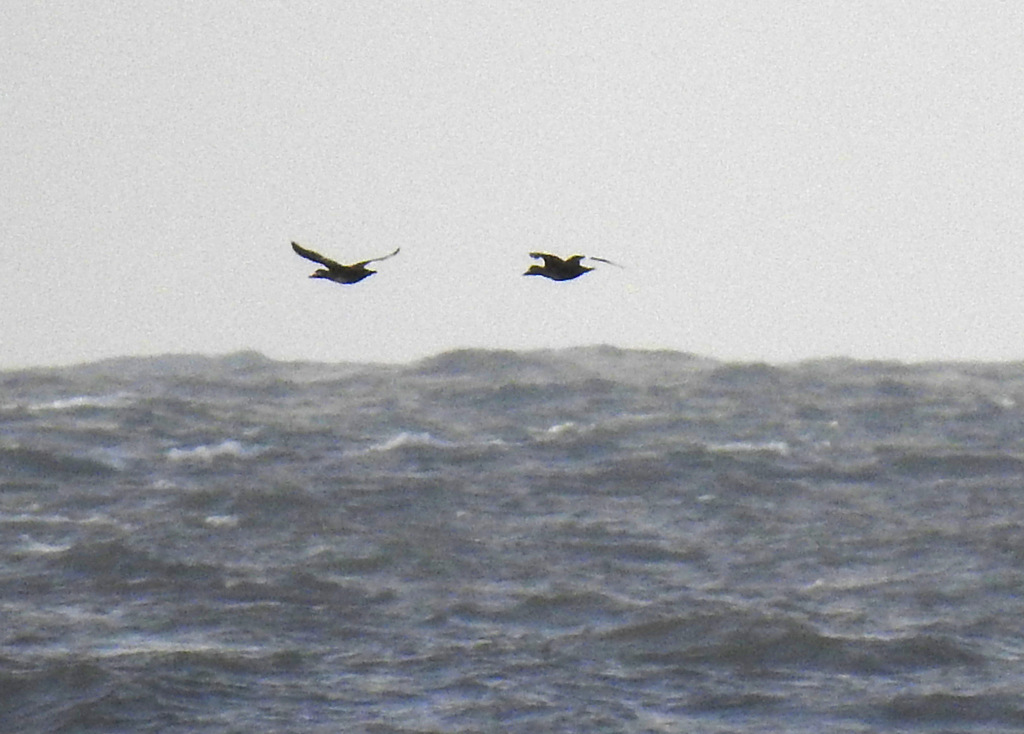
As the Velvet Scoters passed me, my modest camera captured this...

The 2 Velvet Scoters that I knew were coming.

Birders always enjoy the cut and thrust of a lively discussion. What sex were those Velvets? What age? Putting your observations into words or - even better - field sketches, making a case for conclusions drawn, arguing that case... Never mind the facts, in the absence of photos it all came down to who was the the most articulate, the best artist, or the loudest. These are not just handy attributes for the bullish birder of course, they are life skills.

Digital cameras have taken all that away. Your wordy description; your clinical artwork; your bold, unassailable argumentation... All for nought.

'Mate, that's rubbish. You're wrong. Just look at the pics. Both pale on the belly; they're first-winter birds. The one on the left is browner, with the face pattern of a female. The one on the right is blacker, without that face pattern; it's a male.'

First-winter male (R) and female (L) Velvet Scoters.

Naturally, as a southern softy I am already at a disadvantage when it comes to strength of character, and modern technology has simply made things worse. Perhaps I need to ditch the camera, leave the phone at home, and search eBay for a nice Nickel Supra. A few months of olde worlde birding hardship might do me some good. Possibly I have forgotten the art of turning blurred, hazy birds into species they are not. Can I still write a feather-perfect description from the briefest of mostly-obscured views? Or dash off an intimate 'field' sketch with really not very much reference to a field guide? These are skills once universal among birders of a certain age. But now? All lost, I suspect.

Aren't they?

Friday, 28 October 2022

Location, Location, Location

I understand that 2022 will go down in mothing history as a pretty good year* for immigrant species. Obviously I have no previous years of experience to compare it with, but mothy Twitter is all a-buzz with such talk. Especially right now. Why now? Well, Crimson Speckled is one reason. Recent days have seen warm winds from far, far away reaching these shores, carrying with them moths from southern Europe and even Africa. Apparently the 2022 Crimson Speckled tally is already more than twice that of any other year, ever. Naturally I have picked up on the vibe here, and wondered if I might be fortunate enough to encounter one. No. More than that. I have hoped for one. Which is totally unreasonable really. After all, I've only been mothing five minutes.

Still, if I look at my own collection of migrant moths so far, it is pretty amazing. Even I can see that. Another new species this week...

Palpita vitrealis (Olive-tree Pearl) is literally see-through, and its scientific name presumably derived from 'vitrus', the Latin word for glass.

That flimsy moths like this are carried here intact from hundreds of miles away - or thousands in some cases - I find astonishing. On Wednesday night there was clearly an arrival of White-point. I caught four here. My first since summer, and I don't think I ever caught more than one at a time. Two at the most.

One of the four White-point caught Wednesday night...

...plus a bonus Vestal.

Of course, I am well aware of the reason for our enviable collection of migrants moths.

Location.

With our little garden situated on the West Dorset coast just three miles from the sea, you could hardly ask for a better spot to put a moth trap.

Or could you?

This morning I took up an invitation to join a moth-trapping session at Abbotsbury Subtropical Gardens. More accurately, the traps were located in what I guess is the nursery yard. On the face of it an unprepossessing spot, with polytunnels and whatnot, situated on the seaward side of the Gardens, a few hundred yards up a grassy slope from the sea. Luke drove me over, where we joined Steve to empty the traps. I'm not sure what I was expecting, but, after such a blowy night, probably not that much if I'm honest. After all, before first light I had counted just 14 moths of 11 species in our garden trap. Sure, there had been some migrants: Vestal, Rusty-dot Pearl and two White-point. And a Blair's Mocha might have been, but was perhaps more likely from local stock. Anyway, considering how much the night's potential had been talked up, I was a bit disappointed. Was Abbotsbury going to be that much better?

Er...yes.

In the very first trap was this...

Small Marbled - a rare immigrant.

It was still gloomy enough that I needed the light from Luke's head torch to get any sort of photo. A tiny moth, and new for me. A very good start. We pressed on, wading through Rush Veneers, White-points, Scarce Bordered Straws... Another new one for me: Delicate. My photo is appalling, so I shan't bother, but it was around this point that I realised I ought to reassess my expectations. As well as the migrants, local speciality, Oak Rustic, was plentiful. I brought one home to photograph properly...

Abbotsbury Subtropical Gardens have many evergreen oaks, food plant of Oak Rustic.

We opened up a small actinic trap which at the beginning of the month had bagged a Death's Head Hawk-moth, and found this...

The legendary Crimson Speckled.

Judging by the numerous colourful expressions prompted by its appearance, I think my companions were quite chuffed to catch this belter. What a stunning moth! As someone on Twitter aptly put it, Crimson Speckled looks like it's made from a shredded pack of playing cards. It is a decent size too; no need to squint to appreciate its beauty.

Steve kept a list of names and numbers. Forty-something species in the end, with immigrants including Small Marbled, Cosmopolitan, Golden Twin-spot, Radford's Flame Shoulder, Delicate, Vestal, Pearly Underwing, Convolvulus Hawk-moth, Turnip, Palpita vitrealis, Rusty-dot Pearl, Silver Y, Angle Shades, 25 White-point, 33 Scarce Bordered Straw and 60+ Rush Veneer. Astonishing! Along with the Crimson Speckled, the first five species in that list were all new for me.

Blown away, I was...

I hadn't been home long when a message came through from Luke. The Golden Twin-spot wasn't a Golden Twin-spot after all. Golden Twin-spot is a very scarce immigrant, and a real prize catch. But, it is possible to go one better. Our Golden Twin-spot was in fact a Tunbridge Wells Gem, a species resident in North Africa. Since the first record in 1870 it has occurred just 20-odd times in Britain. Its exoticness is hinted at by the caterpillar food plants, which include banana, tobacco and Canna Lily!

Wow!

Tunbridge Wells Gem

And here is the Radford's Flame Shoulder...

Radford's Flame Shoulder. Another scarce immigrant.

So, what was my take-away lesson from today? That, yes, there are some good spots for moth trapping, and our garden in Bridport is likely in that category. And then there are ridiculously BRILLIANT spots for moth trapping...

Location, location, location.


*Exceptional?

Sunday, 23 October 2022

Blair's Wainscot

The sound of hammering rain woke me this morning, much too early, and during a brief lull I trotted outside to bring in the moth trap. Among the 14 moths were two I didn't recognise. One was a micro, which turned out to be Plodia interpunctella, or Indian Meal Moth. I'm not sure where that came from, but there are only two dots on the Dorset Living Record map - both near Dorchester - so I'm guessing it is pretty uncommon locally.

The other new moth was obviously a wainscot of some description, and I had a hopeful suspicion of its identity due to a very recent 'first for Portland' which featured on my Twitter feed on Friday morning. The field guide appeared to confirm it, but I waited for a bit of expert feedback before I got too excited. So, here it is...

Blair's Wainscot

This is a genuine rarity. A little bit of research tells me that there is a very small breeding presence in East Dorset, but otherwise we are talking rare immigrant. For example, Devon had its first in 2020, not far from Exeter. Here it is again, alongside a Large Wainscot...

Large Wainscot and Blair's Wainscot

And finally, here is the slightly tatty Indian Meal Moth...


I don't know whether my first few months' moth-trapping experience is in any way typical, but it strikes me that the occasional scarce, or even rare, moth is almost to be expected, certainly more so than with birds. Is that because there are simply so many species out there? Or have I just been ridiculously jammy? At the end of the year I intend to put together a rare/scarce/immigrant summary. I think the numbers and diversity might surprise me...

A quick bit of birding this morning was worthwhile. Though I couldn't find anything new, the Barred Warbler showed quite well, if not that close. The light was a bit dire, but a couple of pics nonetheless...

Barred Warbler in typical pose just prior to diving into cover.

Friday, 21 October 2022

Wonder of the Day

Last night's forecast predicted a decent onshore blow for the morning, so I made plans. As a veteran of countless dire seawatches in conditions of great promise I ought to know better, but cannot help myself. I was up at first light, and hurried outside to get the moth trap in. I would cover it for now, and see to the contents later. Oh, but look, there's a moth clinging to the underside of the funnel. I'll just quickly check to see what it is. Looks like an upside-down Black Rustic perhaps...

Oh my...

Not a Black Rustic.

Since this autumn speciality first began to appear on my Twitter feed, I have been hoping. And hoping some more. The larvae feed on oak, so I've been worrying that perhaps there aren't enough oak trees nearby to make its appearance a realistic possibility. But clearly there are...

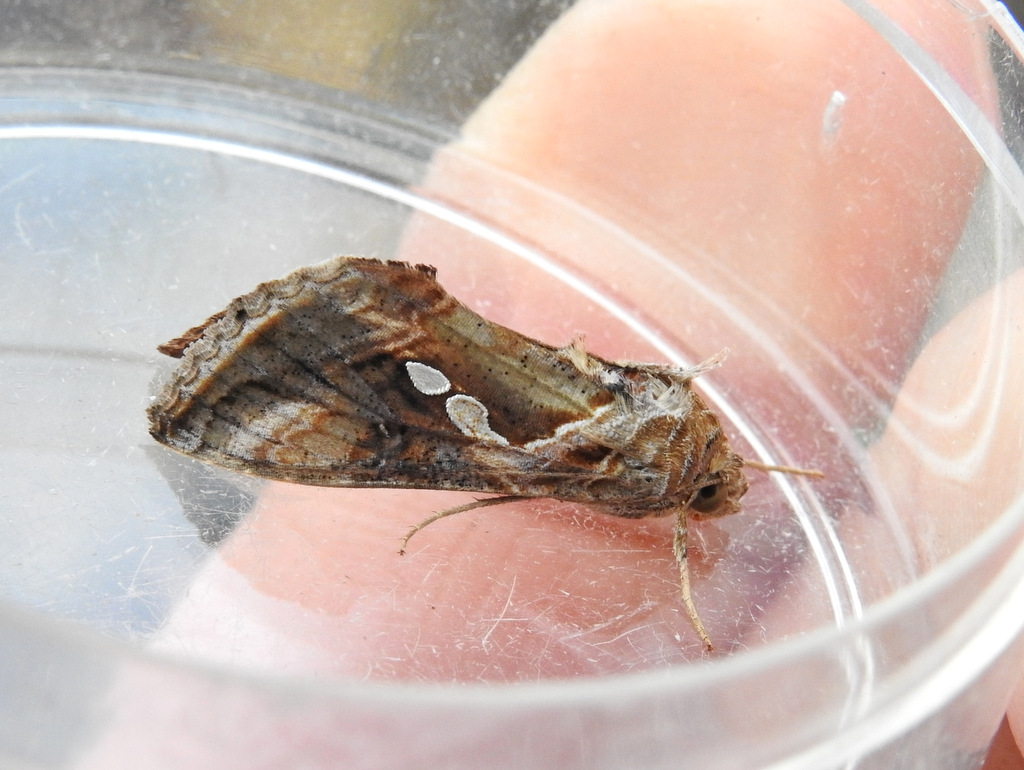
Just look at that! A fresh and gorgeous Merveille du Jour.

What a moth!

Merveille du Jour translates to 'wonder of the day'. Very appropriate. It has certainly been the wonder of mine.

The seawatching was going to have to go some to top that.

In the end it wasn't bad at all. In an hour I counted 136 Med Gulls, 14 Common Scoters, 3 Brents, 2 Balearic Shearwaters, and one each of Kittiwake and Commic Tern, mostly heading east. The latter was easily close enough to ID to species, but I couldn't keep the bird steady in the scope for long enough and failed to clinch it. Annoying. Add in the many Gannets and auks, and it was a nicely bird-filled hour. A great little seawatch in fact.

As the day progressed, the weather upped its game somewhat. A howling gale and tanking rain are easy to stay indoors for, but if the Met Office rain map was correct there was a dry spell due around 3pm. Sure enough...

I thought it would be good to check on the Barred Warbler, and made my way slowly in that direction. The weather had certainly stirred up the birds, and a few bits and bobs were where they wouldn't be normally...

A plug-ugly GBBG on the river in West Bay. One day I hope for a Casp here. I shan't hold my breath.

Of the 34 small gulls here in the dog-walked-to-death field behind Rise restaurant (the first I've ever seen on the deck in this spot) 10 are Meds.

6 Brents heading out to sea after a flight along the promenade.

The sea was spectacular, and a few keenies had come for a look...

The harbour wall. It was possible to get very wet if you fancied it.

A more sensible viewing spot.

Heading up the cliff path was a tiny bit hairy, and approaching the Barred Warbler bushes I could see they were totally blown out. Still, a quick poke around revealed a few birds in residence. I saw three or four birds flit from one bit of deep cover to another. One was probably a Blackbird; the others, all small dark things. Like Robin, or Dunnock, or Radde's Warbler. I didn't see any of them well enough to say for sure...

Then a large, pale warbler flew effortlessly past me and landed in the open, twiggy top of a wind-battered Elder, just a few yards away. Seemingly unfazed by the buffeting hoolie - or my nearness - it paused and peered at me. I had time to get the camera out, fire it up, zoom it, raise it to my eye...

I have come to the conclusion that Barred Warblers are super-hard and super-cool. With what can only be described as nonchalance, it dropped out of view approximately .0001 seconds before I pressed the shutter button.

On my way back down the hill, the heavens opened and emptied. My so-called waterproof is not very. Passing this lot on my way back to the car, I knew exactly how they felt...

Perfect weather for ducks. And Cormorants.