Pages

Friday, 14 April 2023

Littoralis Woes

Sheltering from the rain this morning, I peered out over a lumpy, grey sea. It looked brilliant, and I could imagine close flocks of Whimbrel and Barwits forging into the wind, maybe a skua or three...

Reality was typically short on thrills though, and two Sandwich Terns was the sum of it. Literally nothing else but local gulls and Fulmars. Thank goodness there had been a migrant in the moth trap earlier...

The humble Silver Y looks pretty smart close up. Third migrant species of the year, after Dark Sword-grass and Rush Veneer.

Late yesterday afternoon I ventured up the valley to Mangerton once again. The Daffodils which featured in the last two posts were on my mind. Despite their seeming absence from the Big Book of Dorset Flora's distribution map, the Mangerton Daffs had just received some encouraging endorsement. A friend who knows his plants had taken a look, and sent an email earlier. Hopefully he won't mind me quoting from it...

Their small size, colour of both the 'flower tube' and the surrounding 'petals', the fact that the 'petals' are fairly straggly, and their actual growth habit (isolated small clumps rather than an obvious planted bed of them) are all good for wild Daffodil. So on balance I think they are wild Daffodils...

This objective analysis was really helpful to a wildflower beginner like me. It may be of relatively little consequence in the grand scheme of things, and the species is hardly a great rarity, but I cannot tell you how delighted I am to have found my own wild Daffodils, especially as they are so local and apparently under the radar. They have mostly gone over now, but I look forward to visiting again next year, and hopefully seeing them in their prime.

Other modest highlights yesterday included my first House Martin of the year, plus...

A reasonable flight shot of a Sparrowhawk.

The Raven's nest has at least two young in it.

A pair of Stonechats (blurry female in the background) in a spot where I have seen the species a few times. Hopefully a breeding pair.

So that's the diary stuff up to date. Rock Pipits then...

2023 is the second year that I have become slightly obsessed with finding definite littoralis (so-called Scandinavian) Rock Pipits locally. I have absolutely no doubt they winter here - there is an obvious decrease in Rockit population at exactly the time you would expect littoralis birds to be leaving for their breeding grounds - but proving it is a nightmare. Ideally I hoped to come across birds which had moulted into the breeding finery which at least some of them attain, with blue-grey feathering on the head, plus reduced streaking and a peachy blush to the throat and upper breast. In two years, that hasn't happened. The best I have managed was a bird last year which had moulted two central tertials (possibly diagnostic of littoralis, but certainly indicative) and this bird back in late February...

A definite peachy tint to the throat. West Bay, 28th Feb.

But, is it possible to identify Rock Pipits to race based on less obvious characteristics? Some of the wintering population were rather pale below, for example, with less-intense streaking. Could that be a reliable feature? How about this next bird, photographed at the far end of the prom on 17th March?

And, if you enlarge the photo, it is easy to see some blue-grey feathers moulting through on the head. West Bay, 17th March.

Promising, yes? Unfortunately though, this next photo depicts the very same bird, three days earlier...

Singing Rock Pipit. Factor in the regular song-flighting etc, and it was pretty obvious that this individual was perfectly content right here in Dorset. Not littoralis then...

Anyway, all of a sudden it became obvious that our local Rockit population had quietly melted away without delivering the goods, and once again I was left a little frustrated. And then, on 22nd March, Martin Cade published some Rock Pipit photos on the Portland Bird Observatory blog. With Martin's kind permission, they are reproduced below...

Rock Pipit, Portland. Photos © Martin Cade


Definitely some blue-grey feathering about the head, a touch of pink on the breast, and those eyebrows! If only one of my local birds had looked like this one! Littoralis for sure, right?

Er...no. Please see Martin's fascinating post HERE.

I can accurately pinpoint the date on which my littoralis preconceptions - and, sadly, conclusions thus far - were dealt a severe blow:

22nd March, 2023.

Wednesday, 12 April 2023

Spring Plods On

As I type, a wet and blustery afternoon is going on outside. In here it is warm and dry, but I have a blank page to fill. It is ten days since the last NQS post, a much longer gap than usual, and I am struggling to find something to blame for this slackness. However, instead of lame excuses, have some captioned photos...

On April 3rd I revisited the 'Wild Daffodil' meadow, noting also these Cuckoo Flowers, or Lady's Smock, in fresh bloom. Lovely.

One of several close-ups I took of the putative Wild Daffs I discovered recently. Comparing these with descriptions and online photos of [presumably] genuine Wild Daffodils, I cannot fault them. However, a friend sent me a photo of the relevant page in a handbook of Dorset flora, and the distribution map does not show Narcissus pseudonarcissus occurring in the spot where these plants live. Whatever, they are quite a sight, and wild enough for me. And anyway, perhaps they've been overlooked previously?

Big drifts of beautiful Primroses in the same meadow as above.

En route to the Wild Daff meadow I spied some more good candidates approximately two fields to the south, on a slope of private land across the river. Not easy to make out in the photo, but all those clumps of creamy dots in the lower half of the photo look very convincing through binoculars.

Returning home that same afternoon, almost at dusk, I disturbed this Tawny Owl in a small copse. A bit grainy, but I am pretty amazed the camera managed anything at all in the near darkness. I almost never see Tawny Owls.

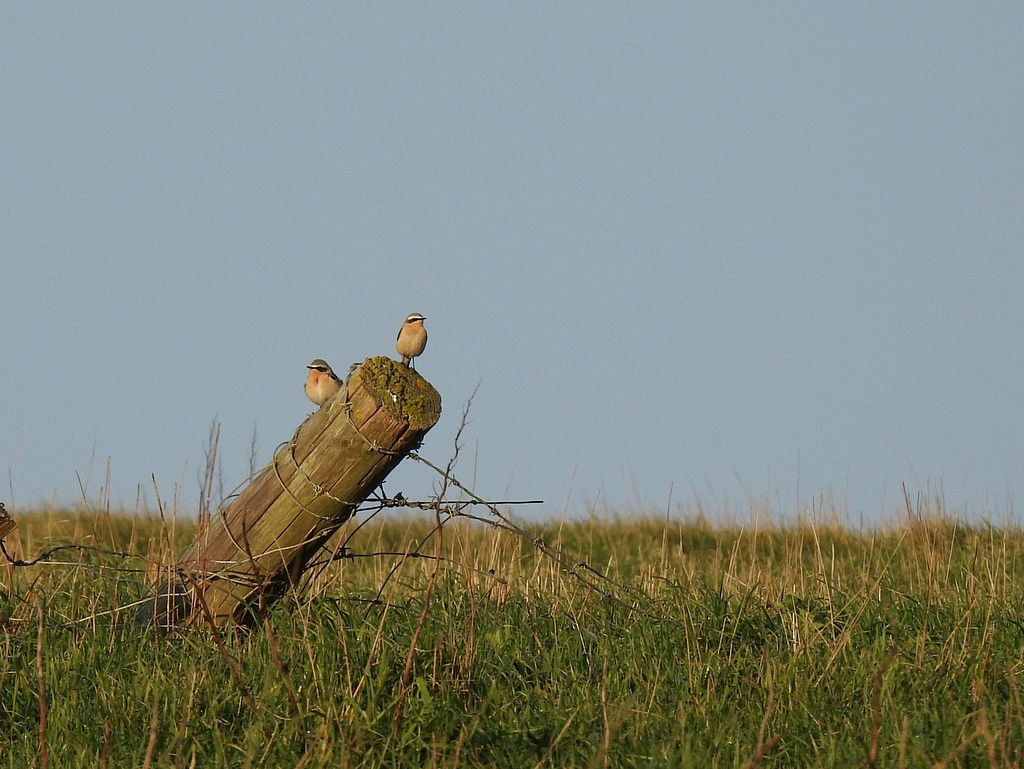
Two Wheatears (of four seen) during an early-morning walk from West Bay to Eype on April 8th. This photo was taken at 07:20. The 'horizon' is actually the cliff edge. Beyond that, the English Channel. Just 30 seconds later, both birds were up and away, heading inland. A few minutes either way, and I would never have seen them.

Later that day, our second garden Red Kite of the year is escorted off the premises by the local gulls.

Caught overnight April 9th/10th, I cannot resist including another Brindled Beauty photo on this blog. A superb moth.

Caught the same night, this is Dark Sword-grass. A genuine immigrant, and seemingly part of a notable influx into southern counties lately. One previous garden record, last September.

The Herald, a genuinely stunning moth. As someone on Twitter observed, it has a 'touch of fire'. A great description. I find it quite easy to visualize this moth in 3D, and that orange mottling as a small but raging inferno, as seen through a partially-consumed flammable screen. Or is it just me?! Anyway, this species overwinters as an adult, hibernating in old WWII bunkers, smugglers' caves and suchlike. What a moth!

The newly-published Bridport Area Bird Report for 2022, featuring West Bay's popular Barred Warbler on the front cover, is now available to download as a pdf, accessible HERE.

I tried seawatching again this morning...

That sentence could legitimately start a huge number of blog posts. Too many, probably. So far in 2023 I have yet to coincide a seawatch with anything spectacular in the way of bird movement, but there is quite often something of note. This morning it was the year's first Common Tern. Three quarters of an hour for one Common Tern, three Sandwich Terns and 12 Gannets is dedication to the cause, but hardly thrilling. Still, on Monday morning a Velvet Scoter flew east at 07:00 - close enough to see that it was a female - and that was mildly thrilling. Not a species you can quite guarantee each year, so a pleasing addition to the PWC2023 list. Talking of which, I have just updated my patch tallies (click on the PWC2023 tab to view) which now stand at 60 species (65 points) for Bridport North, and 86 species (107 points) for West Bay & Eype.

I know that migration is happening, because I see reports of it all over Twitter. Species like Redstart, Pied Flycatcher, Yellow Wagtail, Sedge Warbler etc are turning up at many inland spots, but - assuming weather conditions allow - I suspect that many go straight over the coast without stopping. The two Wheatears pictured above are probably typical - a brief pause, then away. Springtime birding on the West Dorset coast is rarely as migrant-rich as I think it ought to be, or as most birders who don't live here probably imagine. I have yet to see or hear even Willow Warbler locally, for example. Still, the potential for being shocked by a Hoopoe is no doubt much greater than lots of places, and the scenery is pretty decent...

Sunday, 2 April 2023

Barn Owl Worries...

It is just after 9:30 pm, and I've stepped indoors after an hour's 'naked' noc-migging. Probable Canada Goose at 21:06, and that's it. Anyone with serious intent would still be out there, doing the hard yards for a Patchwork Challenge Coot, Oystercatcher or better. But the temperature is dropping like the proverbial stone, I am old and feeble, and my wine glass is empty. Mind you, I'll be gutted if the night's recording coughs up a Coot at 21:45...

I've not talked much about nocmig lately, have I? I will get around to it eventually, but just want to mention something in passing. I started on March 1st this year, and already I am worried. The reason for my unease is Barn Owl, and here is why...


Feb Mar Apr May Jun Jul Aug Sep Oct Nov
2021 occurences x 19 34 10 17 21 10 4 10 0 125
nights 0 30 30 27 26 28 30 24 13 5 213
occ/night
0.633 1.133 0.37 0.654 0.75 0.333 0.167 0.769 0 0.587


2022 occurences 8 19 8 8 1 4 8 16 9 x 81
nights 13 29 30 31 27 29 28 23 16 0 226
occ/night 0.61 0.655 0.267 0.258 0.037 0.138 0.286 0.696 0.563
0.358


2023 occurences x 0


nights 0 28


occ/night
0


I didn't keep numerical records in 2020, my first year of noc-migging, and didn't begin until mid-April anyway, but Barn Owl was a regular feature from the word go. Last year I noticed Barn Owl occurences tail off after March, but was heartened by a resurgence in September. However, the occurences per night figure for 2022 as a whole was significantly lower than 2021 (0.358 vs 0.587 = 61%) and I made a mental note to keep an eye on the Barn Owl tally for 2023. Well, the number 'zero' is hard to miss. Yep, that's zero occurrences in 28 nights.

Is my concern justified, or are they just a bit late this year? We shall see, but I have a bad feeling...

This afternoon I stepped out the door around 15:30 and headed inland. The Bridport North patch has been neglected of late, but the walk to Mangerton is perfect for a Sunday afternoon, being just about devoid of people. I saw Marsh Tit again, and confirmed that Ravens are nesting, and found a meadow full - and I mean full - of Wild Daffodils, a plant I have never knowingly seen before. I got home about two and a half hours later, thoroughly chilled out. Yep, therapeutic is definitely the word...

Raven's nest. There is a bird on it, but invisible from below, and another on the right, mostly hidden by pylon steelwork.

One bearded beast.

A pair of Tufties still present on the pond at Mangerton. Here's the male.

Wild Daffodils

All those little yellow blips are Wild Daffs.

Two Roe Deer keep a close eye on a passing Fox.

As I abandoned the naked noc-migging just now, I glanced briefly at the mothless moth towel and wondered if there will be anything in the trap tomorrow. A March Moth settled on the towel just on dark, and I wouldn't be surprised if that is the sum total of the night's catch. Clear sky, big moon and plummeting mercury - conditions could be better! Still, last night was good, with one new moth and another which has occurred just once before, in June last year...

Once again I am impressed by the P900's ability to capture a pretty decent shot of a tiny moth. And look at it! Loads of micros are really awesome when magnified a bit.

What a stunner! Brindled Beauty is a new one for me.


Saturday, 1 April 2023

West Bay Redshank

The month closed with a real treat yesterday afternoon, my first ever wader on the Brit Estuary mud. And what a cracker...

Redshank, well on the way to full breeding dress too.

I've seen Redshank just once before at West Bay, when two were in the soggy field north of the river, sharing a big puddle with a Black-tailed Godwit in March 2020. Such Patchwork Challenge riches would be very welcome right now but, as yesterday's Redshank was so handsome and obliging - and unexpected - I was more than satisfied.


There was a lot of flotsam washed up on the mud and, surprisingly, my vague hope that something might be poking around amongst it was actually realised.

The last few days have mostly been slow going bird-wise, but even so it is a rare thing to come home without some noteworthy little nugget. Like the Cetti's Warbler opposite West Bay's Spar shop on Thursday. Super loud, as they always are, but oddly stilted, incomplete phrasing, as if it might be a youngster finding its voice. Or the flock of 8 Red-throated Divers flying east together that morning, the stand-out highlight of an otherwise dire seawatch. Or this...

Loafing gulls, just east of the main West Bay car park on Thursday afternoon.

Having a decent flock of gulls to pick through is a novelty here, so I made the most of it and spent a few minutes watching the comings and goings. Just before taking that photo there were 292 birds on the deck, all Herring Gulls bar a handful of Lesser and two or three Great Black-backs. I have a feeling the wait for a West Bay Casp is going to be lo-o-o-o-ong...

Other birdy bits and bobs since the last post...

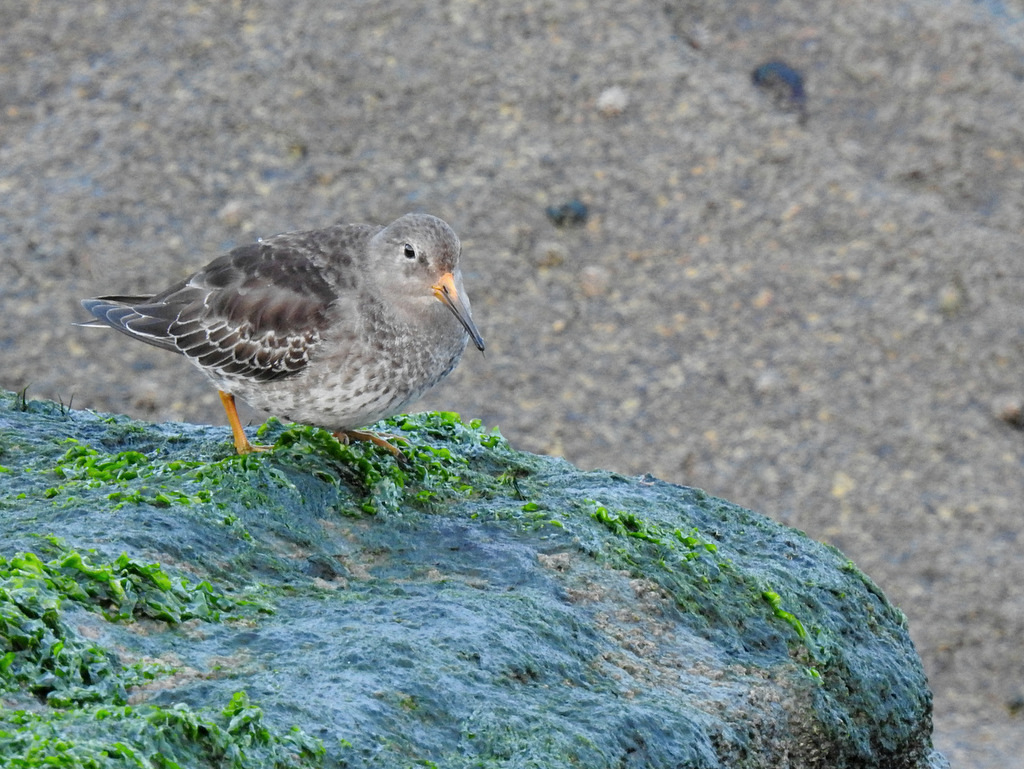
In Monday's pre-work gloom, a single Purple Sandpiper back on the harbour wall rocks...

...followed shortly afterwards by the long-staying female Black Redstart, plus a Wheatear that didn't hang around for photos.

Despite some blowy weather, seawatching has been consistently slow. Here is a list of highlights:


And so to today, April 1st. A pleasant afternoon stroll to Eype and back, but no migrants other than a few Chiffs, and four Swallows through. Best was this...

Despite complete absence of mud, amazingly the River Brit Redshank was still around.

Also on the river was the drake Wigeon, chalking up its fifth calendar month with us...


I wonder if the female Mallard it had seemingly hooked up with is losing interest? A few times lately - including today - I've come across the Wigeon on its own, mooching about aimlessly and calling loudly. During this period I have also seen them together occasionally, but whenever you hear that rather forlorn whistle echoing around the harbour it is a sure sign that the Mallard is elsewhere right now. Poor Wigeon is clearly not quite all there, and I feel a bit sorry for it.

Moths have been a constant pleasure, with a steady trickle of new ones...

Oak Nycteoline. Our second, following one last July.

Pale Pinion - new for garden.

Really chuffed with this photo. A micro that's actually big enough for a quality pic.

Like a tiny carrot. I love this one.


I'm always pleased to catch micro-moths. Despite the potential ID challenge they present, and the scientific names to learn (and forget...and learn again...) I find them totally addictive. A few recent ones, like the above tiny carrot for example, are evidently not an everyday catch locally, and a touch of scarceness always adds to the attraction. So far the year's tally is 36 species and 2 aggregates.

I'm sure there will be many more new moths as spring gets going properly, but for me the month is all about birds, and April is traditionally when the migration floodgates open. I cannot wait.

Sunday, 26 March 2023

No Fireworks

Despite evidence elsewhere in the land, it feels like the migration door has been shut all week. From Monday to Saturday, early visits to West Bay have basically featured south-westerlies of varying vigour (with or without rain) and seawatching has therefore been the default option. I have tried to stick it for 30 minutes or more each day, but direness made me fail a couple of times. Here's what I've seen...

129 Gannets, 112 Kittiwakes, 8 Red-throated Divers, 7 Common Scoter, 6 Med Gulls, 5 Sandwich Terns, 5 Manx Shearwaters, and singles of Guillemot and Peregrine. Plus a few unidentified auks. A fine tally really, until you realise it's the sum of six individual seawatches.

This morning, finally, the weather relented, and at 07:45 my first Wheatear for a week popped up on the seafront...


This afternoon I added Red Kite to the West Bay & Eype Patchwork Challenge list when a lone bird drifted west and upset all the gulls...

Red Kite over West Bay.

Apart from another Wheatear this afternoon, the only other vital things to record this week are the continuing presence of West Bay's odd couple in the harbour...


...and three new moths for the garden...

1. A slightly battered Satellite - apparently not a common moth locally.

2. March Moth - subtly attractive.

3. Small Quaker - two caught last night.

Early Thorn. Caught plenty of these in the latter half of last year, the 2nd-generation version. The name seems a lot more appropriate when you catch one in March though.

Beautiful Plume. Another moth which is not new, but I don't think NQS has ever featured a photo of this crazy creature.

Another Oak Beauty. Photo just because. I mean, why wouldn't you?

So, an enjoyable week, but no fireworks.