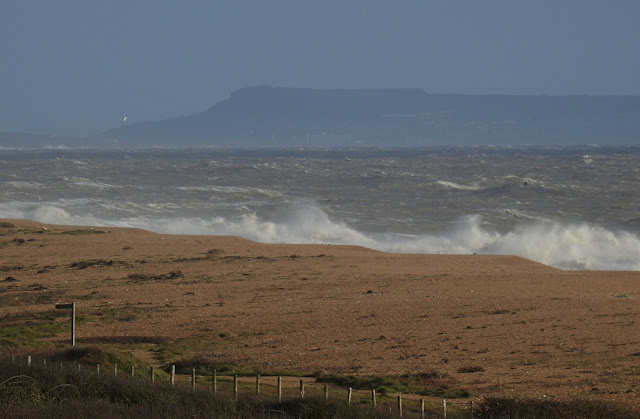
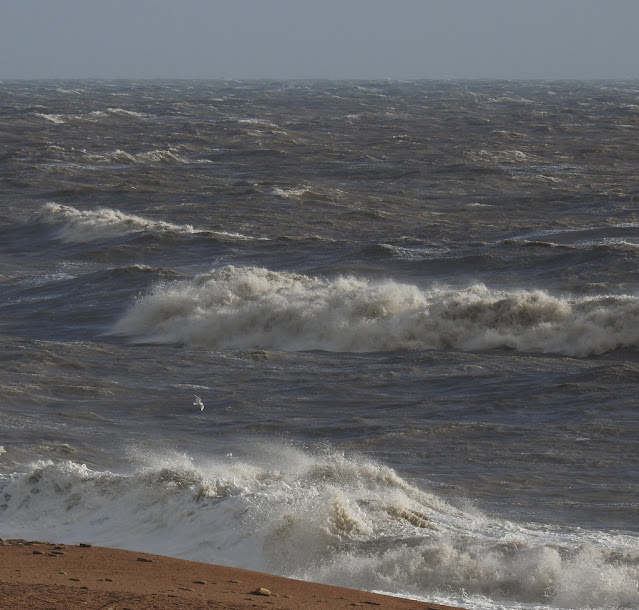
Storm Eunice battered a merciless path across Britain on Friday, taking one
and a half of our neighbour's fence panels with it. The storm also did a
pretty thorough job of sweeping our bit of Lyme Bay clean of birds. Seriously, a
late-afternoon seawatch from Cogden yielded precisely nothing...
|
There might not have been any seabirds passing, but wow!
|
Meanwhile, in the sunny lee of a hedge...
|
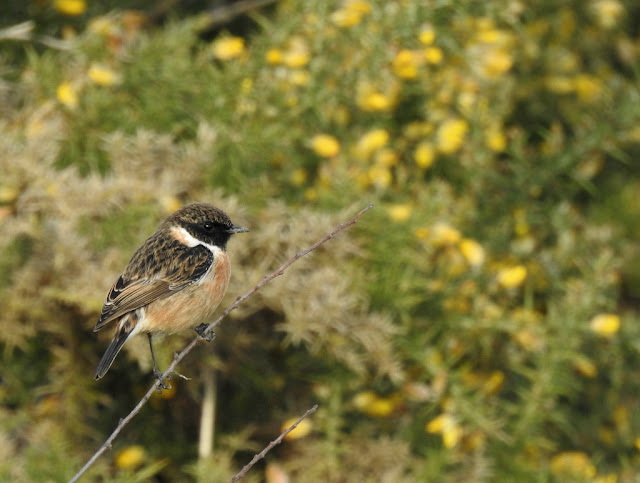
This Stonechat - and the gorse - acting like it's spring
already
|
To be honest, if asked what the storm might produce in the way of seabirds I
would have replied, 'Probably none.' Plus a rider that the next day or two
might do the business. Which is why I've been in the West Bay shelter first
thing these last two mornings.
I stuck it for an hour yesterday, but just 30 minutes this morning. On
Saturday I counted 124 Kittiwakes, 11 Gannets and 3
auk sp. Most of the Kittiwakes were literally miles out, and
identifiable only by jizz. This morning was slower: 10 Kitts, and
singles of Gannet, auk sp, Med Gull and
Common Scoter.
Yay! Common Scoter! Finally, a ton up for the #LocalBigYear list.
So that's the sea. What about the land? Not much to tell, but a walk from
Cogden to West Bex and back yesterday was suitably bracing, if not that birdy.
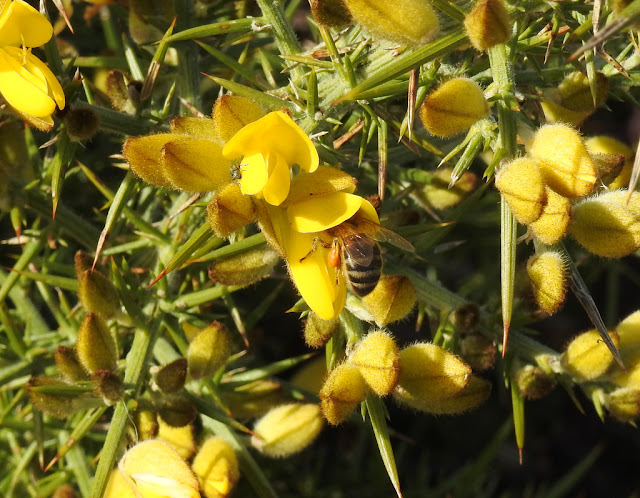
In fact, the first winged creature I noticed was not a bird at all...
|
Honey Bee in the sheltered gorse, also acting like it's
spring.
|
I counted 30 Teal, 2 Wigeon and 16 Shovelers on the West
Bex Mere, and a Shelduck flew west. The gulls were unapproachable and
disappointing, so I went to check out the buntings. It's almost two weeks
since I last gave them any time, so it was nice to see four male
Reed Bunts in the gang now. One of the female Cirls was also in
residence. A few pics...
|
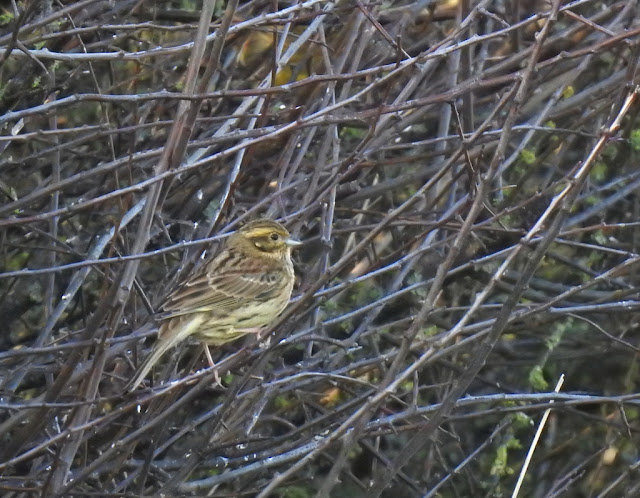
Female Cirl Bunting is a tricky ID challenge, but even this tiny
amount of rump on a Yellowhammer would give away the chestnut colour.
|
|
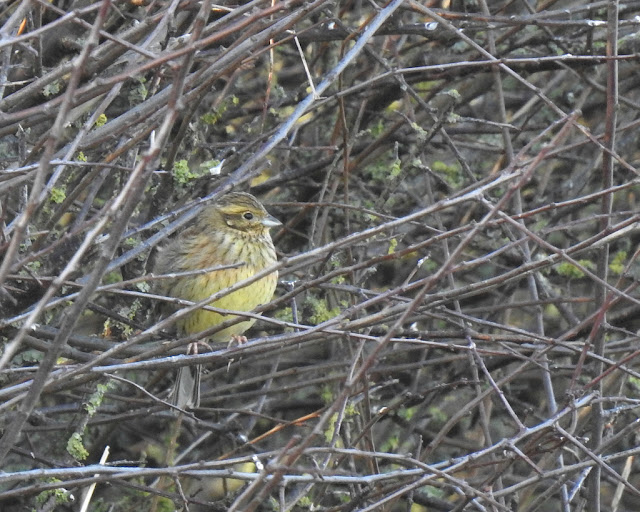
No rump here, obviously, but among other features you can detect a
subtle ghosting of the male's breast colouring: a greeny-grey wash with
a touch of chestnut below at the sides.
|
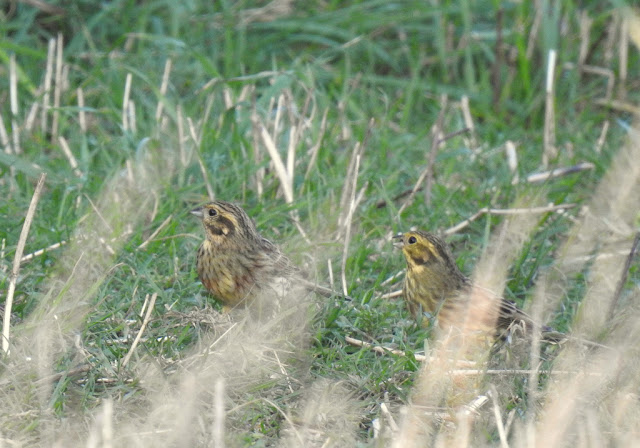
|
Female Cirl on the left, Yellowhammer on the right.
|
I thought it might be useful to enlarge on that last pic. As
Cirl Bunting gradually seems to be expanding its range there is a very
real possibility of birds turning up well away from the core breeding area.
Cirl is still a rarity in Dorset, but in January one was found in
Glamorgan, South Wales. The last Welsh bird was in 2004, and the most recent
Glamorgan record in 1982! It was a male, therefore unmistakeable, but I wonder
how many extralimital females slip through the net every winter.
Cirl Bunting must surely be a realistic target in much of southwest
England, and perhaps elsewhere? So...
Although the two birds in that photo look very similar, there are some subtle
- but consistent - differences. I'll mention three:
- Cirl has strikingly dark facial stripes.
-
The pale ear covert spot (between the rear end of each dark stripe) is
almost white, and though small, it stands out vividly in almost any view.
Often it is the first feature to catch my eye when looking for the
Cirl. On Yellowhammer the spot can be quite variable, but it
never seems to stand out to that degree.
-
Devon birder
Mike Langman
is more familar with Cirl Bunting than most, and put us on to this brilliant feature last winter: See that fine, sharp, dark streak curling
over the eye? Apparently it is diagnostic* of Cirl Bunting. Yellowhammer doesn't seem to show it, or if it does it
is very, very faint. That dark streak is obvious in all three photos above.
Even if I can see barely anything else on the bird when it is buried in the
hedge, that streak is enough to tell me I'm looking at the Cirl.
* Hopefully 'diagnostic' is not too strong. If it is, I'm sure someone will put me right.
I've learned to beware of the occasional dull, washed-out Yellowhammer,
and concentrate instead on the facial features, plus rump of course, if it's
visible.
I hope that might be helpful for any birder who fancies sifting their local
Yellowhammers. Obviously I am no expert, but I'm a bit better at them
now than I was 14 months ago!
Finally...
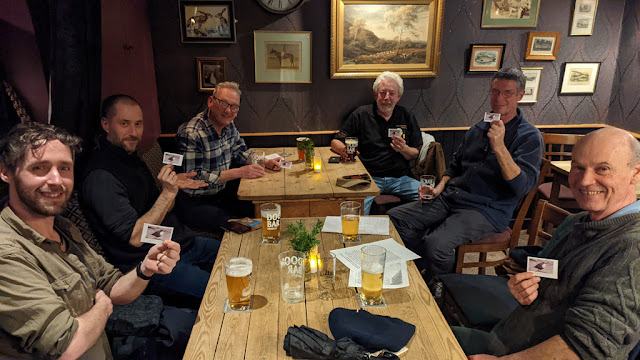
Local birder Tom Brereton recently organised a get-together of other Bridport
birders at the excellent Tiger Inn. It was in effect the inaugural meeting of
the Bridport Bird Club, though there was a bit more to it than meets
the eye. But I'll save that for another post...
|
The fledgling Bridport Bird Club proudly show off their
'membership cards'. L to R: Luke Phillips, David Martin, Keith Desbois,
Steve Crimp, me, Pete Forrest. (photo © Tom Brereton)
|