Pages

Sunday, 6 March 2022

Unanswered Questions

A lot of questions this past week or so...

Around 06:20 this morning I popped outside to retrieve the nocmig recorder and noticed a little group of small gulls heading north. Not a regular sight here. I went back in, donned thick coat and bins, and emerged once more. Fifteen minutes later the movement was over, and I was roughly 200 BHGs to the good, plus 30-odd Common Gulls and my second-ever garden Med Gull. Clearly these were birds which had roosted offshore last night, but why this route today? Was it the northerly wind? Or a regular thing that I've simply never noticed before?

This afternoon, another inland circuit. About 6.5 miles, only a small part of it new to me. Highlight was my fourth pair of Marsh Tits this year. Prior to these I had seen only one Marsh Tit locally. A bit of effort and they seem to be popping up all over the place. Just how many local pairs are there? And how close to home?
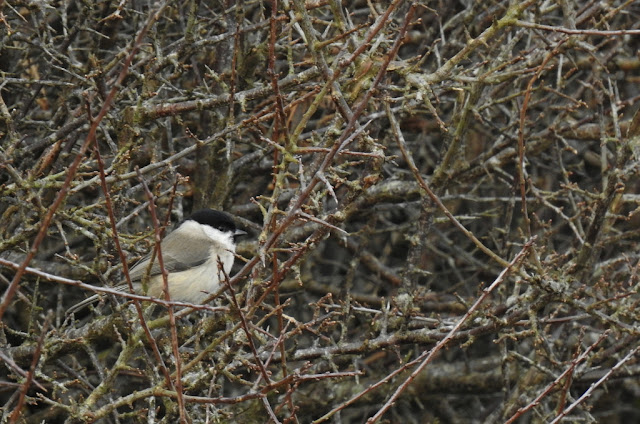
Marsh Tit in roadside hedge

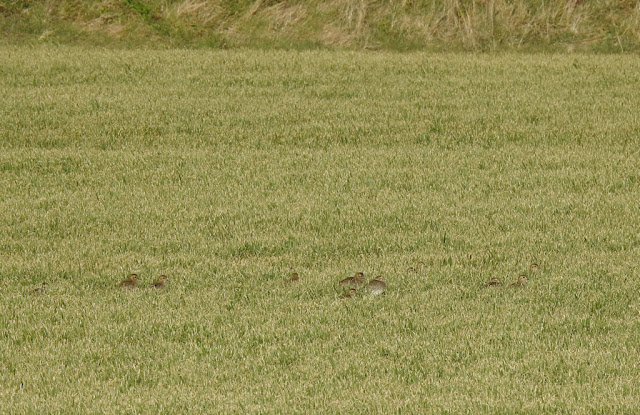
At the end of February I added Golden Plover to my #LocalBigYear list. There were 16 in a sea-level field just behind the beach at East Bexington, exactly the same field which held some last year at this time. When I first discovered them (six on 2 March) I assumed it was a one-off, but no, by the 14th there were 36. Is their reappearance this year just a coincidence? Or is the field perhaps a regular stopping-off point for Golden Plover in late winter?
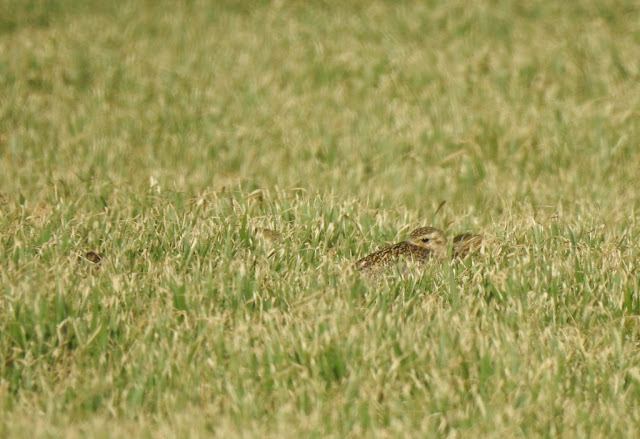
Golden Plover x4 - not exactly obtrusive

I thought there were nine or ten, then a Sparrowhawk flew past and 16 heads poked up for a look. This shot of most of them was taken shortly after.

This time two years ago I was a few short weeks away from taking up nocmig recording, a quite unanticipated development. If someone had asked me to predict what species I might get on a regular basis, I can safely say that Moorhen and Coot would not have been on that list. The notion that gangly rails which normally do everything possible to avoid taking wing might be wafting about over our estate at night simply would not have occurred to me. Well, now I know that they do. And I have a question: Why?

I don't have BWP but, regarding Moorhen, Witherby's Handbook says this: '...is fond of flying about at night for no obvious reason, well up in the air.' And of Coot: '...sometimes flies about at night.'

So there we have it. Even the ornithological experts of the day could not answer that one, and I take my hat off to the authors' restraint. It must have been so tempting to speculate.

Here's a recent Coot, flying about at night because...er...just for the hell of it...


Meteorologically speaking, it is spring. Birdy-wise there is much to anticipate, and probably more unanswered questions. Bring it on.
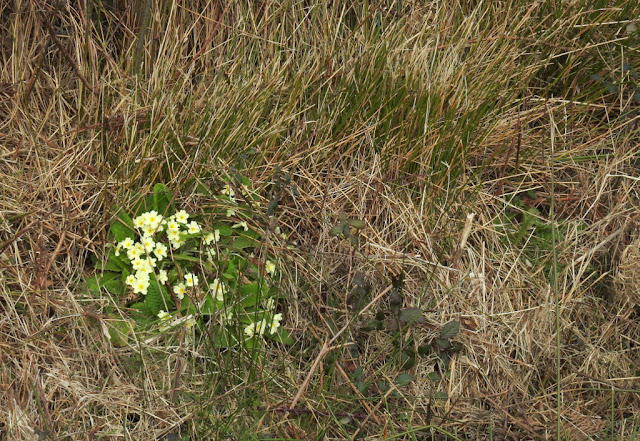
March Primroses

Monday, 28 February 2022

#LocalBigYear - February

January is an easy month to get excited about. The new start, the blank sheet (in some cases literal, as birders crack open a pristine notebook) and every species an addition to the nascent year-list. January is a hard act to follow...

And so it has sometimes proved in years past, with February a big let-down. But this year has been different. Instead of covering the same ground I did in January, and experiencing the inevitable law of diminishing returns, I ventured inland to areas I have previously given little or no attention. And it has been a revelation. To be fair, my species list hasn't increased hugely (from 89 to 101) but the enjoyment quotient remains pleasingly high.

I could single out a few birds which provided special moments, but it seems a shame to reduce this month to a list of species when other factors contributed just as much to February's highlights as the birds themselves. My main pleasure has come from simply broadening my horizons and trying out a few quiet corners of my local area. Quiet corners where birders rarely go. The usual word is 'underwatched' but I wonder if 'unwatched' might be more appropriate in some cases.

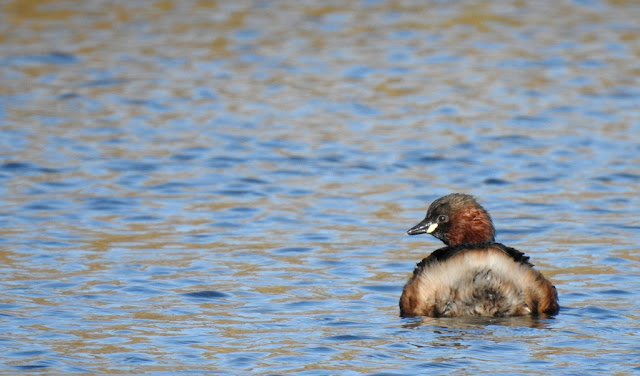
One such area provided me with 130+ Stock Doves and four Little Grebes. No big deal maybe, but Little Grebe was a year tick and the Stock Dove count higher than any recorded in the latest Dorset Bird Report! A new spot for me, made very memorable by two common species. Context is everything...

Little Grebe, this one photographed at West Bexington yesterday

At this rate I might have to start calling myself a birdwatcher rather than birder! But seriously, easing right off the throttle has been very good for me this past couple of years, and I can honestly say I am enjoying my birding at least as much as I ever have.

I've had the nocmig kit out on 14 nights since the 6th, and at the moment there are three species on my nocmig list which have yet to feature in any other way: Barn Owl, Curlew and Oystercatcher. In fact Oystercatchers have flown over, calling, on four nights so far. Where are they off to? Fascinating.

In a month's time there should be one or two summer migrants on the #LocalBigYear list, and last year there was a bonus Laughing Gull too. Also in March 2021, Long-tailed Duck, Eider and Pochard. I've always considered March one of the better months for wildfowl goodies, so here's hoping. But as for vagrants, well...

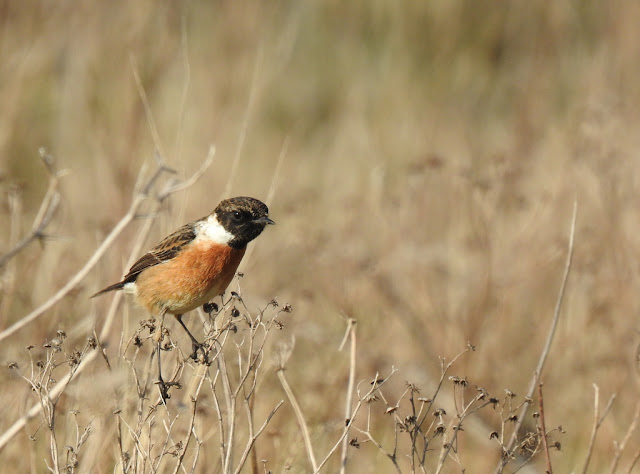
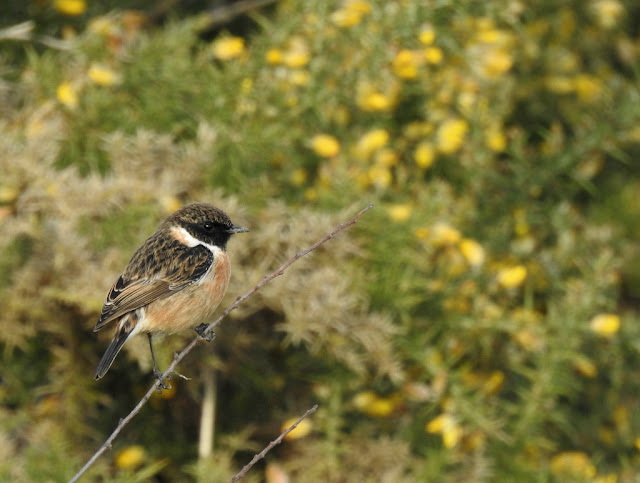
Photogenic Stonechats are a feature of every month, thankfully.

Friday, 25 February 2022

A Dose of Meds

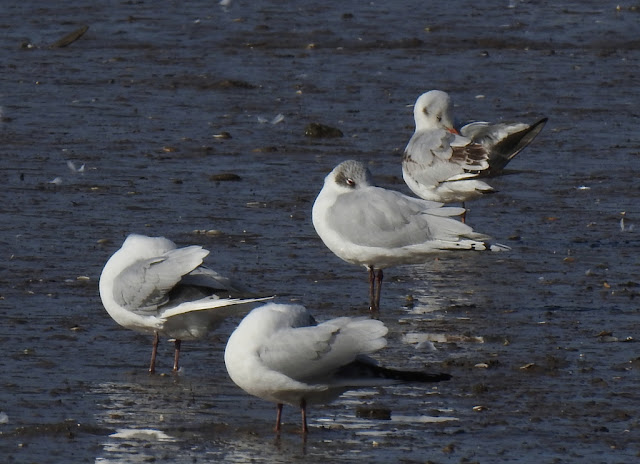
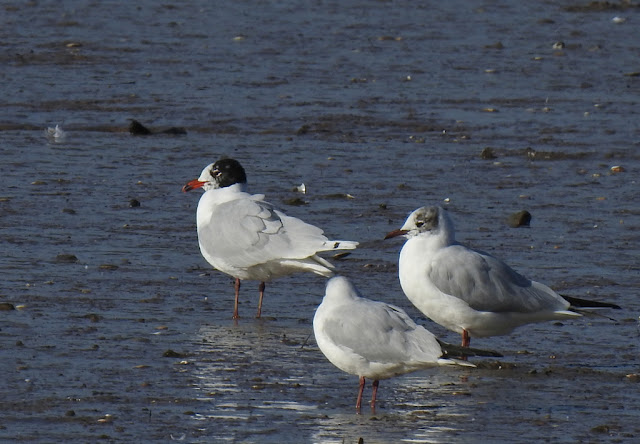
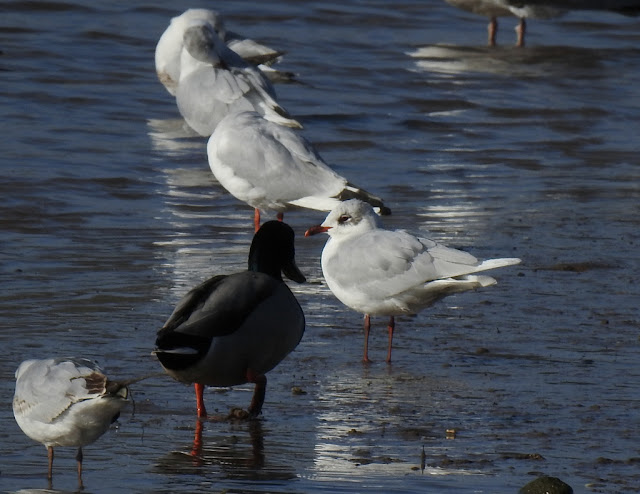
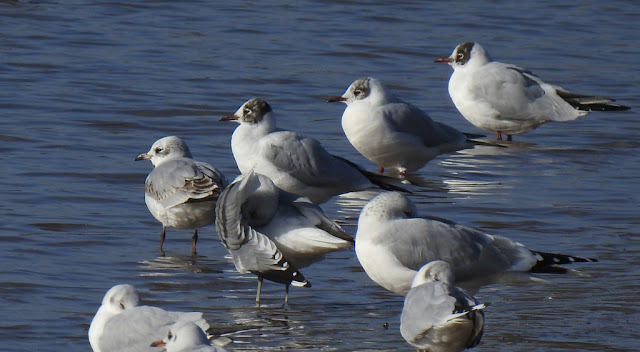
I do bang on about gulls quite a lot, don't I? I can't help it; they have the capacity to surprise and delight like no other group of birds I can think of. The other day I was chatting with Mike, one of the Axe patch birders, and he reminded me of that day two years ago when Mediterranean Gulls invaded the Axe. I had a feeling it was about now, but in fact it was January 29th. From a previous peak Med Gull count of 30-odd, the Axe record jumped to a staggering 123, completely out of the blue. I was fortunate enough to witness it, and of course wrote a blog post to celebrate the occasion. So far this winter on the Axe I've had just the odd Med Gull here and there, but this afternoon there were four. Dazzling sunshine made for low ISO and [relatively] high shutter speeds, so here are all of them...

2nd-winter

2nd-summer, more or less

Adult

1st-winter (on the left-hand end of the line)

Even now, after many thousands over many years, each Med Gull winkled from a flock of BHGs still feels like a precious little nugget. Or, on the rare occasion I've seen them in big numbers, the joy is in the sheer spectacle. Like that time last October when loads flew past me at West Bay, including a sample count of 100 in nine minutes. I wrote a blog about that too.

Not Quite Scilly would be a lot poorer without gulls.

Thursday, 24 February 2022

Quality Gulls

Despite a fair bit of checking, so far this winter I haven't found many gulls to get excited about. An unexpected intermedius Lesser Black-backed Gull, a few Meds, a couple of young Common Gulls with retained juv scapulars, and that's about it. But things seem to be warming up at last.

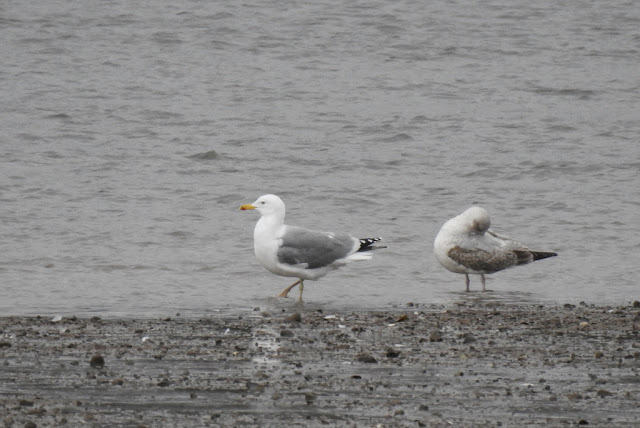
Yesterday I spent a bit of time at the Axe Estuary, between jobs and after work. A light sprinkling of LBBGs was good to see, mostly graellsii, but at least two or three dark intermedius jobs. And many of the adult Herring Gulls are looking really smart now, with lovely clean, white heads. And then, late in the day, I noticed a slightly darker-mantled bird among them, north of Coronation Corner. Momentarily I thought it had a dark eye, and got a slightly Casp-ish vibe from it, but no, the iris was pale, and the bill a bit too brightly coloured for a typical adult Casp. Also, far too much black on the underside of p10. Not a brute by any means, so I put it down as a presumably female Yellow-legged Gull...

Quite a looker. An elegant female (probably) Yellow-legged Gull

And again, with an adult HG on the right for mantle shade comparison purposes

Unfortunately it was a bit distant for really good pics, and flew off downriver within a few minutes. Still, great to finally get a nice gull. All pleased with myself, I too headed off downriver. I could see a sizeable bunch of large gulls by the tram depot. This is about the best spot on the Axe for close views, and they're really easy to do with bins here. To my surprise, among the closest birds was the Yellow-legged Gull. It hadn't flown out to sea after all...

Lovely light for comparing mantle shades. Adult argenteus HG in the background. The dark markings on the bill suggest the YLG is not quite fully adult.

Again I only had a short time with the bird, because something spooked the whole flock and this time they really did all head out to sea. Reviewing the photos afterwards I suddenly realised this wasn't the bird I saw at Coronation Corner. A number of subtle differences, certainly enough to be conclusive.

So. Two Yellow-legged Gulls. Both showed small signs of immaturity still, but near enough adult as makes no difference. And both very elegant examples of the species, lacking the brutish look of big males.

In other news, a solid hour of lunchtime at Kilmington WTW failed to yield any tristis Chiffs, despite good numbers (20+? 30+?) of standard collybita. And an early seawatch from West Bay on Tuesday simply added another 28 and 7 to the year's Kittiwake and Gannet totals respectively.

Thank goodness for gulls.

Sunday, 20 February 2022

In the Wake of Eunice

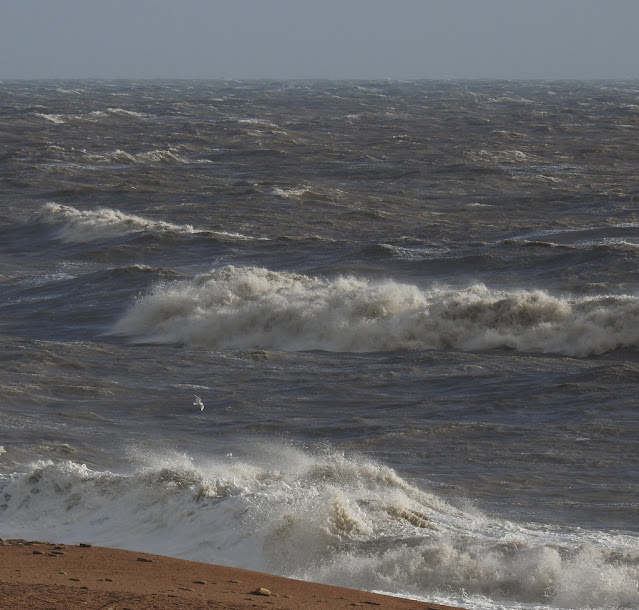
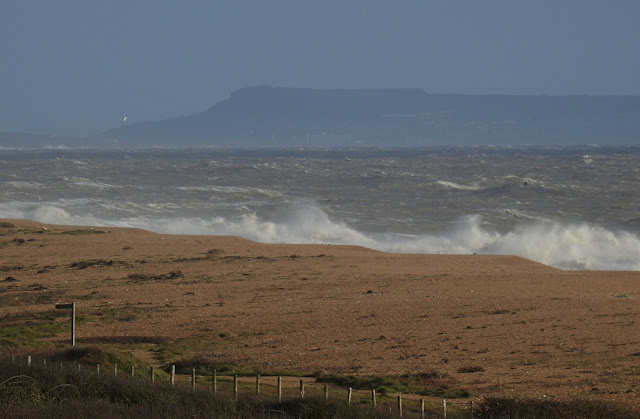
Storm Eunice battered a merciless path across Britain on Friday, taking one and a half of our neighbour's fence panels with it. The storm also did a pretty thorough job of sweeping our bit of Lyme Bay clean of birds. Seriously, a late-afternoon seawatch from Cogden yielded precisely nothing...

There might not have been any seabirds passing, but wow!


Meanwhile, in the sunny lee of a hedge...

This Stonechat - and the gorse - acting like it's spring already

To be honest, if asked what the storm might produce in the way of seabirds I would have replied, 'Probably none.' Plus a rider that the next day or two might do the business. Which is why I've been in the West Bay shelter first thing these last two mornings.

I stuck it for an hour yesterday, but just 30 minutes this morning. On Saturday I counted 124 Kittiwakes, 11 Gannets and 3 auk sp. Most of the Kittiwakes were literally miles out, and identifiable only by jizz. This morning was slower: 10 Kitts, and singles of Gannet, auk sp, Med Gull and Common Scoter.

Yay! Common Scoter! Finally, a ton up for the #LocalBigYear list.

So that's the sea. What about the land? Not much to tell, but a walk from Cogden to West Bex and back yesterday was suitably bracing, if not that birdy. In fact, the first winged creature I noticed was not a bird at all...

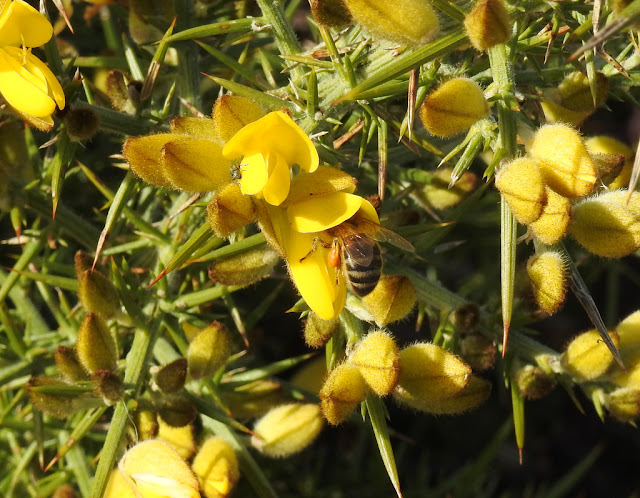
Honey Bee in the sheltered gorse, also acting like it's spring.

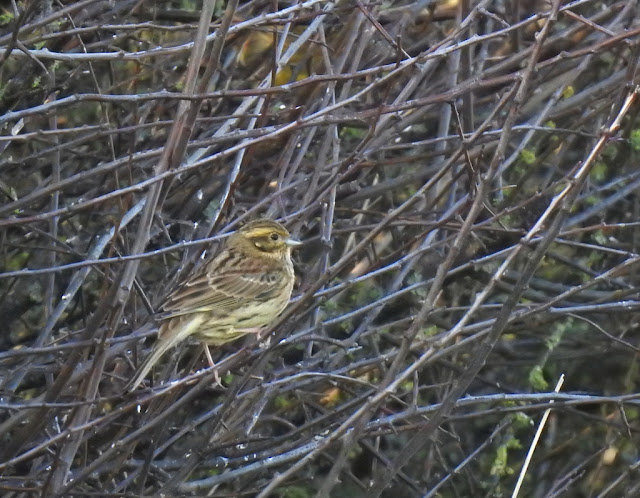
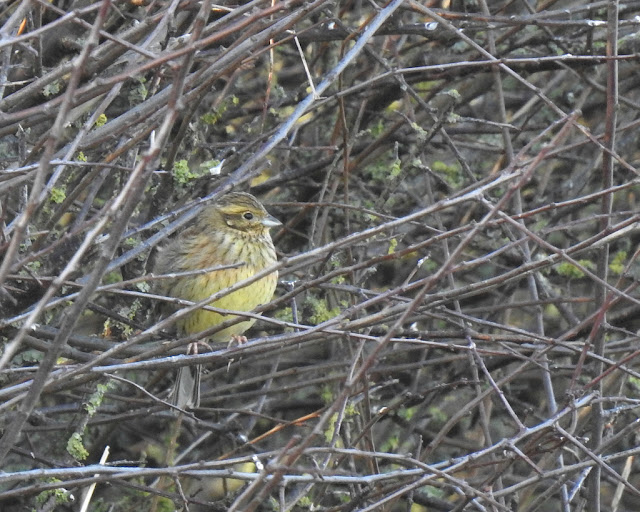
I counted 30 Teal, 2 Wigeon and 16 Shovelers on the West Bex Mere, and a Shelduck flew west. The gulls were unapproachable and disappointing, so I went to check out the buntings. It's almost two weeks since I last gave them any time, so it was nice to see four male Reed Bunts in the gang now. One of the female Cirls was also in residence. A few pics...

Female Cirl Bunting is a tricky ID challenge, but even this tiny amount of rump on a Yellowhammer would give away the chestnut colour.

No rump here, obviously, but among other features you can detect a subtle ghosting of the male's breast colouring: a greeny-grey wash with a touch of chestnut below at the sides.

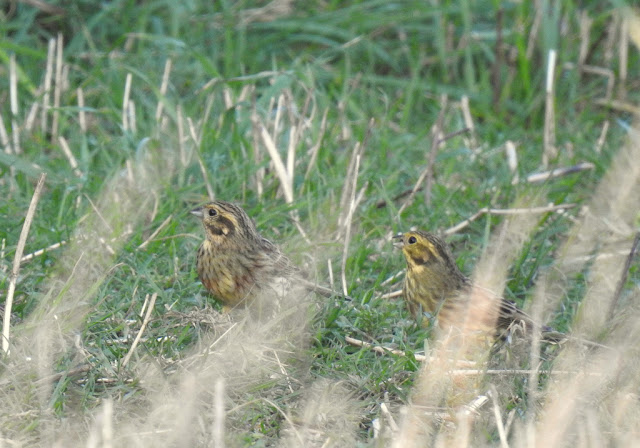
Female Cirl on the left, Yellowhammer on the right.

I thought it might be useful to enlarge on that last pic. As Cirl Bunting gradually seems to be expanding its range there is a very real possibility of birds turning up well away from the core breeding area. Cirl is still a rarity in Dorset, but in January one was found in Glamorgan, South Wales. The last Welsh bird was in 2004, and the most recent Glamorgan record in 1982! It was a male, therefore unmistakeable, but I wonder how many extralimital females slip through the net every winter. Cirl Bunting must surely be a realistic target in much of southwest England, and perhaps elsewhere? So...

Although the two birds in that photo look very similar, there are some subtle - but consistent - differences. I'll mention three:

  1. Cirl has strikingly dark facial stripes.
  2. The pale ear covert spot (between the rear end of each dark stripe) is almost white, and though small, it stands out vividly in almost any view. Often it is the first feature to catch my eye when looking for the Cirl. On Yellowhammer the spot can be quite variable, but it never seems to stand out to that degree.
  3. Devon birder Mike Langman is more familar with Cirl Bunting than most, and put us on to this brilliant feature last winter: See that fine, sharp, dark streak curling over the eye? Apparently it is diagnostic* of Cirl Bunting. Yellowhammer doesn't seem to show it, or if it does it is very, very faint. That dark streak is obvious in all three photos above. Even if I can see barely anything else on the bird when it is buried in the hedge, that streak is enough to tell me I'm looking at the Cirl.

* Hopefully 'diagnostic' is not too strong. If it is, I'm sure someone will put me right.

I've learned to beware of the occasional dull, washed-out Yellowhammer, and concentrate instead on the facial features, plus rump of course, if it's visible.

I hope that might be helpful for any birder who fancies sifting their local Yellowhammers. Obviously I am no expert, but I'm a bit better at them now than I was 14 months ago!

Finally...

Local birder Tom Brereton recently organised a get-together of other Bridport birders at the excellent Tiger Inn. It was in effect the inaugural meeting of the Bridport Bird Club, though there was a bit more to it than meets the eye. But I'll save that for another post...

The fledgling Bridport Bird Club proudly show off their 'membership cards'. L to R: Luke Phillips, David Martin, Keith Desbois, Steve Crimp, me, Pete Forrest. (photo © Tom Brereton)

Thursday, 17 February 2022

The Calm Before the Storm...

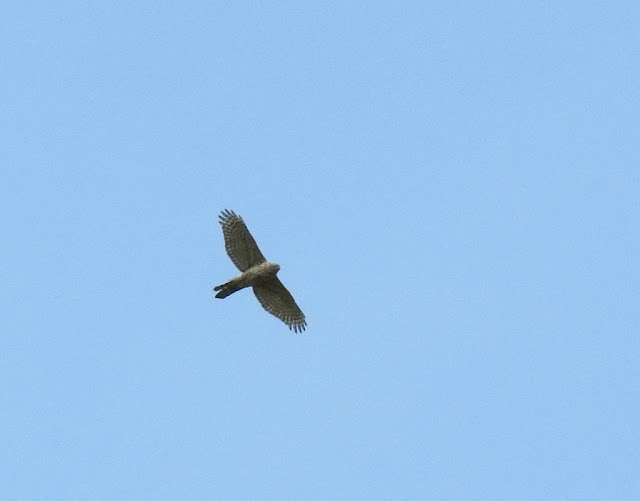
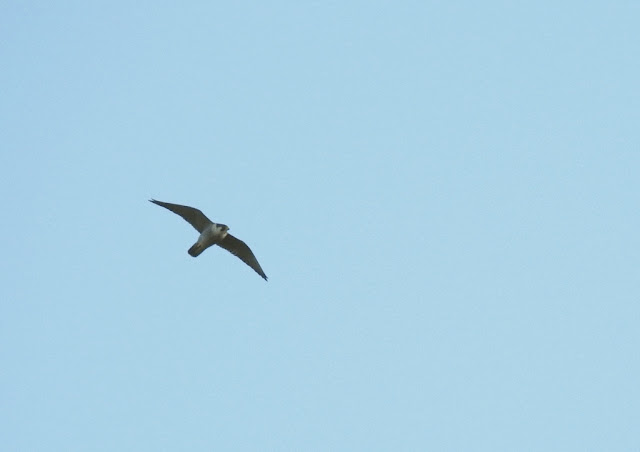
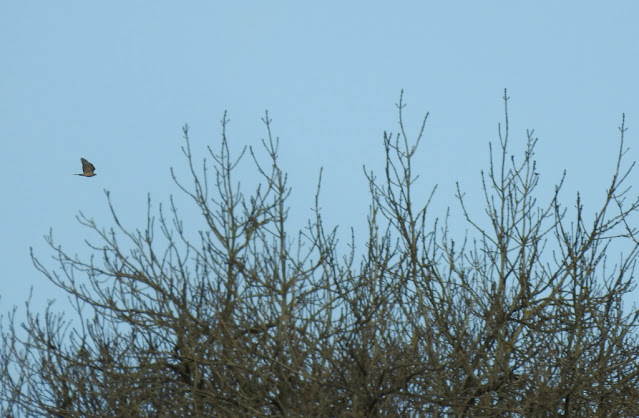
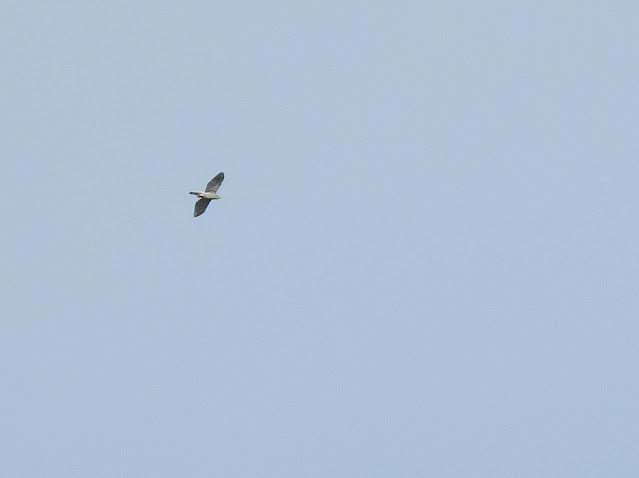
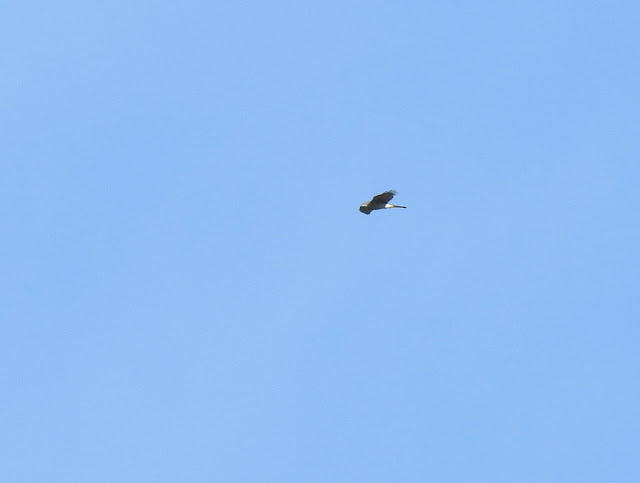
Enjoyed an absolutely brilliant walk earlier today. A roughly seven-mile circuit, much of it new to me. It was in the general vicinity of recent Goshawks, so my hopes were high, but reality definitely exceeded expectations. Over the course of four hours I had several sightings, probably on most occasions that I stopped for a good scan. Mostly the female today, but the male at least three times. Like the many Buzzards, they appeared to enjoy the brisk wind. Along with a Sparrowhawk, two Kestrels and a surprise pair of Peregrines, Gos and Buzzard took the raptor count to five species. I don't often manage that without a Red Kite or Hobby on the list. I even got photos of all five. A few of the less awful ones...

The female Goshawk. The spotty/streaky underparts indicate a 2cy (2nd calendar-year) bird.

Female Peregrine

Female Goshawk - typical view!

The male Goshawk. Prominent white undertail coverts visible even in this tiny image.

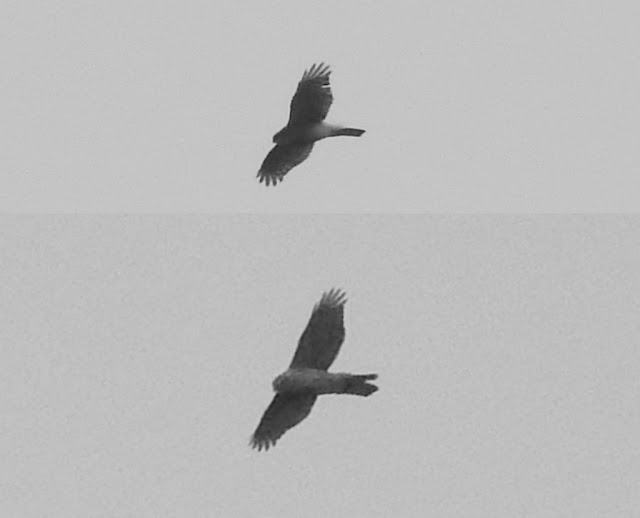
I thought it might be quite instructive to make a comparitive collage of the Sparrowhawk and female Goshawk. I suspect the Sparrowhawk is a female too, but cannot be sure. As I was only interested in the silhouettes really, here it is in B&W...

Sparrowhawk above, Gos below. Not to scale.

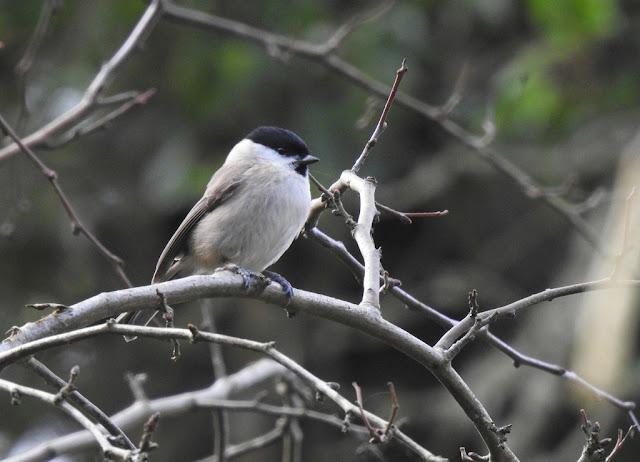
There was plenty of other stuff too. Two Marsh Tits, a sprinkling of winter thrushes, single Siskin and Jack Snipe; all in very scenic countryside.

One of the Marsh Tits

I've really enjoyed poking around in spots away from the coast this winter. It is quite hard work, but the rewards have made it more than worthwhile. That said, the previous couple of days have started with a short seawatch from West Bay. Apart from a Red-throated Diver and a meagre helping of Kitts, Gannets and auks, it has been quiet. I'm still waiting for my first Common Scoter of 2022.

Storm Eunice arrives tomorrow. There'll probably be a Common Scoter in the garden...

Monday, 14 February 2022

Avoiding the Definite Article

It is impossible to be a birder on Twitter right now and not know what a drake Baikal Teal looks like, or an American Robin. Every few minutes a fresh reminder appears. Some of the photos are really excellent, and if you want your search image for these two species reinforced, Twitter is a fine place to go.

I would imagine that some birders are galvanised into instant action by such pics: 'That is stunning! I must go and see it NOW!' Many years ago I might well have responded like that. Nowadays I get no further than the first three words, and with some other species which have bloated my Twitter feed on occasion, not even that far. I do sometimes ponder my complete disinterest in twitching, and wonder what led to it...

Complete disinterest? Hmmm...

It is true that I have moved pretty quick for some good local birds. Technically, that is twitching I suppose. But the last time I was struck with a must-go-and-see-it-NOW urge which took me out of my local area was the Axe Estuary American Herring Gull two years ago today, and it was possibly the most stressful 30-minute drive I've undertaken. But that was as much about context as it was the bird. A mega-rare gull at a much-loved former patch, and the very place I went to gull school. It had to be done. But other birds?

I would be the first to agree that the Baikal Teal really is stunning. However, though I've never seen one in the flesh, I definitely do not need it, and feel no urges.

What I do need is pleasure from my hobby, contentment, fulfillment; that kind of stuff. And I feel very privileged that I can get almost all of it from relatively common birds. Mind you, offer me the less common and I won't say no...

Another visit to the Goshawk site produced a very-much-hoped-for pair. For a while the female was chivvied by a Raven, and comfortably matched it for size. What a truly impressive beast! Mostly it was distant scope views, and I botched a brief opportunity for photos. This is the only one worth posting...

Female Goshawk, admittedly not looking as huge and impressive in this photo as I would have liked...

Much closer to home I added a new species to the #LocalBigYear list, bringing the tally to 99. I find it quite bizarre that I had so far failed to see this species locally in 2022, when exactly 1.62 miles from my house there was a field-full. And it still needed someone to tell me about them!

Lapwings - a few of the 196-strong flock!

The title of this blog post was inspired by my Twitter feed. Recently I noticed how frequently the definite article (i.e. the word 'the') appears in front of bird's names in the tweets of some birders I follow. Obvious examples are the American Robin and the Baikal Teal. But often the species involved will be far less rare. So we have the Shore Larks, for example, the Black-necked Grebe, and on one occasion even the Water Pipit. And it suddenly struck me how many birders treat a day's birding as basically a tour from one 'known' bird to the next. I'm not knocking it, but it made me take a close look at my own behaviour to see if I do similar, if on a more compact scale. And yes, sometimes I do go somewhere to see 'the' something-or-other, but it is not the norm. By far and away the majority of my outings are totally on-spec visits, with no specific target or expectation. And this made me wonder if therein lies one of the keys to contentment with relatively everyday birds? I suppose I reasoned this way: If you go somewhere to see the [insert species] and you fail to see it, well, that's disappointing, isn't it? If you go somewhere expecting nothing in particular, surely it's hard to be disappointed?

Or perhaps I'm being a bit simplistic. Whatever, I know which I prefer these days.