Pages

Monday, 21 March 2022

What? No Garganey?!

I spent much of yesterday afternoon waiting in vain for another garden Red Kite. The powder blue sky was just begging for one, and the 'gardening' that I was out there for suffered from want of attention. Still, there will be other days. And compost doesn't go off.

The local Ravens do a close fly-past

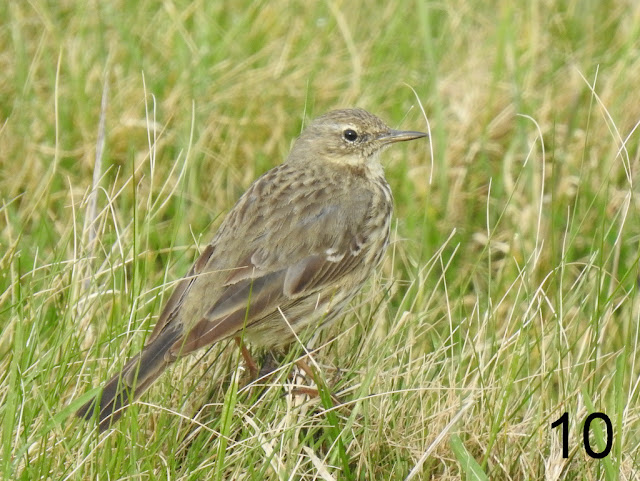
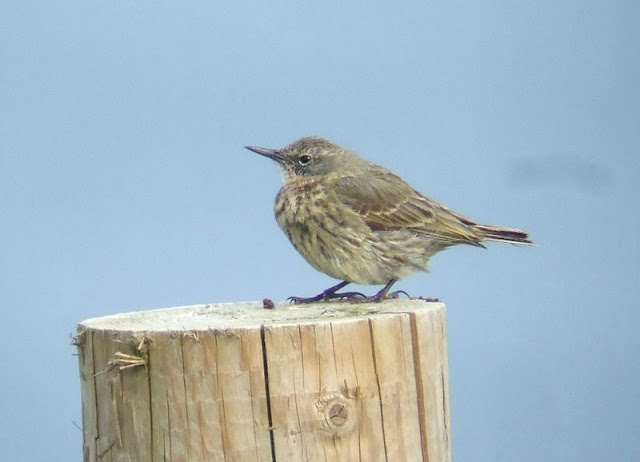
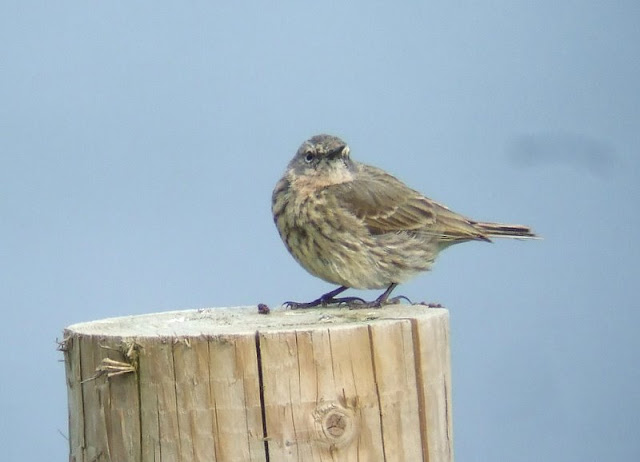
Rather late in the day I scuttled off to Rockit Land, but struggled to find any. Just two for my troubles, and photos of only one of them. Mind you, it was a significant one. Just a quick pic for now, but I shall revisit this bird in a later post...

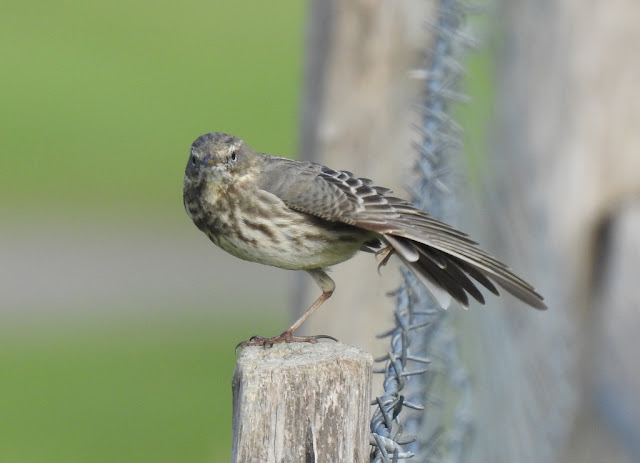
An old friend, this one. Rock Pipit number 10.

I headed there again first thing this morning, but likewise struggled to find some Rock Pipits, ending up with just three, and no decent photos at all. My previously prolific sessions have all been late morning visits, so maybe I should stick to that time of day if possible..

When I first arrived at Burton Bradstock today, I paused for a quick scan of the sea. Four Common Scoter immediately flew east, then a couple of close Gannets. Momentarily I wondered if I ought to be seawatching...and then headed of to hunt pipits. And again, just before leaving I had another scan. A small flock of dabblers flew in from the west and landed on the sea. Definitely two or three drake Shovelers among them, but way too far out to ID them all with bins. Just as I was zeroing in with the camera, they took off. I managed a quick burst of shots, and got back on them with bins. As they headed away east I could see there were 12 birds. By size it looked like 7 Shoveler and 5 Teal. Conscious that there has been a fair bit of up-Channel Garganey passage recently, I checked the photos. Hard to tell for sure, but yes, those little ones did look like Teal rather than Garganey.

Later in the day, news reached me (also gripping photos) that at least two little groups of Garganey (five and three) had passed West Bexington, the trio among a wonderful flock of 17 Pintails. Needless to say, this evening I sat down and revisited my photos...

There they all are. A fine flock of 12 pixels.

As you can see, there isn't much to work with. But I tried...

Three of the little ones bringing up the rear. The left-hand bird has the ring of a drake Teal to it. Kiss of death. Even I can't string a Garganey out of that lot.

Yes. I should have been seawatching. Possibly the honey on my breakfast toast might have tasted even sweeter than usual.

Anyway, it was pretty obvious that at least a couple of all these Garganey were going to drop in to the West Bex Mere before the end of the day, so there was a late-afternoon shingly slog...

One of three gorgeous male Wheatears on the beach.

Absolutely immaculate drake Pintail on the West Bex Mere.

And of course, no Garganey.

Saturday, 19 March 2022

A Pinch of the Unexpected

The back end of the week has been heavily loaded with work and other stuff which has kept me from Rock Pipits. But I am very encouraged by the nice noises made by some of this blog's readers. Clearly I am not the only birder intrigued by the cryptic little blighters. Two or three have been enormously helpful with literature too, and I now have a small pile of homework reading. Not only am I very grateful of course, but, as always, touched by such unsolicited kindness. Birders are a decent lot, by and large.

No work on Wednesday though. What a dismal day! In the afternoon, as the rain began to ease, I headed out to find a Garganey, reasoning that the West Bex Mere would be the best bet. No Garganey, but a pair of Pintail was a nice result.

Pintail pair. Grim record shot through rain-spattered lens. I was quite eager to get the camera back in its cosy bag, and didn't wait for a better pose.

I walked on, all the way to Cogden, where some rainwater pools behind the beach held a nice little prize...

Only a Dunlin, but my first of the year.


One other notable aspect of that afternoon was the number of Chiffs, presumably held up by the weather. I counted 14 in total...

Chiffchaff just behind the beach at West Bex, freshly arrived.

And so to today. Lunch in the garden was a good move. Two Red Kites were my first of the year. The first bird was through like a bullet, but I managed to grab a shot of the second about 40 minutes later, as it was hustled out of Bridport airspace by a Herring Gull...

Red Kite. Just. That roof is about 230m away.

After lunch I almost went a-Rockit-ing again, but the prospect of mixing it with the inevitable sunny-Saturday-afternoon crush was too unpalatable, and I opted for another plod around West Bex instead. Standard fare, until the very last stretch of beach. I was surprised to spot a small flock of waders fly in and land by the water's edge, just like you might see later in the spring. I hurried over to see what they were...

11 Dunlin and a Ringed Plover

Excellent. They soon moved up the beach and settled down for a rest...

Ringed Plover

Two Dunlin

Yeah, I know. Dunlin and Ringed Plover are 'only' common waders, but the Ringo was new for the year, and all 12 of them added that big pinch of the unexpected which spices up any local outing. Wonderful.

Wednesday, 16 March 2022

More Questions Than Anthus

Warning. Another niche post coming up...

Rock Pipits again. This is the sort of thing I never do, so I am somewhat in the dark re methodology. Still, it seems wise to get some stuff down in writing so that there is a kind of order about it all.

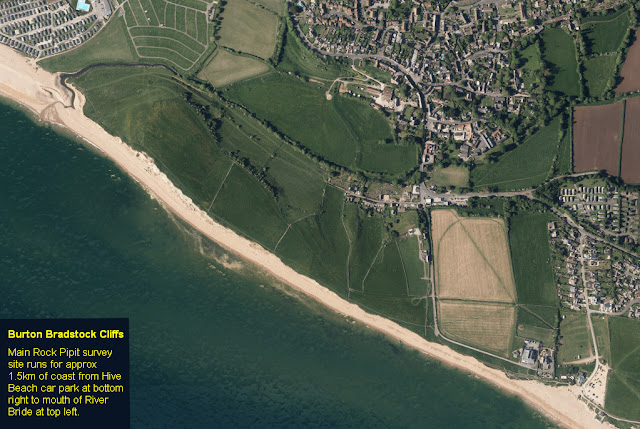
First, a photo of Rockit Land...

The best Rock Pipit habitat lies between the river mouth (top left) and the seaward end of Cliff Road (bottom left corner of the two pale fields) though I have seen them by the Hive Beach car park (bottom right) and on the holiday park (top left).

Yesterday was my fourth visit to the...ahem...'study area', where I have tallied between 7 and 10 Rock Pipits each time. I have photographed as many as possible, and discovered that they are individually identifiable by comparing tertials and visible coverts. As I have managed to photograph more right-hand sides than left, henceforth that will be my aim with every bird: get a decent snap at least of the right-hand side. Thus far I have pics of 13 different individuals. I have also identified one definite petrosus, though that ID is based on the assumption that only petrosus will be singing and displaying at the moment. And right there is my first question: is that assumption a safe one?

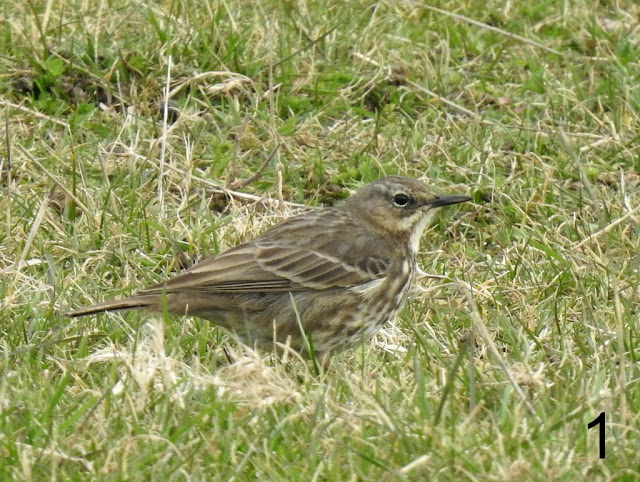
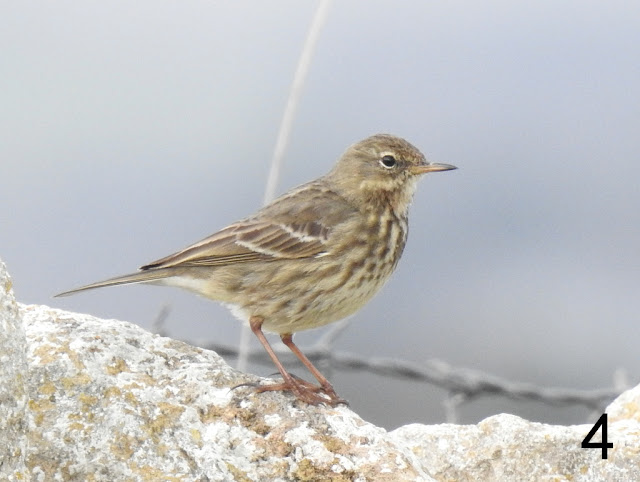
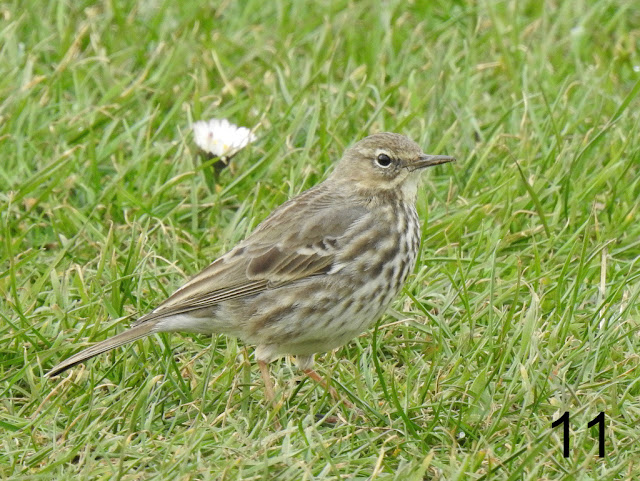
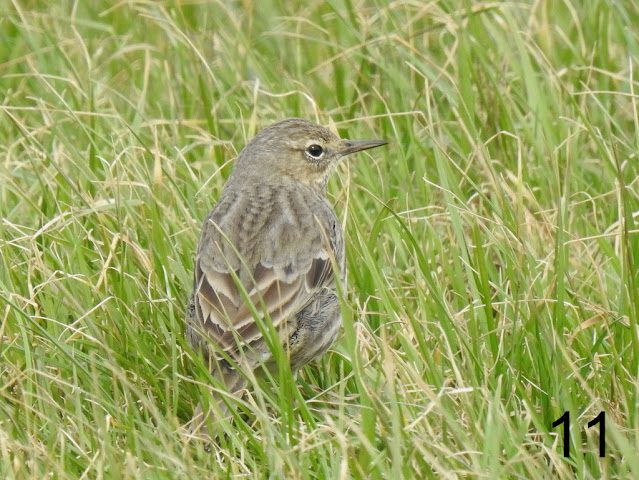
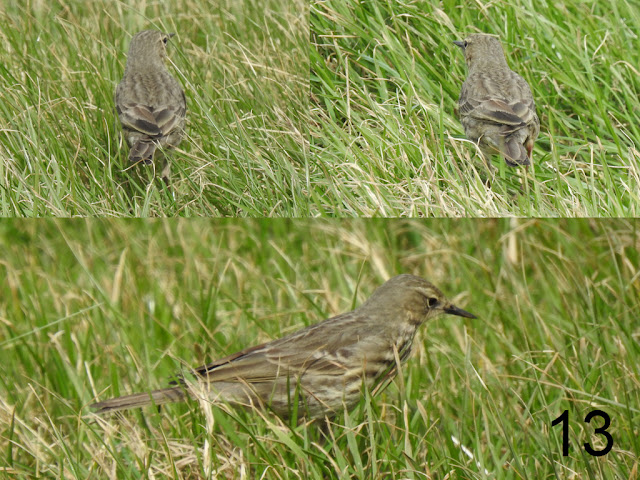
So, here are all 13 birds. A few are captioned where appropriate. The extent of subtle variability is rather surprising. At least, it is to me.

The first Rock Pipit I photographed (on 9/3) - next to the Hive Beach car park - and coincidentally the first photo too. Yesterday (15/3) the same bird was in subdued song and giving brief display flights by the end of Cliff Road. So, until I know different, this one is labelled Anthus petrosus petrosus.


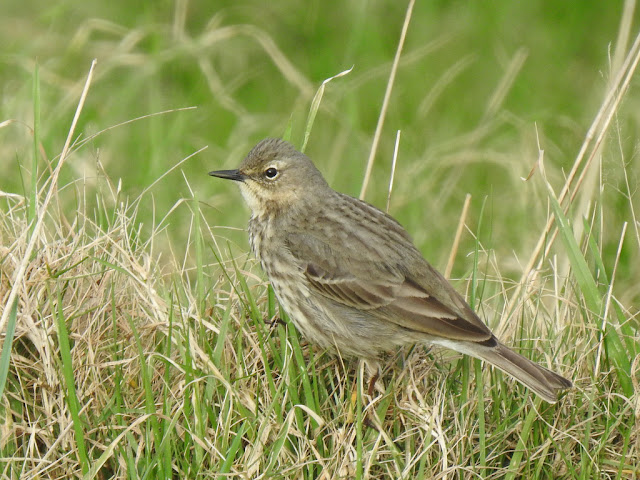
Legs can look very pale in some lights. This individual has a lot of yellow on the bill, while on many birds it is completely black.


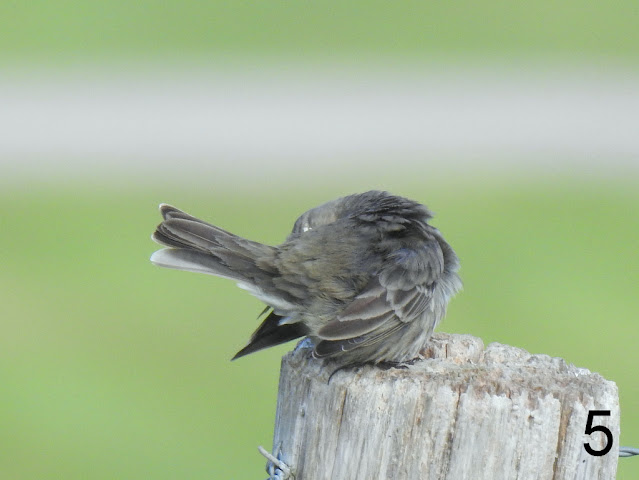
Nice to get a pic of the outer tail feather on number 5, which has an obviously pale grey wedge, but with some clean white on the extreme tip. Petrosus?


Those tertials are evidently not all the same age.

Another seemingly pale-legged bird. Very pale ground colour to underparts too. In fact, I would say it is basically white.

Rear views like this are dead useful for identifying individual birds, but can't always get them.


Again, the rear views of this bird show tertials are not all the same age.

Hopefully I will be adding to that collection in due course, but even the current total of 13 different birds is a bit of a surprise. Certainly there are more than I would have guessed. Also, that's the minimum count; I doubt I've photographed every bird present.

Questions then...

  • I have definitely photographed the same bird on different dates a few times, but is the current population resident and stable, or are some birds moving through?
  • Several of the photos appear to show evidence of moult in the wing. What does this indicate re age or subspecific ID, if anything?
  • Black bills. Bills with yellow on them. Does it mean anything? Should I care?
  • Leg colour. Is it significant in any way?
  • And the obvious one: are any of the above littoralis? And if so, which, and why, and to what degree of certainty?

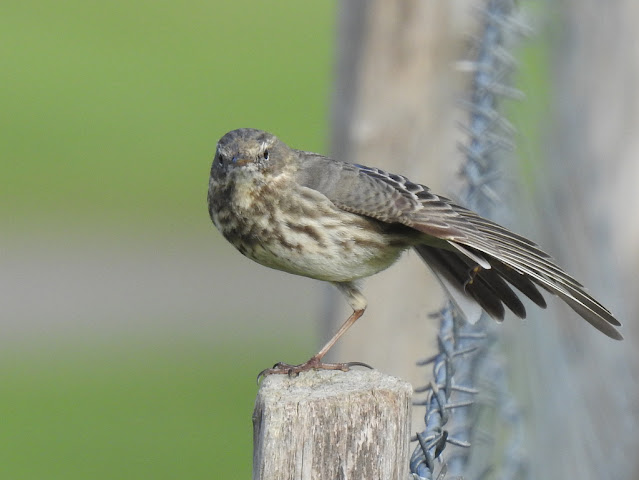
Here's a bird which featured in the last post, having a stretch. Unfortunately I didn't (knowingly) manage a pic of the right hand side, so I don't know if it features above, but look at those outer tail feathers. They are definitely tipped white...


I would say with some confidence that this bird's left-hand outer tail feather is tipped clean white. The underside of the right-hand outer tail feather also looks very white, but I think this is misleading and prefer to stick to the upper side only when it comes to determining its true colour.

All these questions simply reveal to me how little I know. I don't own Pipits and Wagtails by Per Alström et al, nor Moult and Ageing in European Passerines by Jenni & Winkler, and what there is in my scant library is of little help. I briefly toyed with the idea of purchasing the above tomes (60-odd quid each!) before realising I would only be interested in a few pages, and came to my senses. Paul Chapman kindly sent me a screen-shot of a relevant page from Svensson's Identification Guide to European Passerines, which says this:

[Re petrosus] Pale portions on outer TF always greyish-white, never pure white.
[Re littoralis] Pale portions on outer TF greyish-white, or greyish white with purer white near tips.

Hmmm.

So there we go, that's the story so far. At the moment I plan to continue visiting regularly, and to photograph as many birds as possible. Ideally I shall continue into the breeding season, for obvious reasons. If the enthusiasm holds, I might even have a look for breeders a bit further west, along the cliffs between the mouth of the River Bride and West Bay, flanking Bridport Golf Course. But let's not get ahead of ourselves...

Sunday, 13 March 2022

While Not Looking for Wheatears

In years past I have spent a good deal of time looking for that first Wheatear, usually much too early in March. Because repeated failure is disappointing, these days I really try not to do that. Instead I just bumble along - ideally with some distracting little project or other - knowing that Wheatear will just come along anyway. The littoralis Rock Pipit challenge is ideal. It keeps me busy, but at the same time in habitat which Wheatears happen to love. I've been Rock Pipit-ing a couple of times since the last post, and seen a maximum of ten on a single visit. I have photos of at least nine different birds so far. Any littoralis yet? Well...

Rock Pipit gives glimpse of outer tail feathers. Interesting bit of apparent whiteness there...

And this one, a different bird...

Quite grey, rather than olive-brown, on the head and upperparts.

I'm not going to claim either is definitely a littoralis, but it wouldn't surprise me if they were. I think I am going to enjoy pottering about on the Burton Bradstock cliffs and surrounding area this spring. Will I get a nice pink one? I am optimistic. In the meantime, it's not a bad spot for Wheatears. Not that I've seen any there yet.

Early-morning seawatching has been a pleasant distraction too. Numbers and variety have tailed off since that first hit (with the two Shags, Bonxie, Blackwit flock, etc) but there were further single Shags on 9th and 10th, and my first Great Northern Diver of the year on the latter date. I've been quietly hoping for a Little Gull or two, but not so far...

Apart from three Curlews overnight on 8th/9th, nocmig has been uneventful, and gull-wise I have nothing whatsoever to report.

On Friday I had to drive to Milton Keynes. This unpleasant chore was lightened considerably by meeting up with my old mate Ric on the return. We spent a delightful couple of hours doing a circuit of Stockers and Springwell Lakes, near Rickmansworth, Herts. Up until twenty years ago I lived a mere ten-minute walk from Stockers. Although I never really gave the place the time it deserved, my Stockers List has some enviable birds on it, like Blue-winged Teal, Ring-necked and Ferruginous Ducks, Gannet, Hawfinch, Ring Ouzel, and my personal favourite, Red-necked Phalarope. While two birds on my Stockers List - Lesser Spotted Woodpecker and Willow Tit - were once regular but now impossible, several birds which Ric and I saw on Friday were either scarce, rare or out of the question in my day. Like Oystercatcher, Little Egret, Ring-necked Parakeet and Red Kite. Those birds somehow made me feel old.

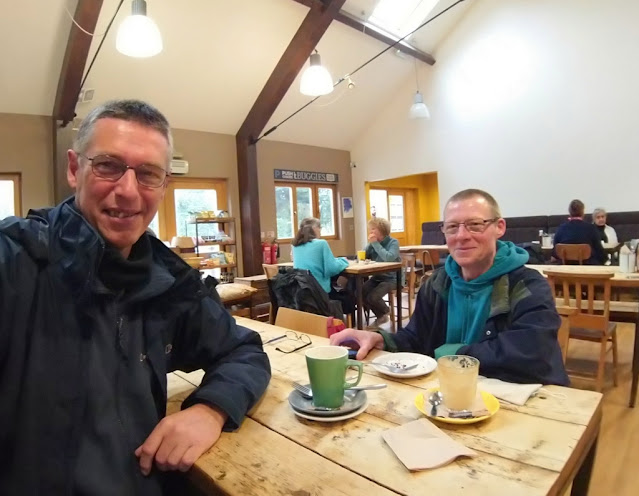
When the rain set in with a vengeance, we retired to the Ricky Aquadrome Café...

Old geezers can certainly pack away the chocolate brownie

I arrived at the arranged meeting spot quite early. While waiting for Ric to turn up I thought I may as well have a little mooch about, so pulled on my boots and reached for my bins. At which point I realised I hadn't packed them. Or my camera. Ah...

Ric saved the day by generously loaning me his lovely Zeiss Victory SF 8x42s. Cracking bins. Cheers Ric!

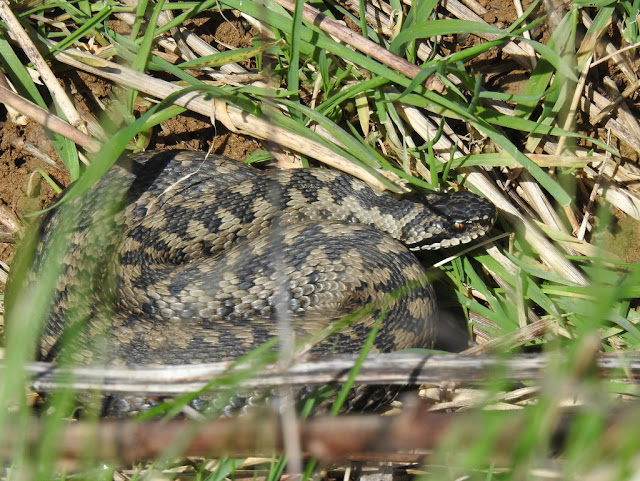
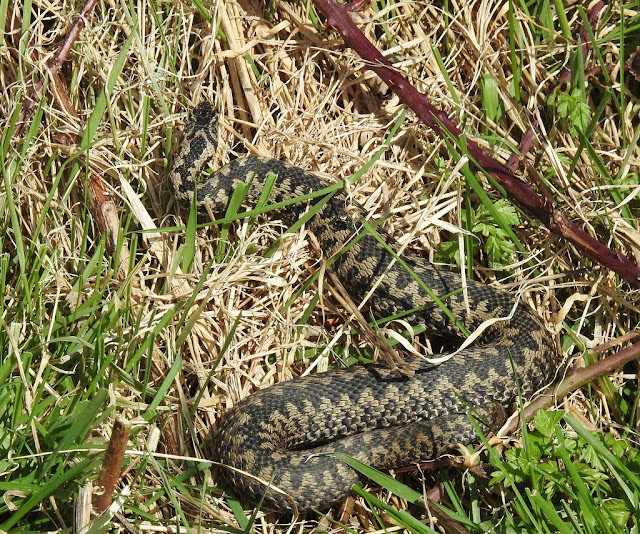
Oh. Almost forgot. Yesterday afternoon's highlight wasn't even a bird. A nice bit of sunshine got me thinking about Adders. Last year I didn't make much effort to see any, and was rewarded accordingly, i.e., with none. No such slackness this year though. Two beautiful specimens soaking up the March rays...

That eye!

I think this one was just sorting itself out here. I had another look later on, and it was coiled up nicely.

This afternoon's outing was a pleasant walk from West to East Bexington and back. Really there is very little to tell. Certainly I was not looking for Wheatears...

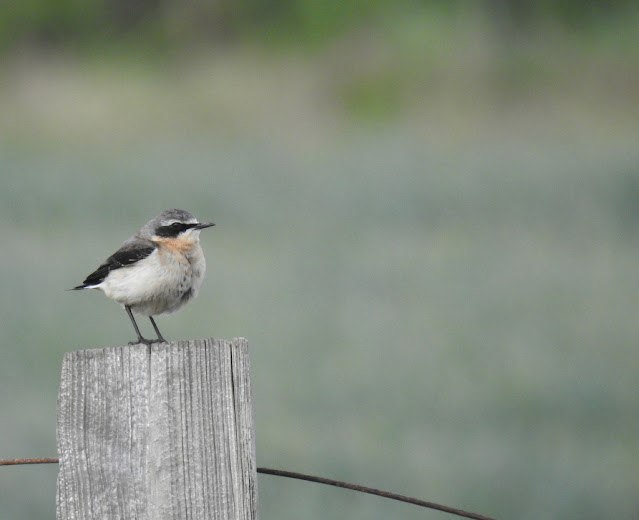
Male Wheatear, East Bex.

March 13th is my earliest Wheatear since I've lived in the Southwest. Clearly, the best way to find an early Wheatear is to not look for one.

Wednesday, 9 March 2022

A Small Springtime Challenge

This is going to be a slightly self-indulgent post, and little more than a reference library of early-March Rock Pipits. There is a reason though...

Rock Pipits breed along the local coast wherever there are cliffs. The cliffs fizzle out just east of Burton Bradstock, and Rock Pipit is actually quite scarce in the cliffless Cogden & West Bex recording area. However, they are a common enough sight on the clifftop grass and nearby suitable habbo. So I've given myself a modest local challenge: find a spring migrant littoralis (so-called Scandinavian) Rock Pipit among the resident petrosus birds. I have no idea what my chances are, but I am going to keep in mind an encouraging experience from my old East Devon patch, way back in 2009. Like our local cliffs, Beer Head has breeding Rock Pipits. But in the old days I would often find spring gatherings of 10+ birds there; my peak count was 15 on 7th April 2006. Frequently they would be feeding together in a loose flock, and at the time I puzzled whether these could really all be local breeders. Maybe some were indeed migrants? To be frank, I simply could not tell, because plumage-wise they all looked alike. There was absolutely no hint of the distinctive  summer colours of a typical littoralis. That is, until 24th March 2009...

24/3/09. These two digiscoped shots depict the only definite littoralis Rock Pipit I ever saw on Beer Head.

The pinky flush to the throat and upper breast, plus that grey head and diminished underpart streaking are pretty typical of sum-plum littoralis.

So that's what I'm looking for. In the meantime, here are a few I found today. Of at least seven [correction: six!] birds present I managed to photograph four [correction: three!] but all of them looked pretty much the same...


Bird 1


Bird 2 [correction: this is actually bird 1 again, despite being photographed about half a mile away!]


Bird 3 [correction: bird 2!]


Bird 4 [correction: bird 3!]


At present, none shows the slightest hint of littoralis-ness. Possibly because they are all petrosus. But whatever, I shall revisit and try again in due course. Let's see what happens.

Tuesday, 8 March 2022

The Lone Seawatcher & Other Tales

Up-Channel movement is a big feature of spring migration, and south coast seawatchers no doubt look forward to it each year. Well, those in Kent and Sussex. West Dorset is not quite the same thing. As well as the Channel being rather wide here, Lyme Bay is well off the main track anyway, so birds need a bit of encouragement to come within range. A decent wind can help. This morning's forecast was good. A strong breeze from somewhere a bit E of S. The West Bay shelter beckoned.

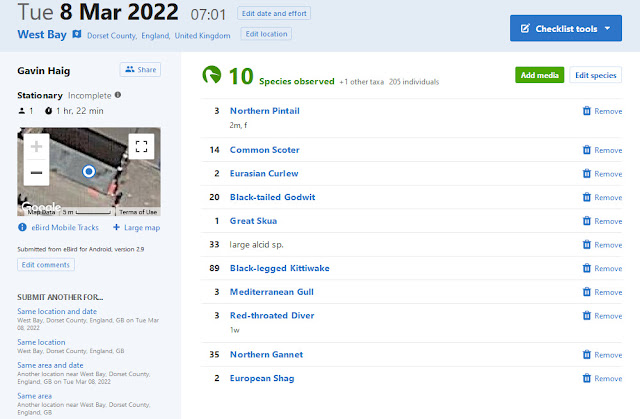
By 08:25 my tally included four new species for the #LocalBigYear list: Curlew, Shag, Bonxie and Black-tailed Godwit...

This morning's eBird checklist

To add a little context, I saw just one local Shag last year, and no Blackwits at all.

The first Shag was distant, but instantly recognisable. It's funny, a few miles west, at Seaton, Shag is a common sight. A few pairs breed on the local cliffs, and I've had the occasional three-figure count while seawatching there. But here it's all Cormorants, and Shag is scarce. The second bird was a nice, close adult; I could easily see the yellow gape.

The Black-tailed Godwits tested me somewhat. The perils of being a lone seawatcher...

By fluke I picked them up very early, well to my right. They were incredibly distant, just a speckled smudge which occasionally popped up above the waves. A flock of something. Auks? No, they look too small. Not ducks either. Waders? Yes, they must be. But definitely not Dunlin or similar, which would be invisible that far out. Bigger waders then. But what? There were 20 or so but I was struggling, and even zoomed right up I couldn't get anything on them. But as they came more level with me I began to see wing bars. And considering the range involved, these were very strong wing bars. The penny dropped. Black-tailed Godwits! Dashing flocks of Blackwits are a regular sight on the Axe, and they can certainly hammer along when pressed, like these were. But they are not a regular sight locally. In fact, that flock was only my second record. I would have appreciated a bit of company right then, one or two fellow seawatchers to discuss the ID with and confirm my conclusion, but I'm happy enough with it all the same. I'm fairly sure they're the first I've ever seen while seawatching, certainly since I've lived in the Southwest.

It was great to get some Pintail too (a pretty rare seawatching sight for me) and the early Bonxie. The forecast is promising more of this helpful wind, so I think it will be another early alarm tomorrow.

I am useless at predicting when conditions might be good for nocmig. Sunday night was clear, and I recorded a single Barn Owl, nothing more. When I switched the recorder on last night, conditions felt little different and I was not optimistic. Yet I recorded at least four (probably five) different Oystercatchers and a Curlew! Nice. Here's the best Oyc, condensed from about 75 seconds into 15...


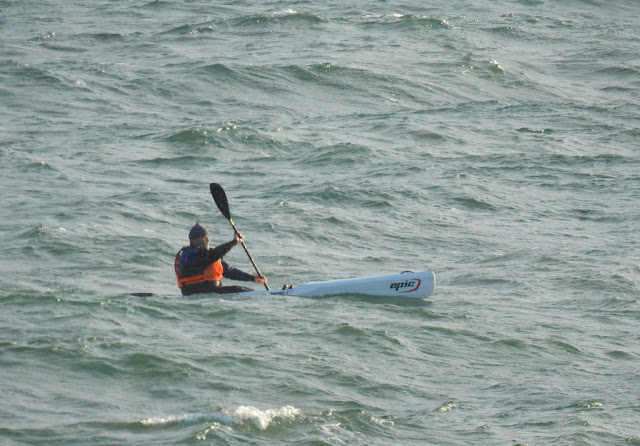
A late sortie yesterday afternoon yielded precious few birds, but there are other things than birds...

Rather him than me. The sea was rough and the wind strong. I wonder where he ended up?

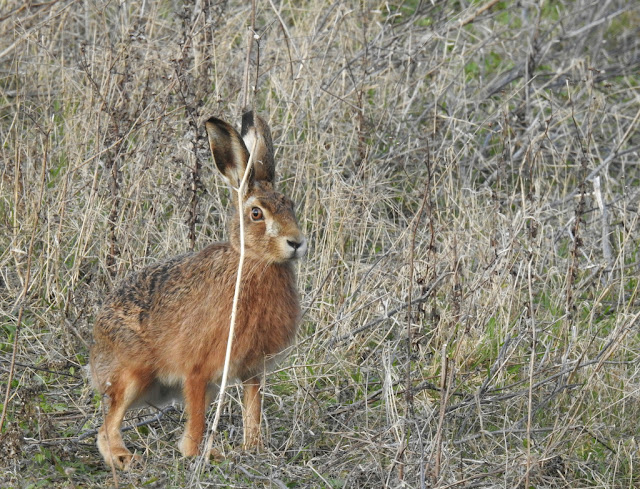
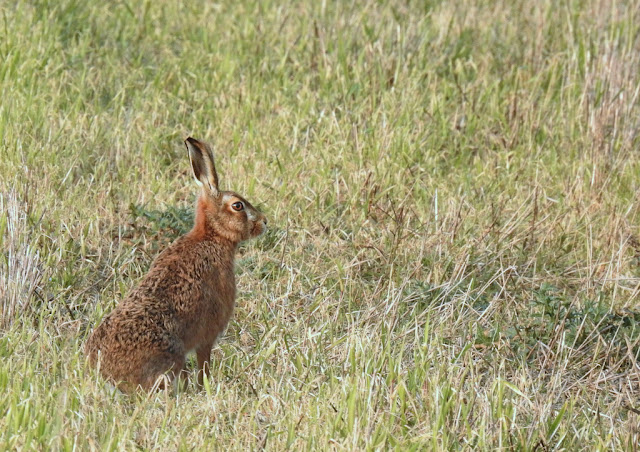
Having gradually come closer and closer, this Hare finally clocks me and freezes behind a handy bit of cover, virtually invisible.

Better than Rabbits