Pages

Saturday, 2 April 2022

Extra Helping of Jam

The last spring Ring Ouzel I definitely recall seeing was found by Karen Woolley on Beer Head in 2011. And I'm pretty sure that is the only E Devon or W Dorset bird I have seen outside autumn. Arriving at West Bex this afternoon I certainly wasn't expecting to find one, but within 15 minutes that is exactly what happened. I always have a good look at fields with horses in them, and usually spend a couple of minutes grilling a load of birdless turf. But not this time...

Ring Ouzel. It might have been right at the back of the field, but boy, what a welcome sight!

Judging by the brownish tint and off-white gorget, presumably a female.

Thankfully Mike Morse was close by, and got to see it as well. As I strolled on up the lane I was well aware that I had peaked a bit early! Still, there were a few bits and bobs...
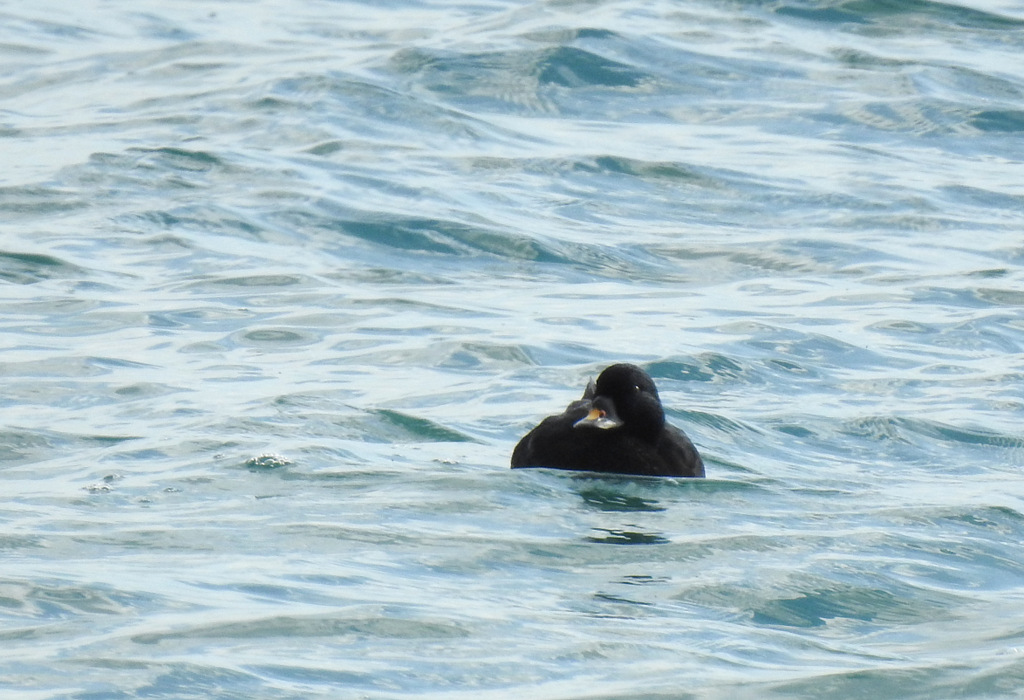
Rubbish light, but a very nice drake Common Scoter quite close to the beach.

The only Wheatears were four distant birds together...
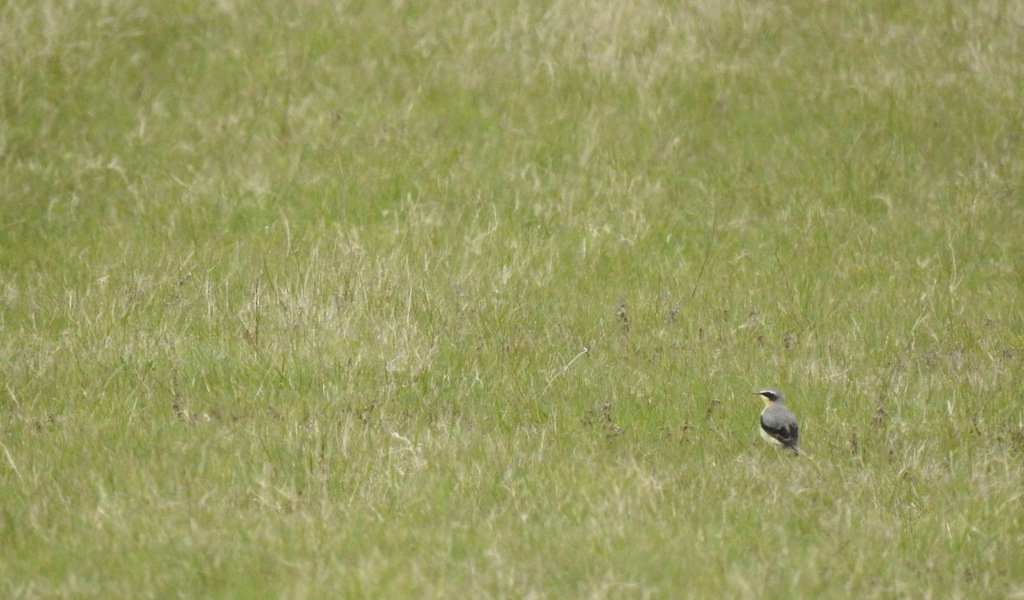
Small Wheatear, big field

On the way home I popped in to Bride Valley Fish Farm in the optimistic hope that I might finally see a Sand Martin this year. Nope. But four pristine Swallows were more than compensation...

Look at those immaculate tails!

To be honest, I didn't deserve the Ring Ouzel. Before even setting out for West Bex I had been handed what should by rights have been bird of the day. This is how it happened...

Last Friday week I sat down and worked through the previous night's nocmig recording. One sequence of calls had me stumped. I put it down as 'possible Wigeon', with a big question mark, and set it aside to review later. I did that last night, and immediately wondered why on earth I'd thought it might be a Wigeon. Could it be another duck that I wasn't familiar with? Pintail maybe? I checked Pintail on Xeno Canto. No, not Pintail. I tried a few other ducks (I won't embarrass myself by naming them) but drew a blank. Only one thing for it: ask the Nocmig WhatsApp group. I resolved to do so in the morning...

This is exactly how my mystery bird looked on the nocmig sonogram, those little blips at c2.0kHz

This is what those marks look like when stretched, cleaned up a bit, and enhanced...


So, this morning I posted the sonogram and recording on the Nocmig WhatsApp group. Literally within seconds (before I had even finished typing my question!) I had a diagnosis...

Avocet.

A couple of other group members said the same, and a quick visit to Xeno Canto confirmed the identification beyond any doubt. I hadn't even considered it might be a wader but, no question about it, at least one Avocet flew over my nocmig kit at 20:52 on Thursday 24th March! It is actually a really distinctive call, and my only excuse for not recognising it is that I never hear Avocets. They are seriously scarce (rare?) locally - certainly I have never seen one - and were just about annual on my old Axe patch. Needless to say, a bit of a nocmig mega for Bridport! Not super-loud, but this is what it sounds like...


Yes, I was already grinning from ear to ear as I stepped out of the door this afternoon. I didn't deserve a Ring Ouzel as well, but I'll take it. And very grateful I am too.

Thursday, 31 March 2022

Redwings

The nocmig kit has been out almost every night this month, plus 13 nights in February (from 6th) and Redwing has featured on most. Usually single-figures, but a good count of 76 on 2nd/3rd March, which more than doubled the 2021 spring peak of 30 on March 20th/21st. Still, nothing outlandish. On Twitter last night I noticed this from Jacob Spinks, assistant warden at Dungeness Bird Observatory...


A big movement of Redwings in SE Kent is hardly something I would expect to be mirrored in W Dorset, but, well...

Reviewing last night's nocmig, it was obvious that Redwings were on the move. By 21:00 I'd counted 12, by 22:00, another 93. And then it all kicked off, with 261 between 22:00 and 23:00, before drying up very quickly thereafter - just another 15 all night. In my experience so far, 381 is an exceptional Redwing count for spring.

A screenshot straight off my laptop. Exactly 28 seconds (from just before 22:30) and there are 11 Redwing calls visible there, ranging from pretty loud to almost inaudible.

The screenshot above illustrates what I would say is a typical bunch of Redwing calls. The screenshot below illustrates a very rare event: a Redwing appears to be screeching directly into the microphone from about two inches away...

 Yes, that is a Redwing at 4sec. A rather loud one.

As we all know, Redwings utter a high-pitched note as they pass overhead at night, a familiar sound to those of us whose ears haven't quite given out yet. However, what the sonogram clearly shows is that there are some quite strong lower-pitched elements to this call also. I am pretty sure I've never recorded such a loud call before, so this was news to me. And here is what it sounds like...


Pretty cool, eh?

Of course, all this unexpected Redwing activity poses a load of questions that I can't answer. For example, there have been very few Redwings around locally, so where were they from? From the Continent? Well, if so, how come the first few were passing over so soon after dusk? I thought it interesting that the Dungeness birds appeared to be heading SE accross the Channel. Were the Bridport birds doing likewise? If so, why? Were they aware of the impending northerly weather, and responding to some urge to flee from it? Or maybe they were from south-west of us (Devon?) and coasting rather than heading north, again because of the imminent weather? If none of the above, then what? Etc, etc...

All good fun.

Tuesday, 29 March 2022

You Just Never Know

A chap jogging along the West Bay seafront early this morning spotted me peering out from the shelter, and paused briefly. 'Much passing?' he asked. I thought it was nice that he had at least some appreciation of what I was up to, so gave him a comprehensive reply: 'Nah. Nothing. Completely dead.'

I lasted 31 minutes. Just as I was packing up, 2 Swallows came in off, my first of the year. Apart from them, my tally was 3 Shelducks, 1 Sandwich Tern and a Gannet. A light offshore breeze is hardly classic seawatching weather, but you never know...

And that's the thing about birding: you just never know.

Mid-afternoon I was free. There wasn't much local news to get excited about, but I wondered if the slightly damp, overcast conditions and light north-easterly might have held up a few migrants on the coast, so headed for Cogden. I stayed till 7pm. Hardly a soul about, it was perfect...

Cogden Beach this evening

Working my way across the upper fields I noted a few singing Chiffchaffs and two Blackcaps, and finally hit the beach at the eastern border of the Cogden recording area, where it meets West Bex. From the beach I gave the first stubble field in West Bex territory a cursory scan, and immediately spotted four Wheatears. Retracing my steps, I wandered over for a proper look. It was leaping with Wheatears! At least 19 of them! They appeared to be moving east, and most ended up on the beach eventually, not far from the West Bex Mere.

I have a feeling there will be a lot more Wheatear photos before the year is out


There were a few diversions offshore...

Two Red-throated Divers


Sandwich Tern successfully hangs on to its tea

It was nice to get a few flight shots, despite the rubbish light


And at the back of the beach, a handful of Chiffs in the scrub...

Chiffchaff, fresh and hungry

Heading back towards Cogden, Wheatears again...

I will never tire of seeing Wheatears on the beach. Just brilliant.


As always, they were a pig to count. On this occasion though, I had some help. A couple of dogwalkers came up from the strandline and gradually flushed every Wheatear in one particular flock I was struggling with, so I simply counted each one as it flew. The day's final tally was 36, which is easily my highest ever Wheatear count in March.

If pressed, I would have predicted that today's weather looked good for dropping a few migrants (Wheatears included) on the coast. However, I would not have predicted that number. This is why migrants give me such a buzz, even the common ones. Yes, migration happens every year, without fail. Yes, it is basically the same species every year too. But when it comes to locations, dates, times, numbers...

Well, you just never know.

Brilliant, isn't it?

Sunday, 27 March 2022

In the Absence of Pink

A family day with small granddaughters has meant birding within buggy-pushing range, so at least the local Yellow-browed Warbler got a quick visit. After that it was all down to the garden. Thanks to an afternoon heads-up from Mike Morse in Bridport, I was suitably alert when this flew over...

Third garden Red Kite of the year

And so to the main topic of this post: littoralis Rock Pipits...

In THIS post (dated 9th March) I wrote:

'...I've given myself a modest local challenge: find a spring migrant littoralis (so-called Scandinavian) Rock Pipit among the resident petrosus birds.'

My idea was that this would involve finding a littoralis in summer plumage, i.e. with pinky flush to throat and upper breast, much grey on the head, and diminished breast streaking. So far I have failed to do that. However, I do seem to have found a few 'probables', and I get the impression one or two NQS readers think so too.

But 'probable' littoralis is no good at all. 'Probable' is one of the worst words in birding. Any bird saddled with it might as well not have bothered showing up at all. Understandably, I want a 'definite' littoralis. But surely there's no way that can be done without pinkness? Well...

A littoralis Rock Pipit's summery glow is attained through its pre-breeding moult. Pipits & Wagtails by Alström et al* has some interesting stuff to say about the pre-breeding moult of Rock Pipits (which largely takes place January to March):

'In littoralis on the Swedish west coast most individuals moult at least 50% of the head and body feathers (mainly crown, mantle and breast). These birds frequently also renew 1-3 pairs of tertials and the central pair of tail feathers, and occasionally a few median and inner greater coverts.'

'The moult of petrosus is either absent or limited to a few feathers on the crown, mantle and lower throat/upper breast...'

Although the authors don't state how many petrosus they examined, they came across just one which had renewed any wing or tail feathers at all (the central pair of tertails) in its pre-breeding moult. In other words, a spring petrosus Rock Pipit is very unlikely to have new tertials or central tail feathers. To put it another way, any spring Rock Pipit which does have new tertails and/or central tail feathers is almost certainly going to be littoralis, and likely this will be evident in extensive head and body moult too. Which brings me to Rock Pipit #10.

I first came across Rock Pipit #10 on 15th March, then again on 20th. Here is a collage of those two encounters. Note the yellow arrows...

Rockit #10

The top two shots show five days of growth in the central left tertial, and the bottom two highlight the central tail feathers and central right tertial. All moulted and in active growth. This bird is undoubtedly NOT petrosus.

In addition to the wing and tail moult, #10 was strikingly pale below. On 20th March it was on a sunlit slope with another Rock Pipit (which did a bunk before I could photograph it) and noticably had much paler underparts...

From a distance this bird positively glowed in the sun

Despite absence of pink, I have absolutely no qualms in calling this a definite littoralis Rock Pipit.

I'll be honest, I had no idea that evidence of pre-breeding moult in wings and tail might be a key factor in separating spring littoralis from petrosus. Clearly it is, and learning this fact has been a game changer for me. I've yet to see any Rockits quite like #10 though, which incidentally has not reappeared since 20th March. I suspect it is in Sweden right now, going pink.


* I am indebted to Kev Thornton for kindly providing access to his copy of Pipits & Wagtails.

Saturday, 26 March 2022

A Beautiful Afternoon

Birdy stuff is happening thick and fast, so here's a quick update before it all gets out of hand...

An afternoon visit to Rockit Land has done my head in a bit. I found five birds and got photos of them all. This evening I've been trying to match them to the previous 13 (and it is 13, not 14 - the bird in yesterday's post is actually #1 again, my only definite petrosus) but without success. I cannot believe it was five new birds today, but there is only so much looking at Rock Pipit photos a person can take, and I need a break now. It definitely is possible to tell them apart from photos, but it ain't easy!

I am finding that a good shot of the tertials is probably the most useful pic.

Also in Rockit Land was my first Burton Cliffs Wheatear of the year...

...and my first female.

Here it is in context. Taken from a clifftop field overlooking the splendid shower block of Freshwater Beach Holiday Park, with the B3157 coast road passing the western outskirts of Burton Bradstock village in the background. The road was very busy. Judging by the noise, a fair few Harley Davidsons had been dragged out into the sunshine this afternoon...

Wheatear circled


 Next, I headed inland to a spot where at least two Green Sandpipers have spent the winter...

Green Sandpiper

Even at considerable range the bird in that photo was looking very twitchy, nervously bobbing up and down. I find it really difficult to get anywhere near them for a close-up photo, but today I spotted an opportunity. It involved crawling on hands and knees, then on my belly, wriggling into position behind a little clump of sedge. I shuffled sideways until the camera was free of sedgy impediments, zoomed in and fired away...

Without the help of a hide, this is probably the best shot of Green Sand I'm ever likely to get.

At this point I bumped in to West Bex stalwart Alan Barrett, and together we headed to Puncknowle WRC to see if any Chiffs were still in residence. At least two or three birds present, but no sign of the wintering Sibe Chiff. As we stood there chatting, Al alerted me to a raptor flying east up the valley. It was not much above head height from our position up the hill, and gliding along at an unhelpful angle, but didn't look quite right for a Buzzard. Was that tail a bit too long? It was steadily going away, but at the last minute twisted in the air and dropped behind a hedge, presenting us with the gloriously dark upperparts and cream crown of a female Marsh Harrier. Yesss! If my sums are correct, that's #LocalBigYear bird number 115.

With things going so well, it seemed obvious that I should visit the Bridport Yellow-browed Warbler before calling it a day. As far as I know, the classiest bird within ten minutes' walk of my home. How could I not say hello once more?

If I don't get a better shot to remember it by than this one, I shan't care.


I am frequently amazed at how deftly the autofocus on my Nikon P900 is able to thread its way through a forest of twigs and foliage, and find the bird. Impressive. As I stood there alone in the late-afternoon sunshine, papping away like a togger at one of the smartest little warblers to draw breath, the unwelcome thought that I'll be getting an hour's less sleep tonight was far from my mind...

Friday, 25 March 2022

Pipits & Wagtails

Not too much time for birding these last few days, what with all this lovely sunshine and the need to make hay. But I did manage a short session in Rockit Land on Wednesday morning. Again I really struggled to find some. Two or three at most, and so-so photos of just one. I can't find a good match among the birds photographed so far, and reckon it's probably a new one...


I wonder why I'm struggling to find them in any numbers all of a sudden? Have they got a new favourite hang-out? Somewhere I'm not looking? Or, have some of them moved on? Towards...er...Scandinavia maybe? Anyway, I'm not done with them yet, so will keep at it.

After work yesterday I called in at a local spot with some water, hoping for a Sand Martin or two. It was a peaceful evening, and I watched the setting sun turn a beautiful red as it bowed out of the day. No Sand Martins, but there were several Pied Wagtails to pick through instead.

I always enjoy hunting for White Wagtails among the Pied in spring, but it looked like I had drawn a blank this time. It was 18:15, and the light dimming fast, and then one bird finally did catch my eye. Not in the usual way, i.e. because of an obviously pale mantle, but rather because its white bits were so clean and bright. Its mantle, in fact, seemed to be a surprisingly dark shade of grey...

I never saw the rump, but the somewhat limited (and pale) grey wash on the flanks is a good sign

The solid black nape suggests a male but, as I learned in the paper 'White Wagtail and Pied Wagtail: a new look' by Adriaens, Bosman & Elst (Dutch Birding 2010), only a fool is dogmatic about alba Wags. Here is yesterday's bird compared with a West Bex peach from 2nd April last year...

Yesterday's bird (top row and middle right) and West Bex White Wagtail (bottom two and middle left)

Let me share a gem from that Dutch Birding paper.

Mantle shade (on Kodak Grey Scale): yarrellii (10-18), alba (7-12)

And scapular shade: yarrellii (10-18), alba (7-11)

The paper defines 11 as 'dark grey' and 12 as 'very dark grey', and certainly a quick glance at a Kodak Grey Scale supports those definitions. The point is, of course, that there is overlap between the two races. So, purely on the basis of mantle/scaps colour, my bird yesterday might be a pale Pied or a dark White. I'm going for White. And I might even be correct.

Really though, the bird's actual identity is immaterial. Yet again, a common species has given me a lot of fun. And that'll do nicely.

Wednesday, 23 March 2022

Bridport BirdFest

Yesterday could only be described as unusual. It began in fairly standard fashion, with a West Bay seawatch. And one of the very first birds through was an Oystercatcher. Again, normal enough, even if it was my first (non-nocmig) Oyc of the year. But, then...

Er...

I am fairly certain that no other birder in the northern hemisphere wrote in their notebook: 'Black Swan 2E at 06:35'.

Next on the oddness agenda was a local tick that I never in a million years would have predicted might fall in March. On Monday afternoon, a snippet of second-hand news from Kev Hale and Luke Phillips that a Yellow-browed Warbler had been seen by our local Co-op, a mere ten-minute walk from my home. I wasn't able do anything about it at the time, and mentally wrote it off. I could not imagine such a bizarrely unseasonal bird being so daft as to stop for another day. Well, it did...

Yellow-browed Warbler. It was close, but an absolute pig to photograph.

A 'nearly' shot...

...and another.

And it was still present today. Bonkers!

However, yesterday's most unusual event took place in the evening...


This blog doesn't often feature pics of actual people, but NQS readers may remember this photo from a few weeks back...

Inaugural meeting of the Bridport Bird Club

The Bridport Bird Club is the brainchild of Tom Brereton and Pete Forrest, and last night's presentation its very first gig. As the flyer indicates, the presentation showcased the Bridport area's bird life, principally as revealed by an extensive survey of its breeding birds, with additional data provided by a...er...Bridport-based nocmig site, as well as the casual records of local birders. The upshot of all this will be a proper bird report, out in April I think.

All credit to Tom, for arranging the event, inviting an interestingly eclectic audience, and persuading the likes of me to stand up in front of total strangers and talk about nocmig. Quite a night.

The following photos are all Tom's...

The Bridport area has very few Dippers, and they are among the most easterly in the UK. Luke Phillips enthused us all with his ideas about how our local population might be helped to grow.

The Tiger Inn's Alley Bar, and an awful lot of people.

Earnest bloke does his best, bless 'im.

Tom's talk about the census of Bridport's breeding birds was absolutely fascinating, but alas there is no photo. I have a feeling this might be the start of something...