Pages

Saturday, 17 September 2022

Migration's Little Prizes

This afternoon I walked an 8+ mile circuit from West Bexington to Abbotsbury Beach and back. Being mid-September, and bang in the middle of autumn passage, I expected a bit more than the 8 Chiffs and 2 Yellow Wagtails that I got. Honestly, apart from hirundines, no other migrant birds. On the other hand I counted 19 Clouded Yellows, and the landscape was peppered with Large Whites. Migration isn't all about birds.
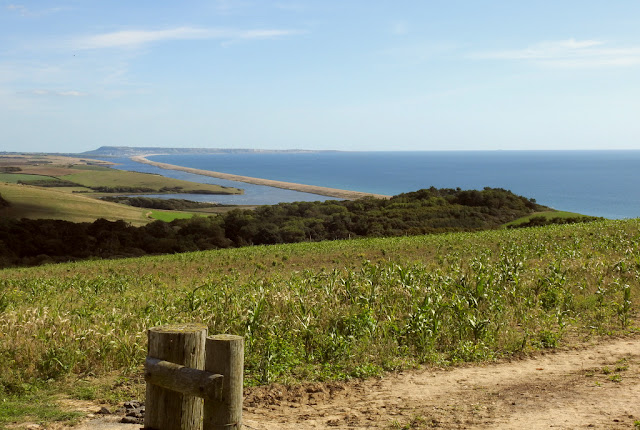
Looking east from the edge of East Bexington. Abbotsbury Gardens below, then the Swannery, the Fleet and Chesil Beach, and Portland curving away in the distance. Ghastly.

This pristine Red Admiral had just been prodding at some over-ripe Blackberries.


Rewind a few days, and things were a lot different. According to eBird, my comprehensive search of Cogden covered just over 9 miles. And it felt like it. I am out of shape, and was knackered. Too much time hunched over a moth trap and not enough shingle-bashing. Anyway, 43 Wheatears was a record count for me here, plus 13 Whinchats, 12 Chiffs, 2 Goldcrests, and singles of White Wagtail, Willow Warbler, Spotted Flycatcher and Lesser Whitethroat. Lots to look at, and it felt like something special could pop out any second...
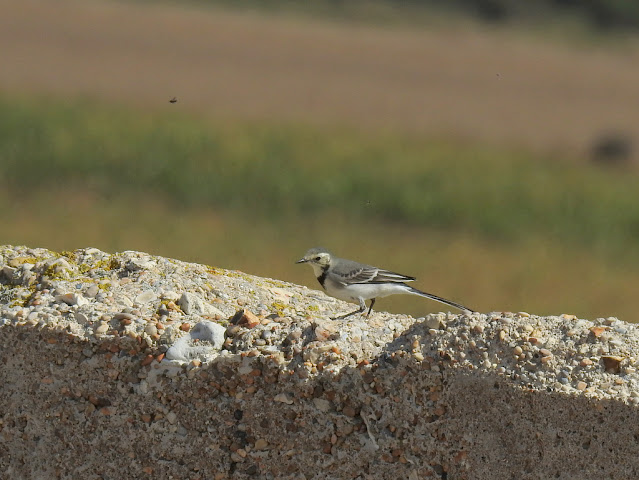
The White Wag found a feast of flies around this big lump of beach concrete.

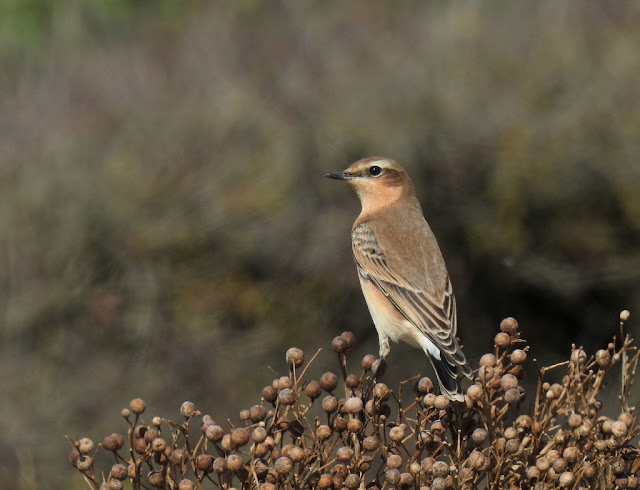
This Wheatear really does not look comfortable.

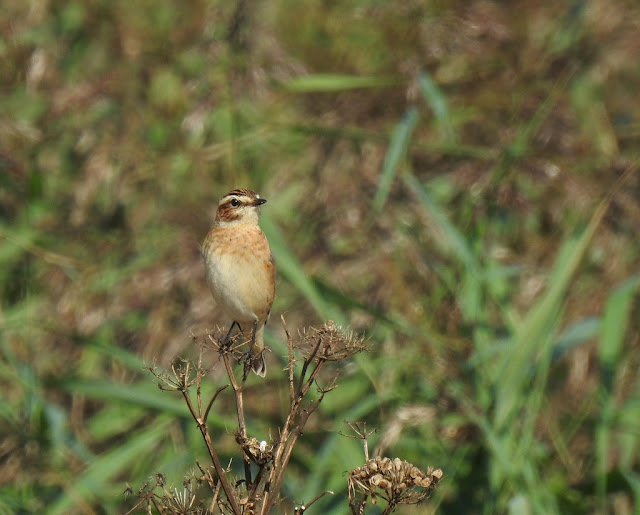
Whinchats are always good value. But, as is usually the case, this one would not allow close approach.

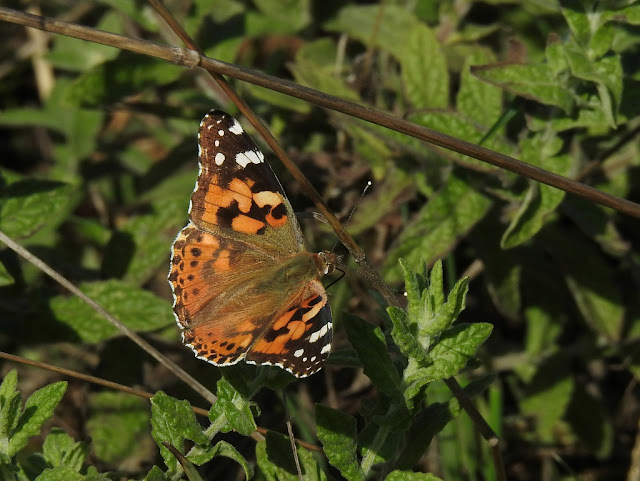
Like today, birds were not the only migrants around. I didn't count properly, but certainly 20+ Clouded Yellows. But just one Painted Lady...

Any patch of Fleabane was worth a quick check.

Once again there is a Fleabane flower involved, but tucked out of sight this time.

However, the smartest Cogden migrant that afternoon was neither a bird nor a butterfly...
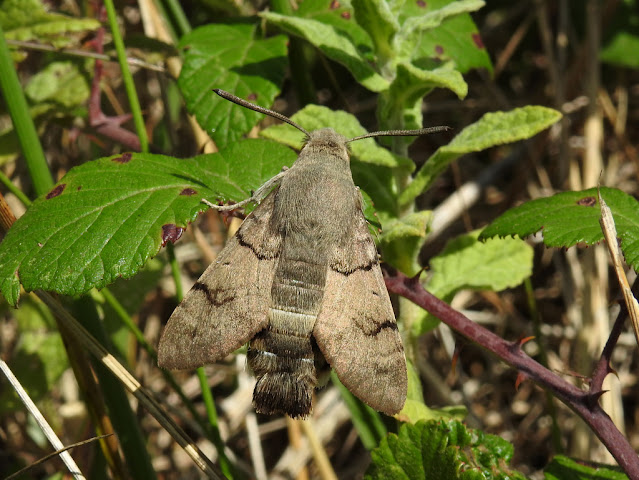
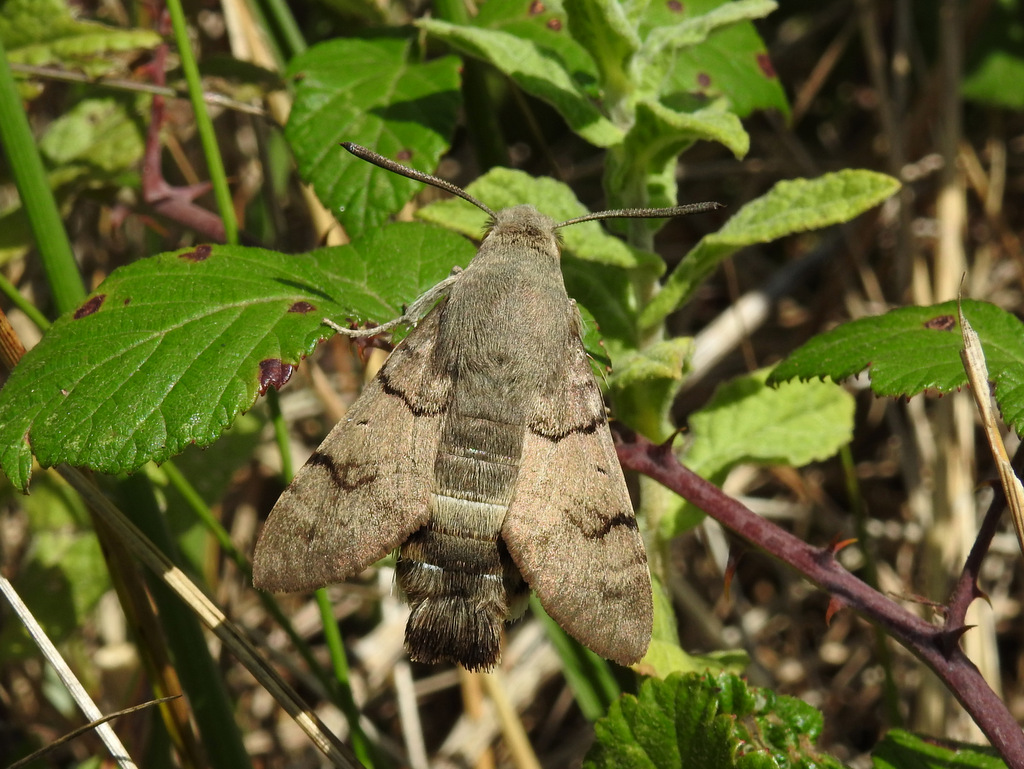
Hummingbird Hawk-moth at rest.

It was right on the coast path, and flushed from its initial resting spot as I walked by. Thankfully it didn't go far. I honestly cannot recall ever finding one perched up like this. A rare treat.

Before I leave the subject of migration I must mention nocmig. Apart from a few days off earlier this month (rain, wind, apathy) the nocmig kit has been deployed almost non-stop since forever, but the autumn birds have been rather few and far between. If a highlighter pen were to scan the last several weeks it might be tempted into action by 2 Green Sandpipers, a Sandwich Tern, a definite-ish and 2 probable Pied Flycatchers. Otherwise it has been routine bits and bobs, and not many of them. And then last night there was this...
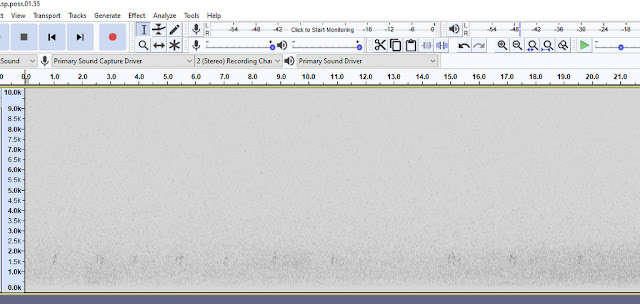
See those tiny blips around 1.5kHz?

The sonogram above is edited from the original, where each blip was separated by several seconds. It has also been cleaned up a bit, noise-wise, so that they stand out more obviously. They went on for more than two minutes, but I must confess to missing the first few initially. Thank goodness I didn't miss them all. I suspected what it was, but sought (and duly got) confirmation from the nocmig WhatsApp group. I give you: one faint and distant Pink-footed Goose...


Needless to say, a nocmig tick for me here in Dorset, where Pink-foot is a description species. The first Pink-footed Geese have been arriving in numbers at many sites north of Watford, and it is easy to imagine one or two over-enthusiastic individuals pressing on a little too far, especially with a bit of wind-assist. Yesterday, for example, one turned up at Abbotsbury Swannery. I would love to know whether it was that bird which flew over Bridport at 01:55 this morning.

Last night was cold and clear, and the moth numbers nosedived. Just 20 in total, and nothing new. Our last migrant tick was on Wednesday night...
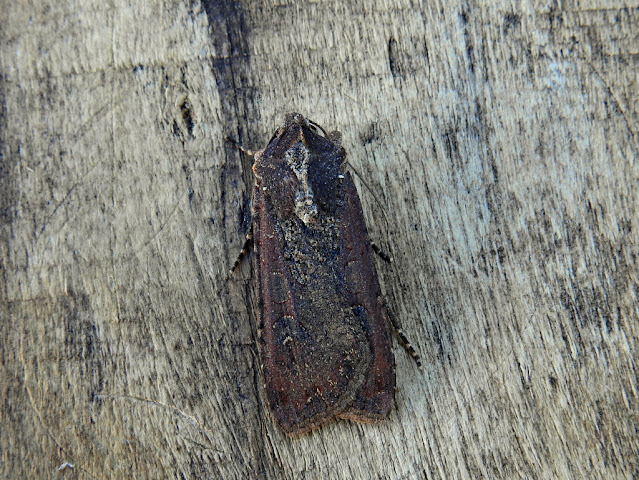
Pearly Underwing. Quite a big moth, and momentarily I almost dismissed it as another Large Yellow Underwing. And then I noticed its grey Mohican.

Of course, it's not all about migrants. Plenty of other moths have forced me to photograph them...
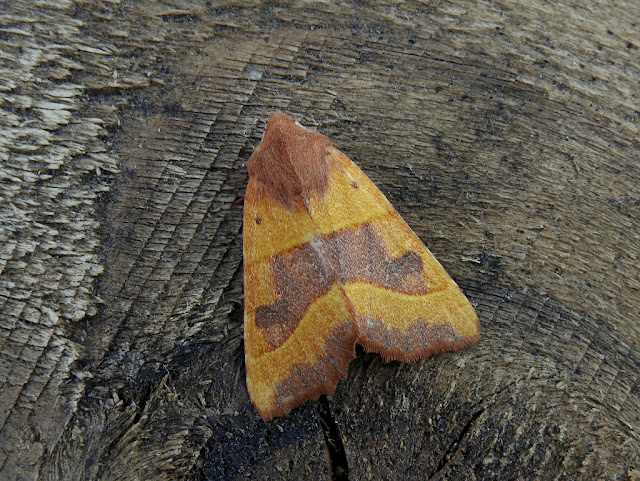
Nice, fresh Centre-barred Sallow.

Another Blair's Mocha. Very prominent spots on this one, and a gorgeous deep colour.

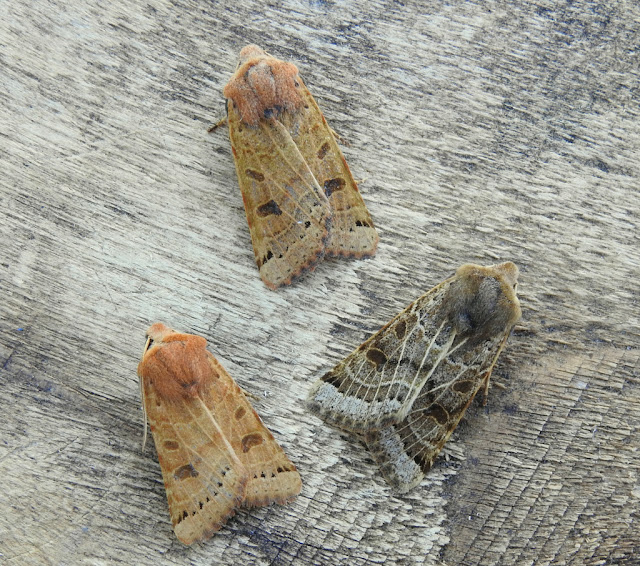
Trio of Lunar Underwings from last night. Quite variable, aren't they? I love that beautiful stripey one; shades of Feathered Gothic.

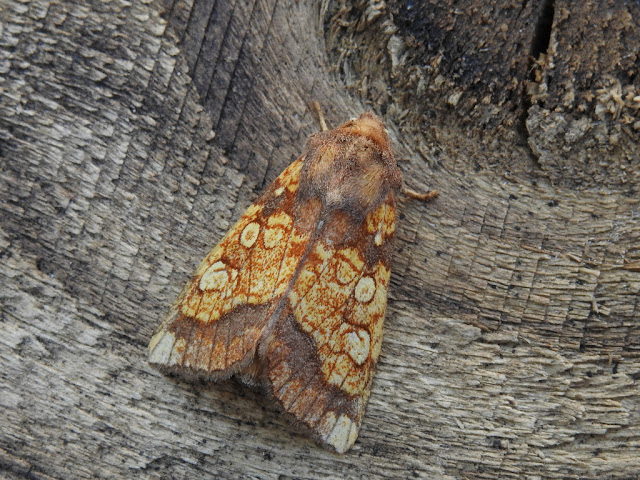
Our second Frosted Orange. Another cracking moth.

The stripey Lunar Underwing definitely deserves a leaf shot.

So there it is. A few of migration's little prizes, plus some regular moths. Chief prize was the Pink-footed Goose of course, and I didn't even have to see it to enjoy it. In fact the whole fascinating process of editing, analysing and investigating that nocmig event galvanised me into doing something I should have done more than a week ago.

On September 10th, at 01:48, a small bird flew over and went 'tew'. I cut out and saved the call, made some preliminary investigations, but ran out of steam. Well, I'm back on the case now. We shall see...
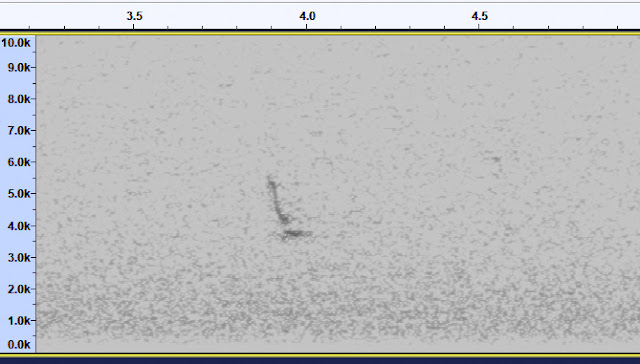
'Tew'

Tuesday, 13 September 2022

Context

'Context is everything,' said someone, somewhere, once. When it comes to birding - and probably any other wildlife-related pursuit - how true that is. On a work trip to the States many years ago, it was a novelty to see American Robins everywhere. But if one of my colleagues had mentioned that there was an American Robin hopping about on the hotel lawn back then, I would likely have raised a mildly interested eyebrow, made 'how interesting' type noises, and turned back to my Happy Hour cocktail. American Robin? Pah! Common bird.

How different my response when one was discovered at Turf Lock on the Exeter Canal some years ago...

Apologies, but it has been a while since this photo last got an airing.

It is fascinating how a bit of context can have us reacting so differently to the very same bird. On a less dramatic level, the pleasure we derive from everyday local birding is also heavily influenced by context. On the Axe Estuary at Seaton, most Redshanks will get little more than a cursory glance, but a fly-by at Cogden would be watched the whole way past, and enjoyed on a different level. Are we somehow calibrated to appreciate stuff all the more if it is not the norm? If it is scarce? I'm not sure, but it often feels that way to me. I've noticed it even with something as intangible as the aesthetic appeal of a moth. It might be just a common species but its beauty elevates it to another level, and there is a correspondingly increased pleasure. For a while, anyway. But after you've seen a hundred of them...

On Sunday morning I peered out to sea from Cogden Beach and noticed a gang of Gannets going by. Then another, and another. Within a very short time I was up to 50-odd. It was about 07:00. With hindsight I wish I had sat down right then and started counting. Almost an hour later I could see they were still going strong, and made a 20-minute count. Unfortunately the movement began to fizzle out about ten minutes in, but 148 in 20 minutes was still a respectable figure for here. I cannot recall the last time I saw such a good passage of Gannets locally. And there it is. Context. I am sure we subconsciously do it all the time, i.e., compare what we experience with what we know to be normal - whether numerically, aesthetically, or in some other way - and adjust our pleasure level accordingly.

I do find this kind of nonsense quite intriguing, but anyway...

Gannets moving...

...and Gannets not moving. Sadly there were several new corpses.

Although I felt compelled to photograph the dead Gannet as a token record of this Avian Influenza disaster, for some reason it felt right to make the shot as 'arty' as my abilities could manage. Even a dead Gannet deserves a bit of dignity...

Also moving that morning were Meadow Pipits. I counted 23, the first signs of what will hopefully be a decent autumn passage. Likewise, 3 Pintail E were another signal that the year is bustling on regardless. A Cogden Redstart on Saturday afternoon - a male too - was probably the nicest (context!) bird of the weekend for me. Also the most unhelpful, photographically speaking.

Talking of photographs, here are a lot of moths. The captions give context....

This little migrant has been an occasional visitor to our trap.

Amazingly, our 7th(!) Convolvulus Hawk-moth. Prior to August 19th I had seen just one adult in 63 years!

So far we haven't caught one of these. I found it while working in Seaton yesterday. Pots are always at hand these days!

Blair's Mocha last night. The first time we caught one I was all excited at bagging such a scarce migrant. Except it isn't. Not in Bridport anyway - it breeds somewhere nearby. We have caught several now, and though I am less excited (context again) I am still blown away by the depth and complexity of their subtle markings. It's like thick, multi-coloured face powder.

Blair's Mocha from the night before. Even better, with its intense colour and tiny, white discal spots.

Our first Feathered Ranunculus. Being early in its flight season I hope we get some more of these peppery green beauties.

This is a male. We've not had many, and unfortunately the hindwing pattern - its best feature - is only hinted at here.

Orange Swift. We've had a few, but this is darker than most.

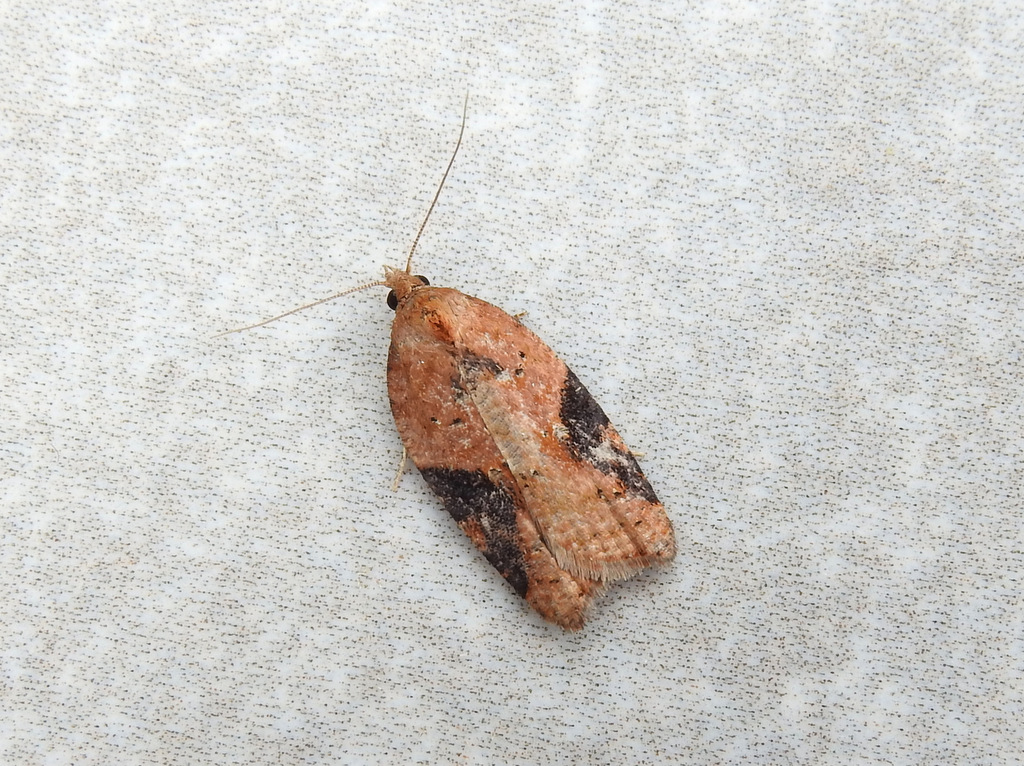
I caught this stunning little item on the mouth of the trap and instantly assumed it was going to be rare. I mean, just look at it! But no, dirt common apparently. It fled the studio and pitched up on the lid of the linen basket. But needs must...

Although plenty have been caught to the east of us, there seem to be no Bridport entries on Living Record, and very few in this corner of Dorset. So, locally, the rarest moth in last night's catch?

I needed help with this one. However, like so many other times, a fairly easy micro to ID when you know where to look. Not many Bridport records, it seems.

In my defense, it is tiny. Hand lens essential.

An annoying one. It is either Endothenia gentianaeana or E. marginana. I must admit to losing interest a bit when I realise the ID is beyond me. Ah well, at least I can enjoy its intricate patterning.

An even more annoying one. Apparently too worn to ID. And in this case I don't even know what the potential options are. Six millimetres of frustration. I released it with gritted teeth this evening...

In many areas of natural history it does not overly bother me that I am unable to name things. But when I am putting in a bit of effort to try and do exactly that...well, yes, it does bother me. Not knowing what a thing is puts context out of reach, and for some reason I find that difficult to deal with. Probably I need help...

Sunday, 11 September 2022

Bringing Back the Beaver...to Dorset

A recent 'good read' is this...

I finished it a few weeks back, which was rather timely.

The author, Derek Gow, has been advising the Mapperton Estate team on the reintroduction of Beavers as part of its rewilding project. I knew this was planned for some time in 2022, but not exactly when, so it was a nice surprise to receive an invitation to come along and witness the arrival of the Mapperton Beavers first-hand on Friday...

The enclosure is massive, and looks pretty robust. Trail-cam installation in progress.

And here they come. The crates are steel, obviously.

Approaching the release point.

Mapperton Beaver

Onlookers getting a close inspection.

This one was slightly smaller, the female I assume.

What those photos do not convey is how enormous Beavers are. In the flesh they are truly impressive beasts. Apparently both are mature adults, with the heaviest weighing in at some 21kg. I was expecting to see something akin to a fat Otter, and was rather surprised to see a pair of small bears emerge from the crates!

Also not evident in the photos is how dark it was down in the bottom of the enclosure. So dark that I thought it wiser to film the actual release rather than bother with photos. I'm very glad I did. There was some concern that they might bolt from their crates. Thankfully no. This is not bolting...


I am really looking forward to seeing how they get on.

These are not the only Beavers in in the county. Another project has been running in West Dorset since early last year, and already that pair has bred. I did check online to see if the location is named. It isn't, so I shan't mention it here. Hopefully the Mapperton Beavers will be as quick to multiply...

Friday, 9 September 2022

Stripes

At 20:45 on Tuesday evening I caught a Convolvulus Hawk-moth nectaring on the garden Nicotianas, and five minutes later missed another. This is getting ridiculous! That's five now...

Convolvulus Hawk-moth #4

I expected great things that night, so 20 moths of 12 species was a bit of a come-down on Wednesday morning. With the weather forecast a bit dire I didn't put the trap out at all on Wednesday, but tried again last night. It was just 20:15 and I had barely fired it up when yet another Convolvulus Hawk-moth appeared at the Nicotianas! I got a short video before it flew off, and five minutes later it (or another) put in one more brief appearance. Unfortunately the video is dreadful. You can see what it is, but I'll spare you.

Once again I assumed the appearance of such a nice migrant early on was a good sign, so loitered by the trap for a while, and kept popping out to it through the evening. But it was really quiet. Before I went indoors for the final time I lifted the lid. One Square-spot Rustic was visible, plus I knew there were a couple of Large Yellow Underwings in there somewhere too. And that was about it. So I really expected very little this morning.

Shortly after 06:20 I placed the trap carefully on my work-bench and lifted the lid. And had a small heart attack...

Striped Hawk-moth. Top tray in the trap. Top moth!

Back in the late spring, this moth was on Twitter almost every day. There had clearly been an influx of Striped Hawk-moths, and many were catching them. As a non-moth-er, all I could do was gawp at the gorgeous photos. I knew that the chances of stumbling across one outside of a moth trap were slim to zero. When I finally did succumb to the Dark Path, this lovely creature was at least partially responsible for my fall. And Striped Hawk-moth has been at the top of my most-wanted list ever since. 

And now, after 80-something nights, it has happened.

Some pics...

A hint of rosy pink on the hindwings.


As the photos suggest, this moth is every bit as lovely as you can imagine. We have caught some fantastic moths this summer, but I reckon this one tops the lot for looks. Absolutely stunning.

Striped Hawk-moth

But it didn't end there. Another four new species for the garden...

Lunar Underwing. Evidently an autumn moth, so I suspect this might be the first of a few.

Cypress Pug. An easy one to ID, and very nice too.

Vestal. Another migrant moth. A pink stripe on a creamy background is more usual. I've never even seen a photo of one with so much pink on the wings!

One of those annoying moths that might be one species or the other. Acleris laterana/comariana

So there it is. On the off-chance that any readers are contemplating the plunge into Darkness, just keep returning to this post on a regular basis. Or not, if you are determined to resist.