Pages

Saturday, 29 February 2020

Please Make it Stop!

Today marks the end of meteorological winter. What it doesn't mark is the end of this wet and windy weather. It feels like the rain has barely paused in four months, and the start of spring will see no let-up. Bo-o-o-o-o-oring! I am really tired of it. Instead of a nice beach walk this afternoon, the prospect of a chilly battering, heavy showers and clouds of spray encouraged me inland to Kilmington WTW on a Sibe Chiff quest. How were they doing since my last visit?

Conditions were poor. The strong wind mostly kept birds out of the boundary hedge and down on the filter beds, so viewing was quite distant. Bright sunshine made the Sibe Chiffs slightly less easy to separate from some collybita than normal, but there were certainly at least two still...

1. Sibe Chiff in typical dining area.
2. Pretty sure I've photographed this one before...
This photo taken 15th Jan. I could be mistaken but I think it's the same as the bird in photo 2.

It was very difficult to assess exactly how many there were though. Two is the most I've seen previously, but it wouldn't be a shock to learn there were actually three or four birds. Today they were generally just too far away for the sort of photos which facilitate recognition of individuals. And they were flighty as anything. The revolving sprinkler arms ensured all the Chiffs were constantly buzzing about to avoid an impromptu dousing.

Midweek visits to the Axe at 'lunchtime' have been disappointing. Med Gulls appear to have resumed their pre-123 levels, with just two or three at a time, and Lesser Black-back passage was negligible. Up until a month ago I needed only to glance at a group of big gulls for a Casp to throw itself at me, but again we are back to normal. All very humdrum...

This blog has been quiet for a few days too. I think the relentless weather is dampening all sorts of enthusiasms just now. Mind you, I've no right to whine about it. At least we're not flooded out like some. That must be just so awful...

Sunday, 23 February 2020

Spray

There are lots of advantages to reaching 60 years of age. Free prescriptions is one. The many others are eluding me right now... But anyway, the disadvantages are very, very few. In fact I can only think of two or three hundred, but one of the worst - and easily on a par with 'vastly reduced amount of remaining life' - is the need for specs. If you are one of those fortunate enough to be old and yet specs-less, I envy you. But don't get complacent. There is still time...

I remember the carefree days of 20/20 vision. As a youngster, happily prancing around in a world of crisp, focused clarity, I had little appreciation of what my specs-wearing friends and relatives were having to put up with. And then one day I realised I could no longer read stuff. You develop little tricks. Holding things up to the light, or at arm's length, or squinting hard enough to compress your increasingly reluctant eyeballs into some kind of working shape. But there soon comes a time when all these dodges are futile, and you get your first reading specs. That was some time in my 40s. You start with +0.75 and speedily work your way through bigger and bigger numbers. It is crushing. When you first try reading specs it's amazing. Print is suddenly BIG and BOLD again. You think 'Wow! These'll do the trick!' but all too rapidly they don't, and it's time for an...er...upgrade.

This was back in my digiscoping days. I could bird specs-free all day long, until I needed to use the camera, because without specs the screen was a blur. Was the bird in focus? Was it even in the shot?! Where did I put my specs? Strewth, I hated the things. Or rather, the need for them...

And then in my early 50s I began to sense that my distance vision was failing too. Where I used to be able to scan a hedgerow and with the naked eye immediately spot a bird sitting up, suddenly I needed bins to be sure. Flyovers became intriguing fuzzy blobs, high ones invisible. And so, in 2012, I joined the world of full-time specs wearers. And not any old specs. Vari-focals. Very clever lenses which combine your reading and distance needs into one window. They take some getting used to, but have transformed my birding. However, there are drawbacks. One of them is sea-spray...

Arriving at West Bexington this afternoon I peered along the beach at this view...

See that hazy stuff hanging in the air? Spray.

All very picturesque, but sea-spray sticks to specs like iron filings to a magnet. In no time at all you've got this...

Frosted glass

It's a right pain. And puts me off visiting Bex, Cogden etc, when there's a stiff onshore wind. Which is a shame, because I love a beach walk on a rough day; it's so invigorating. Even today, though the wind wasn't all that strong, the heavy breakers crashing on the shingle threw up a fine mist of spray. Soon enough you've got half the English Channel clinging to your specs. On really bad days it's been so annoying that I've resorted to taking them off and doing without. It wasn't quite that troublesome this afternoon, but I needn't have worried anyway because the birding was about as unspectacular as it can get. Apart from a handful of passing Lesser Black-backed and Common Gulls reminding me that at least some passage was happening, and a strange urge to count Tufties on the mere (46) it was basically just a Sunday afternoon walk. I didn't quite have the beach to myself, but close enough...

Portland in the distance. Just stunning...

Well, I've somehow managed to wangle a whole post out of almost no birds of note. Result.

Saturday, 22 February 2020

Therapy

Like anyone else I am subject to the stresses and strains of everyday life, and it can certainly take a toll at times. I realise that people have a variety of coping mechanisms, but for me hobbies have always been a powerful antidote to life's downers, a means of therapy if you like. And this afternoon's prescription went like this...

I drove to the Axe Estuary, arriving shortly after 3pm. My visits to the Axe these days are usually squeezed around work, so there's always a slightly urgent note to them, a feeling that I ought to be scoffing down my sarnies double-quick and hurrying back to get on with some honest toil. Naturally I fight such unreasonable constraints, but the notion remains, along with little pangs of guilt. Today though, no such issues. I parked up at the bottom end of the river and then did something I haven't done for years. Normally I would be in a vehicle, viewing from a number of stopping points along the road, but this afternoon I climbed down on to the estuary shore and walked slowly upstream...

The view upriver, towards Coronation Corner

Gulls hang out on the opposite bank, and are very rarely troubled by anyone walking the eastern shoreline like this. Dog walkers do it all the time, and the only time I have known gulls to flush is right at the tail-end of the day when they're on the point of leaving anyway. They can get a bit jittery as dusk approaches and it's almost like they're looking for an excuse to take umbrage at any real or perceived disturbance so they can fly out into the bay to bag a prime spot in the roost.

So that's the story today. A quiet amble upriver, stopping at regular intervals to scope up the gull collection. And I did it properly. Not just the big fellas, where Caspian Gull is the prime quarry, but the little ones also. Although I was probably a bit late in the day for the best numbers, there were still many hundreds of BHGs and Common Gulls to sort through. For me it is a soothingly therapeutic undertaking. Scanning methodically through the assembly, you one by one identify and pass on. BHG...BHG...BHG...Common...LBBG...Ooh! Med Gull. Nice...BHG...BHG...etc... I didn't do much in the way of counting, though there were definitely 25+ Lesser Black-backs. I tried with Meds, but never got past 12 before they'd all lift and fly around a bit. Some would leave, the rest resettling. After a couple of times I gave up. At a guess, 30+ Med Gulls. No Ring-billed or Bonaparte's Gulls today, but if there had been I like to think my careful sifting would have nailed them...

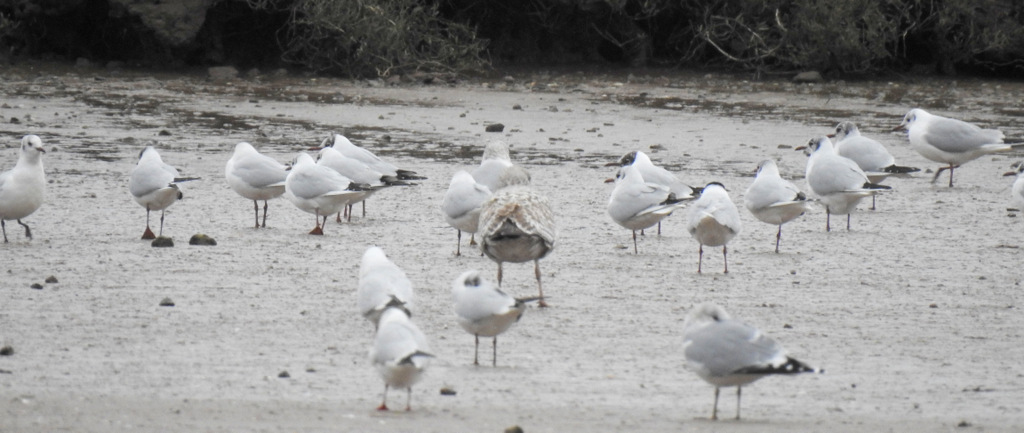
Here's a nice little test for any budding gullers. How many Med Gulls in the following pic? In my London days this photo would have been unimaginable, and I guess it would be pretty amazing even now for many inland birders.

A typical scope-full...

Answer: there are three; two adults and a 2nd-winter. If you reckon you're not really into gulls but still spotted all three within 5 seconds, well, stop kidding yourself, just surrender to it. If you spotted four or more, go take a long hard look in the mirror, you stringer.

The next test is slightly trickier, but there is just the one Med Gull in the photo. So, how quickly can you find it? Ready...go!


Okay, if you spotted the Med Gull without clicking on the image first, well done. If you enlarged the pic first, then spotted it, well done. If you simply clicked on the photo to confirm your suspicion, again, well done. Yes, well done for any of the above, because just making the effort to find the Med Gull is a fine thing, and evidence of what a discriminating birder you are, with a commendable appreciation of avian quality. Med Gulls are without question 24-carat birds, but not all of us are blessed with the ability to detect that. You are fortunate indeed!

So, that was it this afternoon really. A very relaxing stroll up the estuary, carefully picking through the gulls. No time constraints... Very soothing. Nothing special in the way of scarce or rare stuff, nothing particularly notable at all in fact.

Just...therapy.

And back we go...downriver to the car, and home...

Wednesday, 19 February 2020

Soon...

Yesterday lunchtime I visited Colyton WTW for the first time in a while, and eventually found both Sibe Chiffs together in a really photo-friendly spot. Unfortunately that discovery coincided with a downpour, and before it stopped they had moved on and I didn't see them again. So no pics...

Quite good numbers of gulls on the river. I counted 65+ Med Gulls in the morning, and 50+ mid-afternoon. A really good movement of Common Gulls too, well into three figures, probably 2-300 at least. Lesser Black-backs were passing through as well, though I never saw more than 15-20 at a time; but no intermedius candidates yet.

I was in the Seaton area again first thing today, and had an early look at the gull collection. A surprising 55 Med Gulls amongst the otherwise modest gathering. Something quite profound has happened to the status of Med Gull on the Axe. And it's happened overnight. From barely any all winter, and an all-time max of 30-something, to...well, here we are in silly-numbers land since Jan 29th. Very weird.

By this time of the year birding me is usually bemoaning the direness of mid-February, how it's all a bit flat and monotonous. So I was just gearing myself up to write that sort of post. But Serin, a biffing great American Herring Gull, much personal Casp jam, Sibe Chiff joy and so on... You can see the problem. I have nothing to moan about. And yet...

As I made ready to leave the AHG last Friday, Phil jokingly called out: "Hopefully we'll have a proper bird for you soon!" or words to that effect. Phil meant something NOT a gull of course, but yes, no matter how good the birding, as winter drags on I cannot help wanting a change too. And not just in the weather. Spring is just around the corner, and the gull passage already underway is a beguiling reminder of spring's promise. It will bring birds. Lots and lots of birds. Hopefully - if I stay the course and keep my optics shiny - there will be that magic moment when you're traipsing along the beach early one morning, and...

Well, hello again...

Monday, 17 February 2020

Something From Nothing

This post is simply a description of the Caspian Gull at West Bexington just over three weeks ago. I thought it might be useful as an example of what it is possible to extract from a rubbish video. Instead of fumbling around with a camera I could have spent another couple of minutes with the scope and then from memory tried to write a description in the field notebook which I don't carry these days, desperately trying to shelter the imaginary pages from the foul weather. But I didn't. I got some jumpy footage instead. I know which I prefer, and I can guess which is easier for a county records committee to assess...


2nd-winter Caspian Gull

Date: 26th January, 2020
Location: West Bexington, Dorset
Conditions: Very strong SW, steady rain, air full of fine spray. Dull and overcast.
Distance from bird: Probably 100-150m
Time: Shortly before 14:00. The bird was in view for several minutes, but probably less than ten.
Other observers: None.
Previous experience: As of 26th Jan 2020, 14 previous Caspian Gulls (11x1W, 1x1S/2W, 2x2W), all on the Axe Estuary, Seaton, Devon; all photographed. My first was a 2W in October 2007.

Initially picked up on the West Bex mere with bins (Zeiss Dialyt 10x40 BGAT) it was the clean white head and breast which caught my eye, belonging as they did to an obviously immature bird. I realised it was a candidate for 2w Caspian Gull, and scope views (Nikon ED82A 25-75x zoom) confirmed. After loafing on the mere with other gulls for several minutes, the bird lifted off and flew into the wind, over the beach and away.

Despite awful weather I really wanted some images, and recorded 1'50" of video on my Nikon Coolpix P900. The video is available here. The following stills are taken from that recording, and illustrate various ID features, as highlighted in annotations or text...

Photo 1

Photo 2
Photo 2 shows complete, narrow black tailband, and clean white underparts.

Photo 3
Photo 3 also shows dark secondaries. This, plus the complete, narrow tail band definitely rules out 3rd-winter Herring Gull. While I was watching the bird I couldn't remember exactly what HG of this age would look like, so it was a niggling worry at the time. However, 3W HG would have grey, adult-type secondaries with white trailing edge, and just traces of tail band.

Photo 4

Photo 5

Most 2W Caspian Gulls carry a small mirror in p10, and Photo 5 depicts it clearly. Through the scope it was surprisingly easy to see this feature on the open wing, mainly from below because p9 largely masks p10 from above.

The combination of features shown by this bird rules out Herring Gull. It cannot be HG in 3W plumage for reasons outlined above, and 2W HG would not look as clean white on head, breast, belly and underwing. Neither would it be this advanced in moult on the scapulars (usually few grey feathers, if any) and coverts (again, few grey ones) and its tail would have a wider, less sharply-defined terminal band. According to Gibbins et al (2010) a p10 mirror is shown by 1-5% of 2W HGs (particularly argentatus) so any 2W bird which has this feature is far more likely to be a Casp. In addition, there were no anomolous features which might suggest a hybrid origin.

Finally, it is helpful to compare the photos above with the bird in the following image. This 2W Casp was seen in Torbay in November 2015, and three days later on the Axe Estuary, Seaton. Note similar state of moult in scaps, coverts and tertials, the bill pattern, whiteness of head and underparts, and spotted 'shawl' on nape. It all matches the West Bex bird extremely well.

2W Caspian Gull, November 2015
Top: Torbay, Devon (photo: Mike Langman)
Bottom: Axe Estuary, Devon (photo: Ian McLean)


References: Gibbins et al (2010) - Identification of Caspian Gull Part 1 (BB 2010)


Here endeth the description. I realise this kind of post is a bit..er...'specialist', and if you have reached this paragraph after wading through the rest of it I do hope the above was helpful. If I am jammy enough to find interesting birds in the future I might well do it again.

The Twitching Thing

Back in the day  I never gave much thought to twitching, I just did it. I kept a British list, and vaguely remember breaking 200, then 300, and that it seemed important somehow. I suppose the first birds I ever 'twitched' were incidental goodies which happened to be on hand during visits to Norfolk and the like. You'd bump into birders and they'd ask if you knew about the so-and-so. A negative response inevitably led to them telling you where it was, and it seemed obvious to simply follow up the tip by going to see the bird. Was that twitching? Debatable I guess. But episodes like this gave Mrs NQS and me some memorable birds, like our first Dotterel, Black Guillemot, Spotted Crake and Buff-breasted Sandpiper back in 1981/82.

Soon came friendship with other birders, membership of the telephone 'grapevine', and a mutual desire to see new birds, especially rare ones. Almost every twitch I remember was in company, when the thrill of anticipation becomes infectious and stimulating. If our dawn raid to see some feathery little waif was successful it was dead easy to gee one another into zipping across country to the next tick...

Though I do remember one vintage jaunt which had a different vibe. A November day in 1983, and I was at Staines Res. A routine visit with routine fare. Alone on the causeway I pondered the fact that I was here, seeing 'nothing', while a Pied Wheatear was in North Norfolk. Also a bonus Richard's Pipit. Both potential ticks. So I abandoned Staines and drove straight to Weybourne, arriving some time in the afternoon. I did see both birds, but my lasting impression of that trip is one of anticlimax. It felt as if I'd gone simply out of boredom, and was probably the first time I wondered if twitching was really for me. Certainly it felt very different on my own as opposed to in company.

Subsequent years saw many more twitches, some absolutely bursting with stress and anxiety, some just blah... Then there was phasing, and dusty optics. And finally a move to East Devon in December 2002, which rekindled something...

Although there have been periods of deep phase in the last 18 years, mostly I have managed to be a birder. But a twitcher??

Well, sometimes.

In fact, if you count local patch birds, there's actually been a lot of twitching! Unless I was in the middle of a phasing spell I would always go to see good patch birds if I could. One or two were lifers, many were patch ticks, but lots were neither. Which raises the question, why twitch a bird you don't in some way 'need'? Hopefully that will become clear...

So, American Herring Gull. If you read the relevant NQS post it is impossible to miss the utterly frantic nature of the 38 minutes between my learning about the bird's presence and my seeing it. They were awful! But why? I don't give a monkey's about my British or any other list. I'm not a twitcher per se. So what on earth elicited such emotional havoc?

Was it the bird? Partially, yes. I twice tried for Matt Knott's Otter bird a decade ago. I really like gulls, and for years have wanted to see AHG in the flesh, if only to find out for myself how distinctive it is, or is not. But I can say this with virtual certainty: had it been in Weymouth I would not have gone. I've nothing against Weymouth, but the place doesn't mean anything to me.

So was it the location then? Partially, yes. The Axe patch unquestionably has a place in my throbby little birder's heart. I love that estuary. It has given me so many super moments, particularly through its gulls. When Steve was describing to me exactly where the bird was, I asked 'On the gravelly strip?' 'Yes,' came the reply. I could see it like I was there. Except I wasn't! Aaggh!

So, a combination of the bird and the location. Was that it? Was that the magic mix? Again, partially, yes. But there was one more ingredient...

In my years in Seaton I was always part of a team, and those individuals - those birding friends - are inextricably tied up with my fondness for the Axe patch. As clearly as I could picture the bird on that gravelly strip in front of the tram sheds, I could picture so much more. I could see Steve, in a state of mega-excitement and stress, desperately willing others to hurry up and get there, and the bird to not fly. I could see Ian, Phil, Kev and others rushing around for their optics and keys, also willing the bird to please, please stay put. And you know what? I wanted to be part of that. Solitary creature that I generally am, I nevertheless wanted to share in that excitement, to get stuck in and be involved in this momentous event on my old patch.

One occasionally sees twitchers getting knocked, and twitching itself dismissed as some kind of less worthy activity. I think this is very unfair. In my experience at least, twitching has rarely been about a number, but rather about a bird, a location, and good company. That is the magic mix, and it can truly be enormous fun. Why knock it? If there's one thing all of us need in this world, it's a bit of light relief...

Saturday, 15 February 2020

Always Look at Gulls

Badly misjudged the weather today. I can read a forecast like anyone else, but for some reason I thought we were getting just the odd shower until about 2pm. So I optimistically headed over to Seaton for extra helpings of American Herring Gull. Er...

Storm Dennis was going on. And a storm is a storm. The horizontal deluge, brim-full river and thin supply of gulls quickly persuaded me to make do with just the one massive helping I'd enjoyed yesterday, and go home. I spied a few birders huddled in their cars and silently wished them all the best as I slunk away.

There is no doubt that the Lyme Bay American Herring Gull has been a popular bird. A short video I stuck on Twitter has already been viewed in excess of 4,700 times, and yesterday's NQS post has had something like 6x the usual number of readers. And I'm sure some of that popularity is not simply because AHG is rare, but because it's a rare gull. There are a lot of gull fans out there. And yet...

Gulls are a bit Marmite, aren't they? My own interest in them goes right back to early days at Staines Res, and finding my first London Med Gull there in 1982. The species was actually quite rare in London back then, and a major prize. Fired up by this success I habitually scanned any group of gulls I came across, hoping for another. On 28th November that year I was picking through a distant flock on the drained north basin when a slightly odd bird caught my eye. It was smaller than a Herring Gull, very pale grey, and basically had no white tertial crescent. It was London's second Ring-billed Gull, a 2nd-winter bird. It was also only my third 'BB' rarity, and thus far the trickiest ID challenge I'd been faced with, full stop. Being quite 'new' to gulls I was aware of some features to look for on Ring-billed, but had no idea how much you needed in order to clinch the ID, so just noted everything I could see. Thankfully I got enough, but learned later that the description needed two circulations before it was accepted. A close call.

Thirty-eight years later my memory is a bit iffy, but I am fairly sure it was the virtual absence of a white tertial crescent which stopped me in my tracks and made me look again at that bird. But why would I notice such a thing? Because I had been making it a habit to look at gulls. And when you look at hundreds and hundreds of gulls on a regular basis it soon adds up to thousands and thousands. And that steady parade of familiar shapes, colours and patterns gradually becomes a sort of background noise, against which something different leaps out like a shout. That's my theory anyway, but I think it's true.

One of the local birders present yesterday admitted that he would most likely have looked straight through the American Herring Gull without seeing it. I am absolutely sure I would not have. Like Steve describes in his account of the find, it would have yelled at me from across the river. Why? Because over many years I have looked at countless gulls, and eventually you find that even the subtly different birds make you stop and look more carefully. I cannot always say exactly what it was that caught my eye - in fact I doubt that I consciously think about it - but something did. First-winter Caspian Gulls, I do know what it is. It's the white head. Not just white, but white!

A year or two after the Ring-billed Gull I still hadn't seen a London Iceland Gull, but old London Bird Reports told me they sometimes turned up in reservoir gull roosts. That was something I'd never tried, so began climbing in to Wraysbury Res late on a winter's afternoon and sneaking round to check out the roost. On only my first or second try I found a Glaucous Gull. Win! Just the encouragement I needed in order to persevere. Soon I had my Iceland Gull too. Brilliant! It had a dark mark beneath one wing, and turned out to be a bird which was spending its days many miles away in Berkshire, feeding on a tip. That winter I found one or two more Iceland Gulls in the Wraysbury roost, and other birders began to join me. We even had an adult Med Gull one evening. Bonus!

Back then, as now, I got a major buzz from finding a good bird, and looking at gulls was a great way to increase the potential for that happening. I realise that Caspian Gulls and the like are not as obvious as a white-winger, but the field characters are learnable, and with every manky young Herring Gull that you look at, analyse, identify and discard, you are one step closer to something a bit more special. And then one day a bird will stop you in your tracks, and you will realise you've got something different. Maybe a mild panic as you struggle to remember what features to look for. Then a growing realisation that this actually could be a Caspian Gull. And no 'expert' pointed it out. Not only did you find it yourself, but you can even say why it is one. That is a nice feeling.

However, I do realise that not everyone can be bothered with any of this...

I remember once going into the Tower Hide at Black Hole Marsh. Two or three birders were present, and lots of gulls on the estuary in front of the hide. Among them was a virtually white Iceland Gull. No one else had seen it; they basically didn't look at the gulls. When I pointed it out they did look, but it clearly made little impression. Fine. Each to their own I guess.

But boy, are they missing out! Apart from umpteen scarce and rare species to get excited about, there are other things. Like migration. Loads of gulls migrate, and noting the arrival, departure and passing-through of various species adds another facet of interest. And colour-rings. Many gulls are marked with plastic colour-rings which are designed to be read through binoculars or a scope. Recording and reporting them, and getting feedback on an individual bird's history, adds one more facet. And did I mention about the rare and scarce thing? Oh yes, I did. Well, it bears mentioning twice. Because if you don't bother with gulls, then this becomes a possibility:

You won't know what a Pallas's Gull is.

And if that's true, then this becomes a possibility:


Heart-attack material

One of the above could be sitting in the flock right there in front of you, and you would be totally oblivious. And if that's true, what is the point of living????

One day some poor soul is going to be hospitalised as a consequence of finding one of these in Britain. If I am the one destined to suffer this fate, so be it. I am ready.

And if you always look at gulls, you will be ready too.