Pages

Monday, 20 June 2022

No Sleep...

I was late to bed last night. And up at dawn. A day off, entirely devoted to learning mothy stuff...

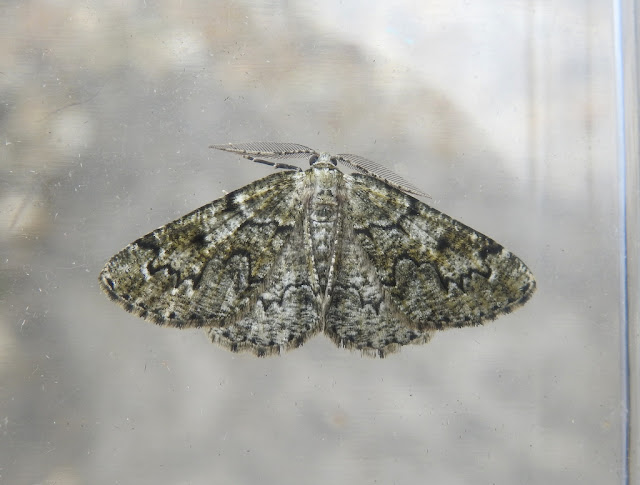
I've taken to hanging an old towel on the cabin door, close to the moth trap, and lurking nearby, pot in hand. As moths come in, they frequently give you a chance to catch them before entering the trap (or flying off) and I have become slightly addicted to this game. Last night I caught this one when it landed briefly on my trousers...

A proper migrant of some quality, and one I have been really hoping for

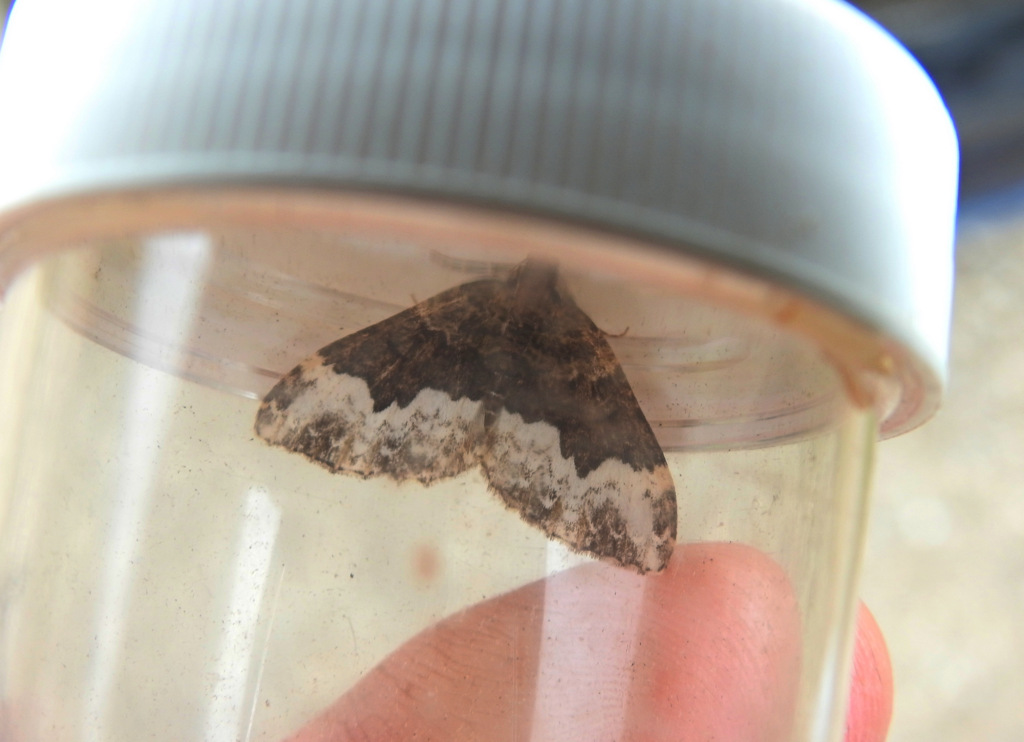
A bit later, this one landed on the towel...


When I saw what I'd caught, I got a bit excited. I knew it was going to be on the page where Maiden's Blush and various Mochas lurk, and I was well aware that one or two are rare. Finally deciding on Blair's Mocha, I looked it up on the excellent Dorset Moths website...

'In Dorset, thirty-four moths have been seen on or close within ten miles of the coast.'

I thought, 'Really? 34 ever?!' Well, no, it turns out that things have changed since the Dorset Moths blurb was last updated in 2019, and the species apparently breeds here now. Still, that did not diminish the buzz at all. A quality moth.

Going through the catch this morning, I potted up all the micros too. Perhaps unwisely, but once I have decided to learn new stuff I usually adopt a pretty determined approach. For me, the hardest bit is overcoming my stubborn reluctance to take that first step. And a learning curve akin to the north face of the Eiger is always going to trigger my natural inertia! Anyway, I'm up and running now, so, game on...

While examining one of my potted micros I noticed a tiny speck flicking about within. It was another moth. I had to use a lens to check, but yes, a miniscule moth. And what is more, I have identified it. Admittedly I had help, but that's another story, for another post. Here it is, and at just 4.5mm in length, I give you: Lyonetia clerkella...

Widespread and common, and seriously below almost everyone's radar.

Sunday, 19 June 2022

How It's Going - Part 2

It went something like this...

Ooh, that looks well-marked and interesting, and possibly doable...think I'll pot it up.

I knew it was a plume moth, but beyond that...er...nothing. I certainly didn't suspect that it might be a rare migrant, originating in southern Europe or North Africa. This morning I received confirmation that my pics were sufficient to see our Scarce Light Plume accepted as a bona fide Dorset record. Which was gratifying, because we released it last night, so there was no specimen available for inspection.

Scarce Light Plume (Oxyptilus laetus)

I feel like a beginner birder who has just shown his expert buddy some photos of the 'weird grey and orange Kestrel' that was perched on a fence post down the road yesterday afternoon, not quite believing how closely it matched the 'vagrant...5-10 records annually' female Red-footed Falcon in the Collins Guide. Yes, I get the distinct feeling that veteran moth recorders would have gone a bit weak-kneed had they spied this tiny scrap of a moth in their trap. In my ignorance I felt no such excitement.

And it struck me what a strong link there is between ignorance and lack of appreciation. Which possibly explains why mankind in general treats the natural world so badly...

Anyway, rather than head off down that unhappy road, a short addendum to yesterday's post, which closed with a reference to moth trapping at Mapperton.

It was rather a jaw-dropping experience to see a bunch of Robinson traps absolutely heaving with moths. And truly humbling to watch as they were inspected and identified with barely a reference to any literature, micros and all...

Jack Oughton and Chris Fox in action

I later learned that the species tally was 163. One hundred and sixty-three! Five of them were nationally scarce, of which I definitely saw two...

Cloaked Carpet

Bright Neb (Argolamprotes micella)

That micro was no more than 6-7mm long, but look at those twin 'horns' and the purple-tinted shoulder pads. My camera doesn't do it justice, but it was pretty impressive.

Bordered Straw is a regular immigrant species which I have seen on Twitter many times, so it was nice to see one in the flesh at last...

Bordered Straw 'warming up' on my grubby trousers.

This morning I led a walk at Mapperton. Wading through the long grass of species-rich meadows, disturbing countless unidentified invertebrates en route to the fine display of Common Spotted Orchids, it was easy to see why Friday night's moth traps were bulging in such healthy fashion. Man's heavy hand has obliterated so much biodiversity, but not quite everywhere...

Saturday, 18 June 2022

How It's Going...

How it started...

21:56 on 2nd June 2022. The first night.

How it's going...

Well. Fractionally more than two weeks later, there is no doubt that I am in big trouble.

Because moths have it all. I know that birds have it all of course, but moths - worryingly - even more so. For a start, some 2,500 species have been recorded in the UK, rather than 600-odd. And they range from dead easy to super-tricky, from dead common to mega-rare. A small minority are dead dull, but boy, wa-a-a-y too many are dead gorgeous. As I say, big trouble...

A few tasters from recent days, with Dorset status in brackets...

Mocha (scattered distribution; always local)

Small Elephant Hawkmoth in early morning sunshine (common on optimum sites, though I have no idea if our garden is close to one)

Lime-speck Pug (common along the coast)

I do not catch millions of moths. The best night so far was 15th/16th, with a catch comprising 46 individuals of 25 species. Though a few micros will have been 'let go' due to my current unwillingness to get too involved with the things. When I get down to adding up the number of species trapped so far, I wouldn't be surprised if it's pushing 100, or perhaps more. Still, quite often I read on Twitter about catches totalling several hundred moths (and well in excess of 100 species) in a single night! Our little corner of Bridport is small potatoes.

Moths look so good in a photo. Thus far I have not done justice to their appearance, with my mostly 'in the pot' pics. It seems de rigeur to have a 'moth plank', upon which the little beasties are posed for portrait shots, so I poked around in the garage for a suitable bit of scrap wood. Behold...


Not 100% on this one, but for the moment it's a Dusky Brocade (locally common to frequent)

Just WOW!!! I am in love! Scarce Silver-lines (local)

Shoulder-striped Wainscot (ubiquitous; frequent to common)

Burnished Brass (widespread and frequent) - the yellowy bits shine like polished metal!

L-album Wainscot (frequent along the West Dorset coast...)


I am much happier with the photos now, and hopefully will get better at it as time goes by.

All the above are so-called macro moths. As I say, mostly I have been avoiding micros. I have dabbled though, and when I spotted a little plume moth in this morning's catch, I potted it up for attention later. Sandra volunteered to check it out, and after a while handed me the book and just said, 'See what you think'. There weren't many candidates, and when I told Sandra what I thought, she replied, 'Me too.'

Unfortunately we surely had to be wrong, because the book said: 'Migrant...From southern Europe and North Africa.' And on the very helpful Dorset Moths website: 'In Dorset, up till 2010, there are just three records for this species. One of these was from the Isle of Portland; since then, a further seven individuals have been recorded on Portland, notably in 2019.'

Had we really caught a pucka immigrant from far, far away? Well, Friday did see a plume of warm air and Sahara dust waft across the south of England, so maybe...

And yes, it turns out we had.


This weird little thing is Oxyptilus laetus, the Scarce Light Plume.

I think it's quite funny that our rarest moth so far is a micro, one of those creatures I'm a bit scared of.

So, there we are. This blog will never be quite the same again.

This morning I was invited to join in the emptying of a whole bunch of moth traps which had been set out at Mapperton. Unfortunately I couldn't spare much time, but suffice to say the first trap took more than an hour to process. It was mayhem! But that's for another post...


Sunday, 12 June 2022

Time Well Spent

As I am leading a walk at Mapperton next Sunday it seemed sensible to acquaint myself with the current flora and fauna. Tom Brereton had already alerted me to the presence of a couple of interesting birds, so I was looking forward to my next visit. Which was this morning. It went better than I could have hoped...

Flora 

I am continuing to make an effort in this area. Today I realised that the stuff I was blithely calling Cow Parsley is actually Hogweed, and the Cow Parsley is largely over now. I had already got to grips with Pignut, but today added Corky-fruited Water Dropwort. Along with lush clumps of Hemlock Water Dropwort that I must under no circumstances be tempted to eat (and loads of Wild Carrot at Cogden) I now have a repertoire of at least five umbellifers. Oh, and Alexanders. Six. Also nailed this morning were Hedge Woundwort, Creeping Cinquefoil and Catsear, and why the knapweed was Common, not Greater. Baby steps.

Corky-fruited Water Dropwort...

...and the basal leaves which helped me clinch it.

One of many lovely Common Spotted Orchids

Fauna

Creep-crawlies...

Golden-ringed Dragonfly

Keeled Skimmer - female.

Mother Shipton

Large Skipper on...er...haven't started on thistles yet.

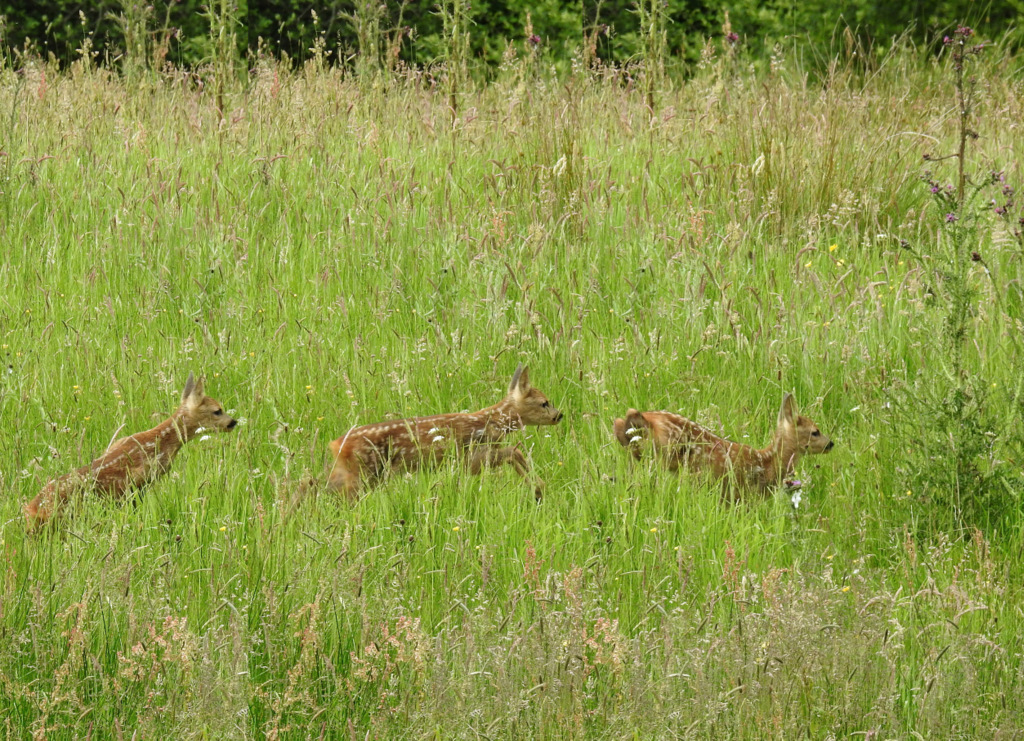
There is a good population of deer in the Mapperton area - too good probably. I saw several Roe and Fallow Deer, including a white Fallow and a spotty Roe fawn which I almost stepped on...

White Fallow legs it...

...then stops to check me out

Regular Fallow trying to work out whether I should be run away from.

I felt a bit guilty about disturbing the Roe Deer fawn. Hopefully mum was able to find it okay...

Composite of three shots. Tiny little thing.

This is where it had lain. A well-used spot.

The birdy highlights were even better. First, a 'mixed-singing' Chiffchaff thing. I cannot recall ever hearing one before, and I have to say it did sound weird. It sang from high in the canopy, and views were pretty rubbish. I recorded a couple of short videos though. Here is a sound clip...


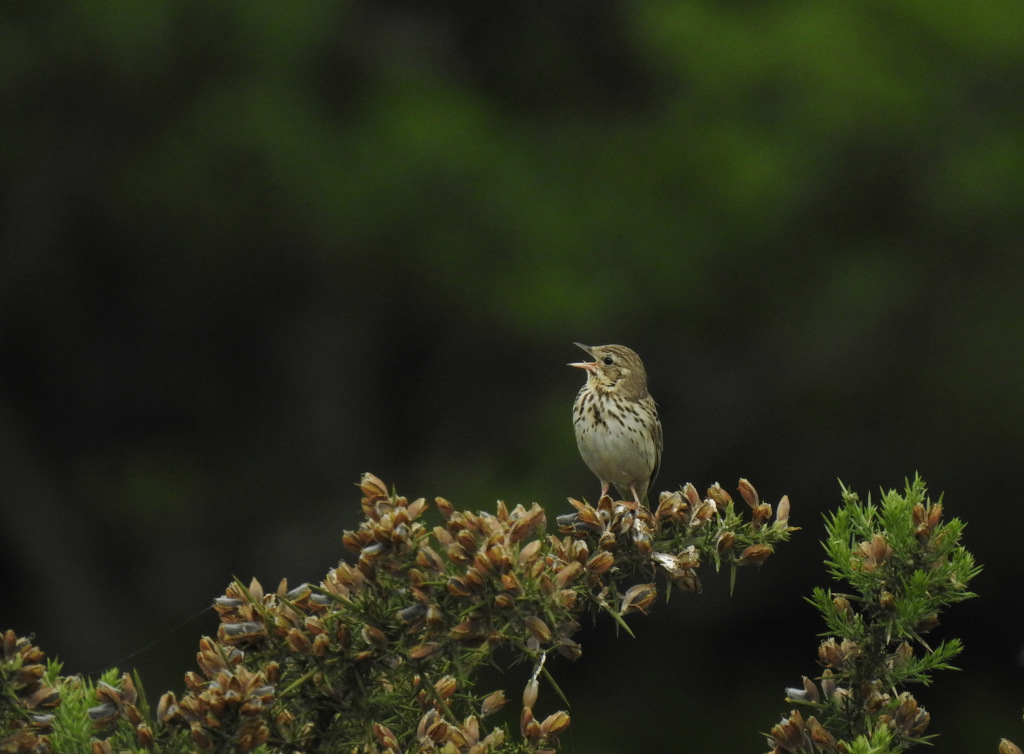
Best of all, a singing Tree Pipit holding territory. Tom found it a while back, and I was really chuffed to see it so settled. Hope it finds a mate. I have never seen a 'local' territorial Tree Pipit, either here in West Dorset or on the old Axe patch in East Devon. The song is exquisite, and I spent ages just listening, and trying to get some decent video. A great deal of patient creeping and crawling eventually secured me a lovely spot to view from, and the bird appeared perfectly relaxed. In the end I was with it an hour or more. Time well spent.

Image overload...


And finally, a short video. Warning: you will see the Tree Pipit appear to fly off, but don't stop the video. What it actually does is launch into a glorious song-flight, which is well worth a listen. Just before the finale, you briefly see it zip through the shot again as it swoops in to land out of view a few feet to the right...


Time just whizzed by. Just me, some amazing habitat and a few lovely creatures. Nothing rare, nothing even that scarce. As so often though, context is everything.

An unforgettable morning.

Thursday, 9 June 2022

Learning Curves

The natural world has fascinated me since childhood, and I have many clear memories involving assorted creatures and a very small me. In one of them I am shown a bat clinging to a wicker chair in a garden. I was probably four or five years old. I recall the wonder and thrill of it, but I definitely do not recall asking what kind of bat it was. It was a bat, and that was good enough for me.

The desire to be more specific, to put a name to things, came later. But even then I might not have been that bothered unless it meant points in an I-Spy book. Birds changed that. I made an effort with birds. And now here I am in my seventh decade, knowing quite a lot about how to put a name to almost any bird you might encounter in these islands. Terrific. However, the same cannot be said about butterflies, moths or dragonflies. Or plants. Or...well...a stack of other stuff...

On many occasions my ignorance has been a source of frustration. Last year I quite fancied trying to find Lulworth Skipper locally. I had never seen one but knew they were here somewhere. I guessed that the best places to look would be where its foodplant was abundant. The foodplant of Lulworth Skipper is Tor Grass, so I just needed to find a load of that. Except I had no idea what Tor Grass looked like. So I looked it up, found some, and scored with Lulworth Skipper at my second attempt.

My delight at discovering the wealth of orchids available at Cogden and West Bexington definitely stirred something, but I suspect my involvement with the Mapperton rewilding project is what finally woke it properly. I don't think I had ever appreciated quite how much plants can tell you about the local geology, habitat and potential invertebrate population, for example. Sure, I can identify a few plants, but have decided - at the ripe old age of 63 - to turn that into 'a lot of plants'. I asked plant buff and fellow blogger Steve Gale for a bit of advice, and as a result now own this...


It fits nicely in the outer pocket of my camera bag, and on several occasions has been open on the ground beside me as I have knelt to grapple with a new plant. Like this one...
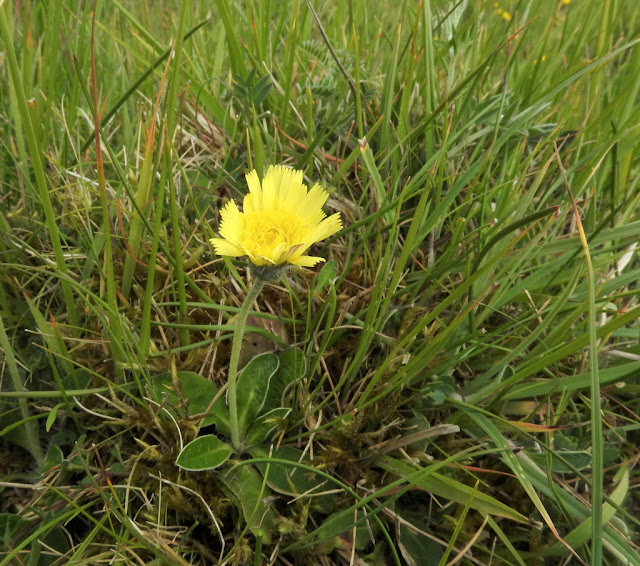
Mouse-ear Hawkweed at Cogden

Its paler, more primrosey shade of yellow made it stand out from its myriad mates (which I'll tackle some other time) and clinching the identification was quite pleasing.

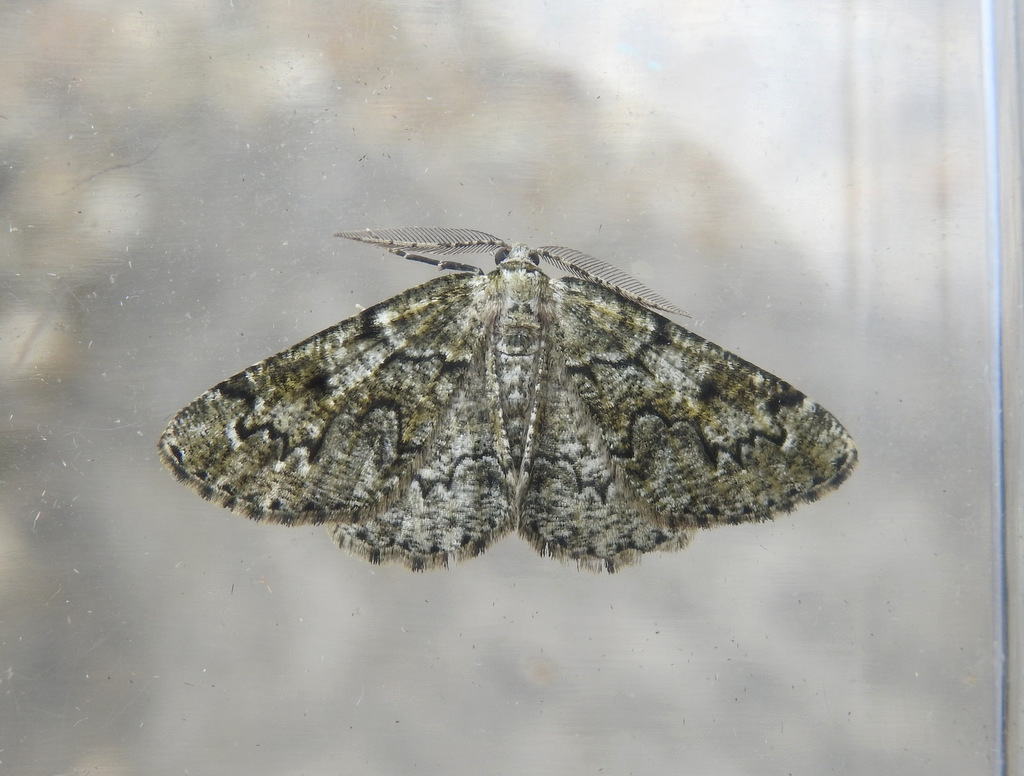
And then of course, moths. Partially that is Sandra's doing, but I didn't need much prodding. What a world of super-subtle trickiness it is. And I thought gulls were hard. Yes, there are plenty of obvious ones. We've had one specimen of the most-photographed moth on the planet - Buff Tip - and this corker...
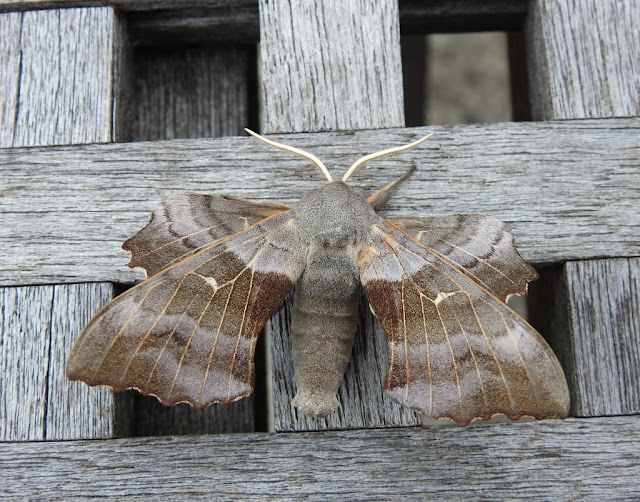
A pristine Poplar Hawkmoth

But there have been several that, while distinctive, are less 'instant'. A couple of examples...
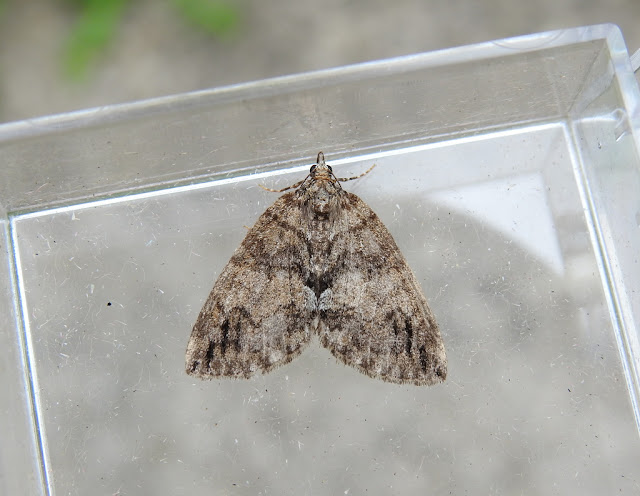
May Highflyer

Brussels Lace - what a great name!

 And then there are those which look different, but might not be...
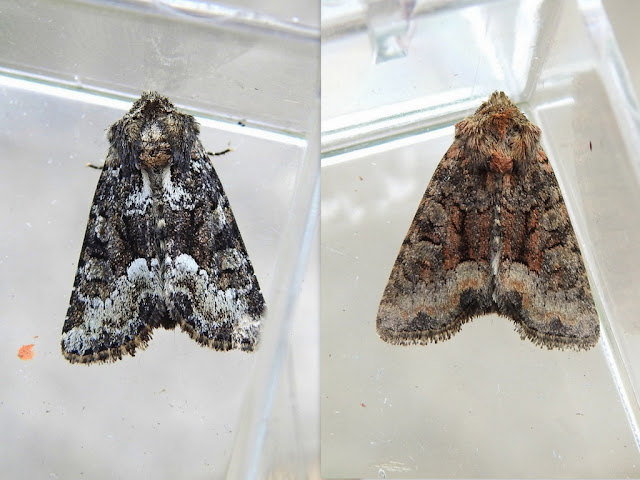
L: Marbled Minor...or maybe Rufous Minor or Tawny Marbled Minor.
R: Tawny Marbled Minor...or maybe Marbled Minor or Rufous Minor.

Apparently the three species can reliably be identified only by examining their genitalia. I shan't be inflicting that indignity upon them. And anyway, all are common.

And then there are the plain weird...
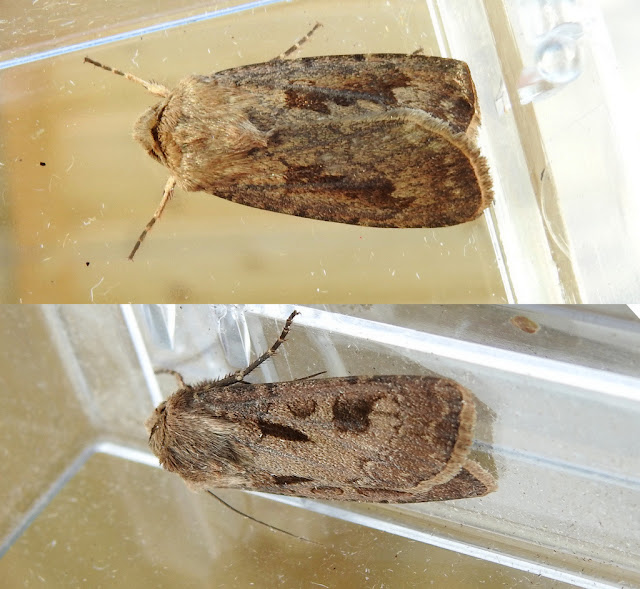
Below: Heart and Dart.
Above: er...

Sandra and I spent ages trawling through the books for a moth with those distinctive 'saw tooth' markings. Nothing matched, not even slightly. Finally we realised that the dark, shallow V on its collar (visible between the front legs) looked exactly like a Heart and Dart. Conclusion? Aberrant Heart and Dart. Strewth! It's hard enough without all that kind of nonsense!

There's even been a bit of dabbling with micros. It was impossible to ignore one with antennae a mile long...
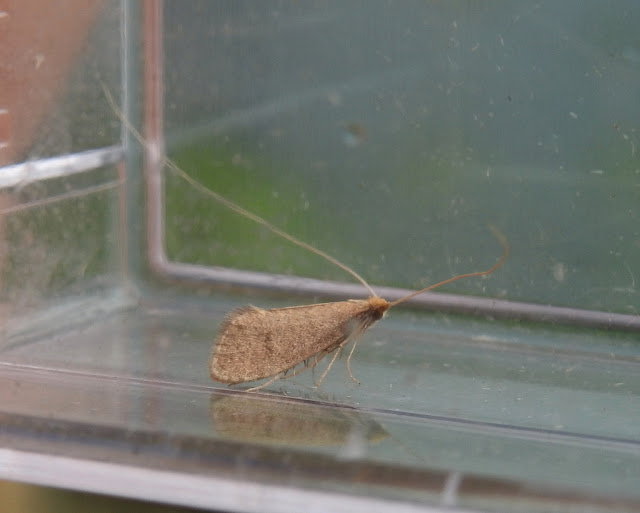
Buff Long-horn (Nematopogon metaxella)

There are a couple of potential confusion species (surprise, surprise!) but I think the identification is pretty safe. And it's not a rarity, so no big deal really.

Two things have struck me since embarking on these two fascinating - but eno-o-o-o-o-rmous - learning curves:

  1. There are not enough hours in the day
  2. There are not enough remaining years in my life

Lesson? Don't be like Gavin. Start young. Sleep rarely.

Monday, 6 June 2022

Ribbit

Two weeks ago I deliberately went searching for a plant that I have never seen before: Frog Orchid. I was acting on a tip-off, but knew it was probably too early and predictably failed. Still, at least I got a feel for the site. Back again this evening.

Many more orchids in flower than a fortnight back...

A good few Common Spotted Orchids, mostly in the early stages, like this one

The pretty little Heath Spotted Orchids seemed more advanced

There were also some Marsh Orchids (presumably Southern Marsh) but I didn't come across them until the light was too poor for pics.

I'm not quite sure how I managed to spot it, but somehow this utterly inconspicuous green thing caught my eye...

That plant in the middle there.

Maybe it was the strappy leaf that I picked up on? Whatever, a close look revealed a tight little bunch of flower buds, and some more strappy leaves lower down. Could this be a Frog Orchid? I took some more photos...

A little bit of purpleness coming through on those buds...

I'll be honest, I was well impressed with my plant-spotting skills. I was pretty sure this must be a Frog Orchid, so made a mental note of its location and pressed on, scanning back and forth intently for another. With nothing more to show for my efforts fifteen minutes later, I felt the need for another dose of self-congratulation, so returned to the scene of triumph. Crouching to look at my prize, I suddenly noticed a plant less than a foot away....

Frog Orchid!

How on earth had I failed to see it earlier? I must have spent at least a couple of minutes taking photos of the diddy little green one, yet here was a pukka Frog Orchid flower spike barely a hand's breadth away.

A bit more obvious from this angle.

Just for fun, the photo below illustrates the view from my eye level. Frog Orchids are not obvious! Well done if you spot them both. Skip to the end of this post for the big reveal.

Both Frog Orchids are in this pic

So, that was it. An evening spent in the quest for a local plant tick. Not so long ago, if you had suggested that June 2022 would see me indulging in this kind of behaviour, I would have laughed at such a preposterous notion. And yet here we are.

And I fear it is going to get worse...