Pages

Monday, 15 August 2022

Dorset Tree Cricket Success

It has been very pleasing to discover that West Bexington's Tree Crickets are seemingly doing well. Since coming across them last year I have had what feels like some weird paternal interest in their continued wellbeing. I have been rooting for them, so to speak. However, there has also been some unfinished business...

Hearing Tree Crickets has been great, but I have very much wanted to see one too. Efforts have been in vain. They tend to stop singing when you get close, which leaves you searching what seems like an acre of vegetation for the proverbial needle in a haystack. It has been disheartening.

Enter Brett Spencer...

Weymouth birder Brett is the first local person to express an interest in the West Bex Tree Crickets, and went to check them out at the end of last week. They performed well, and he heard several. But best of all he saw one too, a female, and got a photo. This was exactly the encouragement I needed in order to try again, which I did last night.

Tree Cricket song is very deceptive, and I was mindful of something Brett had said: 'They sound further away from you than they are.' He was dead right.

Pretty soon after darkness fell, I was tracking down a Tree Cricket. As I stood and cupped my ears, trying to work out exactly where the sound was coming from, I suddenly realised that the volume increased when I crouched a little. So I bent lower still, and the volume went up another notch. It was virtually at my feet! But, could I see it? No. The moment I began to search in earnest, my head-torch laying everything bare, it went schtum. And very, very still.

I don't know how long it took me, but a few minutes for sure. And then there it was, head down, on a twig. Quite obvious, in fact. According to the literature, adults range in size from 10-14mm, so I was expecting a tiny thing. But that must be just the body length. Factor in long hind legs and antennae, and you have a fairly sizeable insect.

My camera is not great for night-time photography, but with the help of two head-torches it didn't do too badly...
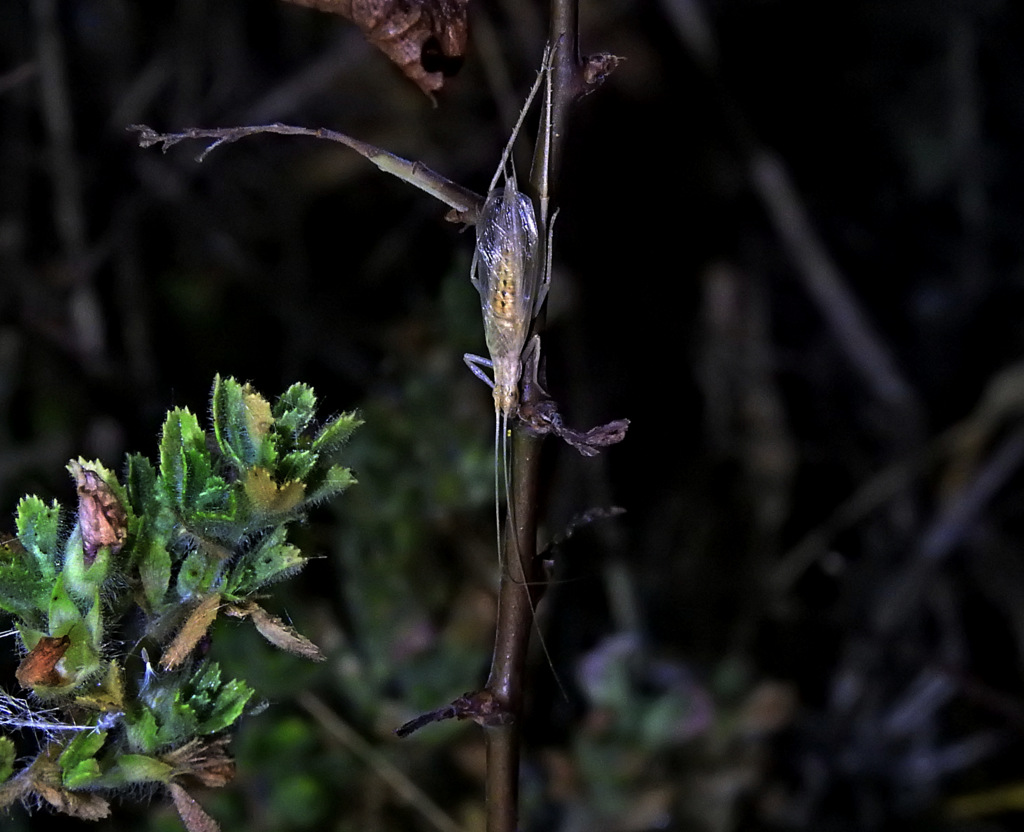
Male Tree Cricket Oecanthus pellucens - West Bexington

Viewed from the top like that, it looks rather a flat creature, but from other angles it takes on a different shape...


I had been concerned that they might be flighty, but need not have worried. It behaved impeccably.

Until last night I had not encountered a Tree Cricket anywhere away from the coastal strip. So I was pleased to come across one singing at least 100m further inland as I headed back to the car. In low, weedy growth this time, I was pretty confident of finding it. In ten minutes of searching I found three grasshoppers, a roosting Meadow Brown and countless little flies, etc, but no Tree Cricket. I tried from different angles, but all to no avail. They are not easy!

A final thought...

It is likely true that crickets are a bit niche. I get that. But it has surprised me how little interest there appears to be in this county rarity at West Bexington. In global terms, Tree Cricket is a common insect. But in the UK it is not, with just the one good colony, at Dungeness, as far as I know. The West Bex Tree Crickets are quite possibly the only ones in Dorset. It struck me quite forcefully yesterday just how precarious must be the existence of so many rare and vulnerable creatures, and how little the vast majority of the population actually knows and/or cares about them. As I waited for darkness to fall, I took this photo...

West Bex beach, sunset.

It was warm and still, the beach thronged with anglers and day-trippers, all having a great time, and 100% oblivious to the little population of Tree Crickets trying to establish a toe-hold nearby. And I realised the latter point would have been true of me too, just 12 months ago. Sobering.

Friday, 12 August 2022

The Camera's Curse

Seeing as I've done so little of it for ages, birding has been quite kind to me lately. That nice Pied Flycatcher at West Bexington last Saturday, for example. Mostly it hasn't felt like a ton of migrants are on the move locally, so to see a decent one was great. And a bit of patience bagged me some pleasing photos.

Photos. Getting nice photos is definitely a thing with me, and I would feel pretty naked without a camera. However, it is a two-edged sword...

On those rare occasions when you stumble upon a good bird, initially there is a massive panic to get a record shot. When that's done (phew!) there follows a potentially endless quest for a 'better' photo. And even if the bird poses beautifully, at close range, perfectly angled and in fantastic light, I can guarantee that the last, utterly faultless image can always be improved upon. Always. A minor adjustment of exposure compensation, or framing, or aperture, or whatever else might make absolutely zero difference, has got to be tried. It is like some hideous compulsion that cannot be denied. As if the camera owns you...

Thankfully, such occasions are very few and far between. But even a common bird, if sufficiently obliging, can induce this behaviour. Especially a Wheatear.

Anyway, I visited West Bex again yesterday evening, quite late. Strolling up Labour-in-Vain Lane I noticed a distant small bird drop on to the road, and raised my bins. It wasn't the expected Robin, but another Pied Fly! Much too quick for the camera, within a couple of seconds it was back in the roadside hedge, and out of view.

I could so easily have said: 'Pied Fly. Excellent. I shall note it down and press on...see what else is about.'

But no, I don't do that. Instead, I wait. I must have spent 20 minutes on that bird. Why? Because the camera has me wrapped around its little finger.

Did I get my photos? Well, you tell me. Are these photos...?

Up, and...

...away.

Views were invariably brief and distant. And there weren't many of them. Ah well...

I also saw a Whinchat and Sedge Warbler, neither of which allowed photography. In both cases though, the camera was out, at least briefly.

It was good to see a Sedgie. About this time last year there was a little influx of Sedge Warblers, an event that caused me to think unrealistic things about Aquatic Warblers. The chance of an Aquatic is infinitesimally small, but that is still a chance. So, this morning I was at Cogden quite early, pishing for England.

First up was a Grasshopper Warbler, which had so far avoided my 2022 #LocalBigYear list. Nice. This was followed by 7 Sedge Warblers and no Aquatics. I thought the least I could do was get a nice Sedgie pic for the blog...

Sorted.

What the above rubbish pic fails to convey is the amount of time invested in it. It is literally the only photo I have with a Sedge Warbler in the frame. But, how many times was the camera fired up in hope? Too many.

Thankfully, things don't always go as badly as I've painted. First thing this morning there was this Wheatear on the coast path. Admittedly the light was 'in the wrong place', but a Wheatear is a Wheatear, so obviously it got papped...

For anyone new to NQS, this is a Wheatear.
Wheatear is a species which features on here sometimes.
That's right. A Wheatear.

And on the return leg, another one. It was distant, the light was now about as harsh as you can get, but hey...

Wheatear

In the end I counted 8 Wheatears, 6 Willow Warblers and a single Whinchat. Along with the Gropper and 7 Sedgies, not a bad collection of early-autumn fare. What I didn't count was how many times the camera came out. But it was a big number. Yes, look, here's another...

Dingy Skipper on the beach.

Just occasionally I hear the camera's unspoken demand for action even when there is no creature to point it at. Like yesterday evening as I retraced my steps along Labour-in-Vain Lane at West Bexington, and the sunset had painted the sky orange...

Homeward...

Tuesday, 9 August 2022

Crepuscular and Beyond

Where does the time go? Just three days since the last post, and already there's a ton of stuff for the blog. And in a slightly more profound application of that rhetorical question, today marks exactly 42 years of wedded bliss. Sigh...

In a blink of the proverbial eye.

Anyway, blog-worthy birds are few, but who can resist the consummate poser that is a Wheatear? As anyone who dips into NQS occasionally will know, not me...

A late-morning jaunt around Cogden produced three Wheatears today. This one on the beach...

...and this one below the car park

I have massively neglected my local birding spots in recent weeks, but hope to make amends as autumn migration picks up. There was little evidence of that today though, with a single heard-only Willow Warbler the only other obvious migrant.

I was at West Bex yesterday and the day before, but not until late. There was a reason for that...

This Barn Owl wasn't the reason, merely a coincidental bonus of my crepuscular timing. Also, it was actually at East Bexington, seen while I was killing time prior to business at West Bex.

I've been keen to learn whether last year's surprise Tree Cricket discovery was a flash in the pan, or a sign of something a bit more permanent. Like an actual colony, say. Well, it's looking good. On Sunday night there were several Tree Crickets in fine voice, and I made some short recordings. This one features at least two individuals...


It wasn't particularly warm as darkness fell, and last night felt similar. I wonder if activity will increase through the month (I didn't come across them until August 31st last year) and on warm nights? Yesterday they went quiet after about 30 minutes or so.

Being out and about at night has been a revelation. I am slightly embarrassed to admit that during a lifetime of interest in things Nat Hist I have never seen a Glow-worm. Or rather, had never seen a Glow-worm...

Just astonishing! As bright as an angler's luminous beta-light!

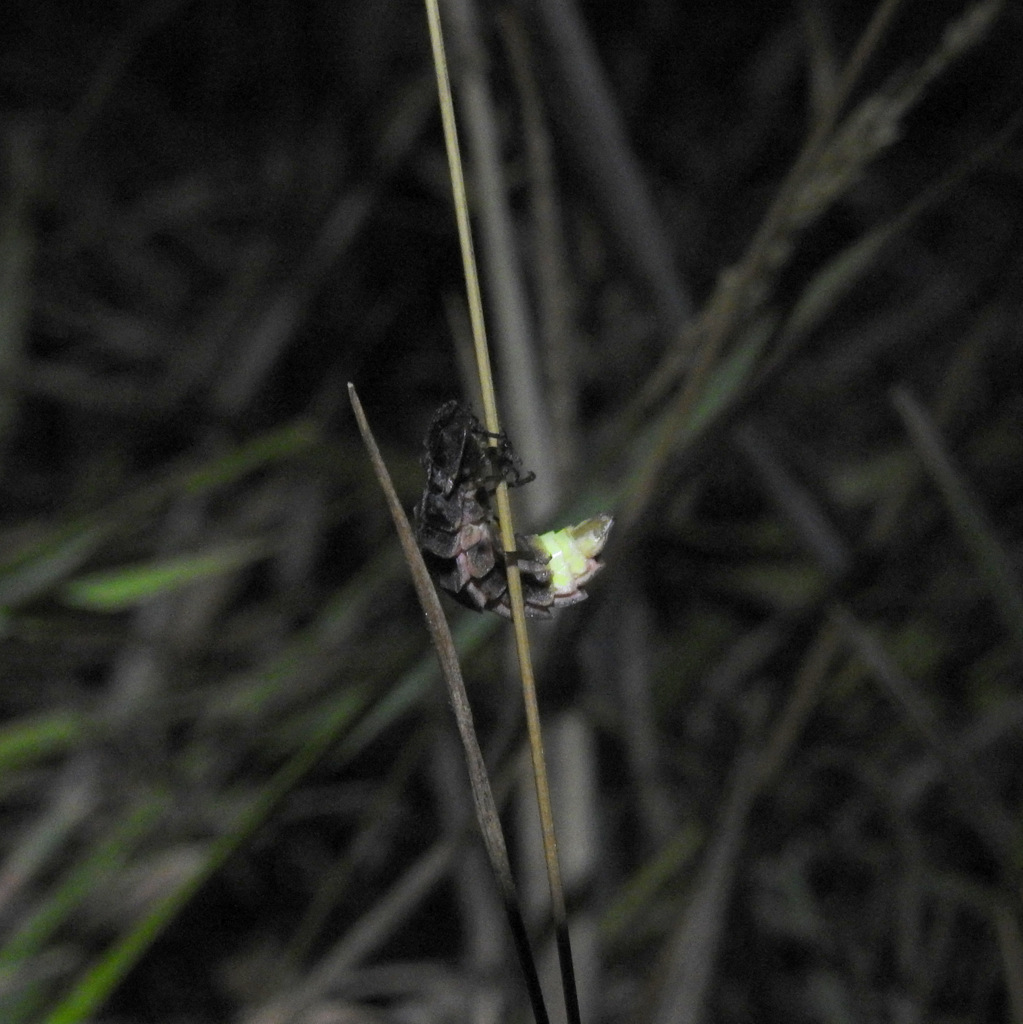
And here is the culprit. A female Glow-worm seductively waving her little lantern, hoping to catch the attention of passing males.

I counted more than a dozen both nights, so it looks like there's a healthy population here.

In addition to the Glow-worms, there have been other night-time attractions. Lately I have taken to carrying a few plastic pots in my camera bag, just in case. And last night I wore a head-torch too. West Bex delivered mightily...

My first Vestal. What a stunner! Hopefully I'll get one in the garden trap eventually, but in the meantime I was more than happy to make the acquaintence of this attractive migrant along the coast path at West Bex.

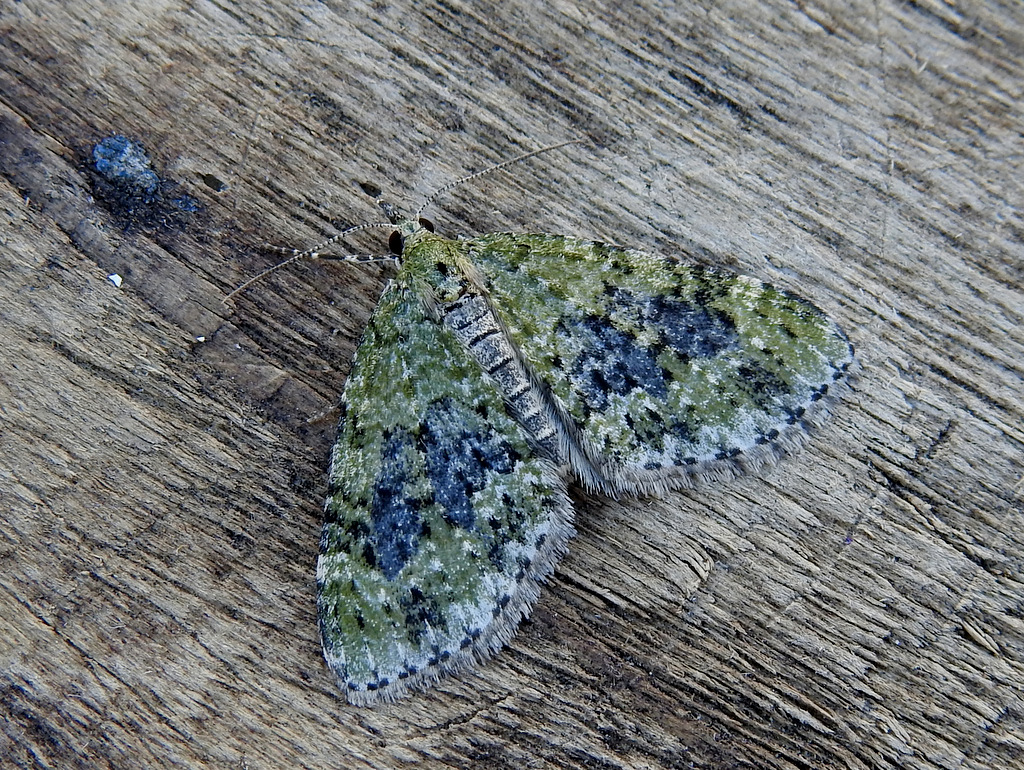
We've had a garden Lime-speck Pug before, but it was great to pot another last night.

Actually, I think the caption should be Neocochylis molliculana. Anyway, the Ox-tongue Conch is apparently a recent colonist (since 1993) and hopefully will also wind up in the garden trap one day. A nicely marked micro.

While I'm in moth mode, some garden goodies from recent nights...

White-point. Our first example of this nice migrant.

Pale Prominent. Not our first, but such a whacky moth deserves a pic.

The Nutmeg. Another first. Doesn't appear to be that common locally.

Yellow-barred Brindle. Another garden first. Fresh ones - which this is - are green, apparently. At which point they make whoever is responsible for their vernacular name look a bit silly.

There is so much more I would like to include in this post, but already it's a bit fat, so, I shall sign off with my favourite photo from this morning's Cogden outing...

Wheatear and cattle.

Saturday, 6 August 2022

PM Pied Fly

It felt just like the old days this afternoon, when I used to go birding a lot. A slow, easy plod around the eastern side of of West Bex. Conditions were hot and sunny, slightly mitigated by a cool offshore breeze, and I hoped for little more than a Willow Warbler or two. However, I got none. Terrific weather for butterflies though...

Clouded Yellow was plentiful, and I saw 10+ without even trying.

Ditto Painted Lady, mainly near the coast path.

Always good to see a Small Copper. The little 'tail' in the hindwing stands out nicely in this pic.

My first Brown Argus of the year.

Migrant birds were at an absolute premium, and I heard not a single 'hoo-weet' from the hedgerows. The best I could muster were 2 Wheatears at the back of the beach, and 40+ Med Gulls on it. The heat-haze made photography a non-starter. Well, almost...

Wheatear, through a gap in the heat-haze.

I was almost back at the car when I got a brief (i.e. one second) view of a Pied Flycatcher along Labour-in-Vain Lane. Darting instantly from its open perch to some thick foliage, I got nothing else but an occasional flicking movement in the leafage, and eventually not even that. After a few minutes I moved on, and had very nearly got my keys out when I surprised myself by deciding to go back and give it some more time. 'Okay. What's to lose?' I thought, and retraced my steps...

Yep, definitely worth the bother. Pied Fly.


So, that was nice! My first Pied Flycatcher of the year, and a great little performance to boot. It cost me about 15 minutes.

Shortly after this, a Hobby dashed west, and a smart Lesser Whitethroat popped out of a hedge for me. I am glad I loitered.

Prior to this afternoon's birding I was trying hard to get a decent pic of one of the smartest little micro-moths I've yet seen. We've caught one previously, but on that occasion I failed to do better than a rubbish pot-shot. Unfortunately I didn't do a great deal better today...

Hopefully this shot conveys the size of it, or lack of...

Despite being photographed through the wall of a plastic pot, this is about the best I managed. Those black-bordered body stripes are gleaming silver. It is an outrageous little thing!

Phyllonorycter platani appears to be quite scarce in Dorset. Its food plant is London Plane, so perhaps that is a limiting factor? However, we happen to have an impressive London Plane tree on the green across from our bungalow. Winner!

We bagged another classy little micro a couple of nights ago...

Our second one of these. At 3.5mm, easy to miss!

Some of the micros we are getting appear to be quite scarce in Dorset, but is it more likely that they are simply under-recorded? Anyway, here's another recent one...

We've had this once before too.

New moths include one of those where you have to see bits that are normally not visible, in order to confirm the identity. Svensson's Copper Underwing requires a good view of the underside of the spread hind-wing in order to separate it from the regular Copper Underwing. Tricky. I've been practicing on Lesser Broad-bordered Yellow Underwings, checking them to see if any are Langmaid's Yellow Underwing. Not so far. Trying this lark on a fully-awake moth is a mug's game. It's like trying to grip a greased almond! I don't want to damage these beautiful creatures, so I only bother trying it when they've been in the fridge a while. Then I can be quick and gentle, and hopefully see what I want to see. And this morning I saw the underside of a Svensson's Copper Underwing's underwing. Nice.

Some recent new ones...

Unfortunately this Bordered Beauty looks like it's had a lucky escape from a bat.

Micros are growing on me. Pre moth-fever, I wouldn't have given this a second glance.

Another one with lovely markings.

So, August has arrived with a bang. Pied Flycatcher has stirred the slumbering birder, and now I have two things demanding that I rise at stupid o'clock, instead of just one...

Wednesday, 3 August 2022

An Actual Bird

22nd May, 1978 is the date pencilled in my old Peterson guide. Google tells me that was a Monday, which doesn't surprise me. A layabout student could pull a birding skive any day he fancied. In this case, a short cycle ride to Wraysbury Gravel Pits to see his first Little Ringed Plovers.

Until quite recently I took LRP a bit for granted. In the early 1980s you could watch breeding pairs raise their young on the drained north basin of Staines Res from the causeway. And back on the Axe patch in Seaton, LRP was a gimme every spring and autumn, sometimes in numbers. Roughly a decade ago, some nasty spring weather caused a bit of a migration pile-up at Black Hole Marsh, with Little Ringed Plovers arriving, but seemingly unwilling to push on. I forget what the final tally was, but my unreliable memory says 20+ birds together. Which was a very big count for Devon, especially in spring.

And then I moved to Bridport.

Until today, I think my local LRP count was one. Now, thanks to a prompt message from Alan and Mike over at West Bex, it is two...

Gorgeous juv Little Ringed Plover on the dried-up Big Pond.

Some unseen (by me) fly-over provoked this defensive crouch.

A circular walk involving the coast path and some inland areas produced zero other migrants at all, but my bins were nevertheless grateful for a bit of action.

The last couple of moth returns have been a bit disappointing. With the nights so warm I was expecting great things. Even so, one new species in each catch. This morning it was this one...

A rather worn (note shiny, scale-free thorax!) Purple Bar.

In good nick, I can imagine that Purple Bar is a classy little moth. Not uncommon either, so hopefully we'll get a fresher one.

A couple we've had before...

Cochylimorpha straminea - c.7mm long, and beautifully marked.

Flame Carpet. Excellent name.

Cloaked Minor


The other new moth was one of those irritating ones that is almost certainly a something-or-other, but might conceivably be a so-and-so instead. It is 5mm of mini-tripod weirdness, and not the most colourful creature. But what it lack in gaudiness, it makes up for in attitude...

Hopefully my delicate little digits convey some idea of how tiny this moth is.

It is a Parornix sp., and my money is on P. devoniella.

Whatever it is, it's new for us, and not all that common locally I suspect.

Finally, that LRP again...

Ju-u-u-u-st lovely...

Monday, 1 August 2022

Dusty Bins

My camera bag is the home of two things: my camera and my bins. Just lately, only one of those things has been seeing any action. Every time the flap opens, my bins must be thinking, 'Today? Is it today...?' only to see that poxy, smug Nikon lifted out yet again.

So, in the spirit of fairness I have promised my bins an outing tomorrow. So there may be bird stuff on here presently.

In the meantime...

I have just completed an almost unbroken month of garden moth-trapping (one night off, and another in Lyme Regis) and thought it might be interesting to crunch some numbers. Here they are...

  • Mean catch rate: 76 moths of 41 species (from 29 nights)
  • Maxima: 179 moths / 81 spp
  • Minima: 26 moths / 15 spp

Compared with many stats I read on Twitter and elsewhere, this is very small potatoes. It will do me though, and is providing more than enough head-scratchery. And there have been a few scarcities to sweeten the deal. It has been a great way to dip my toes into the water. Of course, said 'water' is actually a bottomless lagoon of deceptive tranquility which has claimed many a former birder's soul, so I am trying to keep a cautious eye on my current depth. For example, a book on micro-moth identification was recently recommended to me, and the haste with which I opened my wallet suggests I am at least up to my ankles already. Should I worry?

Don't be misled by the title. This terrific volume is perfectly at home in Dorset.

There have been no fireworks over the last few days, but still there has not been a single night without at least one new species added to the tally...

Our third Currant Pug, and with a forewing length of slightly less than 9mm (9-11 typical, according to the field guide) a small one too.

Copper Underwing - a new species for us.

A delightful caramel toffee thing, our first Dusky Sallow.

Another caramel toffee, but much, much smaller. Cochylimorpha straminea, also new.

Another new one: Flounced Rustic. If you can see it, that is...

The same Flounced Rustic, uncloaked.*

I took that second shot of the Flounced Rustic for a specific reason. This moth was in last night's catch, and another garden first. I identified it the old-fashioned way, by laboriously thumbing through the field guide plates for a match. To be frank, there are loads of moths that look vaguely similar to this, but Flounced Rustic seemed the best fit. However, this afternoon I thought I should double check. One way to do that is to take a clear photo and run it through the Obsidentify app. So I did...

That'll do.

One slightly unanticipated aspect of moth-trapping is the non-lepidopteral by-catch. Last night there was this interesting creature...

Oedemera femoralis - female

This beetle is a close relative of the common, metallic-green Swollen-thighed Beetle (Oedemera nobilis) but is apparently quite scarce and, unlike the green job, entirely nocturnal. So moth-trapping is a great way to see one. Win-win.

Finally, a tiny bit of bird stuff...


I needed help to identify this triple call, but it is actually a Tree Pipit, and flew over at 01:43 on Saturday morning. I definitely would not have predicted a nocmig Tree Pipit in July. But there you go...


* the first, and probably last, Trekkie reference in NQS