Pages

Wednesday, 18 December 2019

Widening the Goalposts

Well, what a fascinating day it's been. Started work quite early to beat the weather, and a bit later in the morning virtually had to drive past Colyton WTW, so...

Just a quick look. Ten minutes. Fifteen, tops. Tsk! How is it possible to reach my age and still think you can kid yourself?! Chiffchaff heaven! After draining a camera battery and inserting a second I realised I probably should get on...

Via the estuary.

There were lots of gulls. By now it was blowing a hooly, and many birds were hunkered down on the islands above Coronation Corner. I went through them carefully, but drew a blank. Heading along the river I realised there was a good spread of birds all along, so drove to the bottom end and U-turned. First stop, opposite the tram sheds, and a gleaming white head shone across the river at me. Through bins I could see it wore a yellow ring on its gangly legs, and punted out a message on the patch WhatsApp group: 'Yellow-ringed prob Casp on estuary by tramsheds'. Why only 'prob' Casp? Well, I didn't need a scope to see it had much more heavily-marked underparts than I would like to see on a pure 1st-winter Caspian Gull. My ideal is white! A bit of flecking on the breast sides and flanks wouldn't concern me, but this bird had a lot more flecking than 'a bit'! I reached for the camera, dug out the scope and sallied forth...

First views were something like this. Even if 'gull' is a dirty word to you, I expect you can see what made me look twice. In my experience (which isn't vast, by the way) that sharply-demarcated white head is THE classic 1st-winter Caspian Gull feature to catch the eye.

I honestly don't think I've ever seen a more striking 1st-winter LWHG (sorry, Large White-Headed Gull - generic term). And just look at those stilts!

Gorgeous!

For me there are two main reasons why this isn't a classic, textbook 1st-winter Caspian Gull...
  1. The heavily-marked underparts. That grey on the belly and flanks is almost solid! The undertail area looks fine to me, but almost all the rest...er...no.
  2. The strongly-marked inner greater coverts. I have seen chequered markings like that on Casp, but not as extensive. The outer greater coverts look better though, with a plain, dark base and pale tip.
However, having got home and loaded up the photos, I am finding myself a lot more optimistic about this bird. Why? Because everything else about it (that I was able to see) looked absolutely spot on. To me anyway. The structure looks perfect, the bill ditto. To my eye Caspian Gulls have a 'look' - basically a facial expression I guess - and this bird most definitely has it. The tertials and primaries look great. At one point it nearly blew over in a gust of wind, and I could see that it had a crisp, densely black tail band. Again, perfect. I never managed a proper underwing view, or decent open-wing photo. This was the best (the only) shot I got...

Interestingly, although the axillaries look rather strongly-marked, the underwing coverts that are visible look pleasingly pale...

Both the above photos are included just to illustrate the contrast vs typical 1st-winter Herring Gull. Chalk and cheese, aren't they? It's not a huge bird, and certainly not as brutish as some I've seen, so I'm guessing probably a female.

The yellow ring (X78C) indicates that the bird is from a German gull colony. On the ringing project's web page is the following note:

It is not possible to identify the ringed small chicks exactly... In most cases the gulls are Caspian Gulls or Herring Gulls, but note the existence of many hybrids. The participation of some Yellow-legged and Lesser Black-backed Gulls is also possible.

'Participation'. Hah!

So. The parentage of this striking beastie is evidently unknown. I await details of the history attached to this bird's ring, but am told it will probably come back as 'Caspian Gull'.

And then someone got me thinking...

A Twitter correspondant sent me a photo of a near-adult Caspian Gull in all its mature finery and quipped 'This is what it will look like when it gets older!' And a lovely 2nd-winter Casp - yellow X307 from the same colony. The point was clear. It might look a bit mucky right now, but when it grows up it will look exactly like a pukka Caspian Gull. And I believe he is correct. Structurally (and mostly, plumage-wise) I see nothing significantly wrong with it. Let's face it, a colourful family tree is nothing to be ashamed of...

Conclusion? I am going to widen those goalposts like the gull whore I am, and put it down as a Casp. I doubt the Devon Rarities Committee would be impressed though!

Finally. While crouched by my scope and staring intently at my camera screen, waiting patiently for the bird to fly, or open its wings or something, a chap strolled up and introduced himself, whereupon I pointed out the gull. In case he reads this, I would like to apologise to Mark for focusing so rudely on my camera throughout. It was very nice to meet you by the way!

Which reminds me. Crouching! Aaagh!! I am getting too old for prolonged crouching...

Tuesday, 17 December 2019

More Chiffery

I never write posts like this, but thought it might be of interest this once...

Basically a photo-essay of the Chideock Chiff. At..er...lunchtime I visited and took some photos. I am in the middle of reading up on Sibe Chiff and was interested to see how photos appeared in different lighting. Thankfully I was able to get shots in a few different places, and the light was pretty flat; no sun until I was just about to leave.

I shall mostly let the pictures do the talking.

Same time and place as first 3 shots, but notice how much browner it looks. I think the bird was slightly over-exposed in the first 3, and definitely a bit under-exposed in this one (which I have lightened a touch).

Wish it had a spent a few minutes loafing right here. No chance. One shot, gone.

Not a Bonelli's Warbler. Fact.

Lots of colour variation in those images, depending on the light, angle, exposure, etc. Despite how it appears in some of those photos, in the field it was always warm-looking, and basically a pale buffish brown, with almost-white underparts. Depending on the angle, the obvious yellowish-green fringing on the secondaries, primaries and tail was apparent too, also the pale-based bill.

It responded very briefly to tristis song when first played, with intermittent wing-quivering for a few seconds, but quickly lost interest, and didn't do it again [incidentally, the Colyton WTW bird reacted in exactly the same way]. Unfortunately it never called once.

So, is it actually a Siberian Chiffchaff (Phylloscopus collybita tristis)? Well, as far as I can gather on evidence thus far considered, it's definitely not a 'classic' tristis, which average somewhat darker and browner. But neither is it one of the seemingly rare and [possibly] unassignable 'grey and white' jobs either. In fact it seems to be of a type encountered quite frequently, like the Colyton bird...

The Colyton WTW bird from 11/12/2019

And what exactly is this type? As I say, I am still mid-research, but quite probably it is tristis. But, boy I wish the things would vocalise a bit!

Not a Chiffchaff! But a very welcome distraction. There were in fact 2 Firecrests.

Monday, 16 December 2019

When Ignorance is NOT Bliss

How are your bird ID skills? For example, could you pick out an American Golden Plover in a flock of regular Goldies? Not too tricky perhaps. But could you say why it wasn't a Pacific Golden Plover? Or suppose you had the good fortune to be faced with the Radde's/Dusky conundrum. How would you get on? And which of the multiple Subalpine Warblers are you going to plump for. And so on...

American Golden Plover. But why?

And if things weren't challenging enough, modern taxonomy seems intent on making it harder. Personally I lose interest when confirmation of a bird's identity requires a laboratory. However, when it comes to identification in the field, basically I am up for it. There is just one problem: I am rather lazy. To identity birds you need to learn stuff. Which means effort is required. There is simply no getting around it. Which raises the question: can I be bothered? Can you?

Speaking for myself, the answer is 'sometimes'. For example, several years ago I could be bothered to learn how to identify young Yellow-legged Gulls, and Caspian Gull. I am not an expert, and couldn't give you chapter and verse on many subtle aspects of their ID, but am confident enough to call any that I encounter, knowing I'll probably be correct. However, when it comes to those species listed in the opening paragraph, well, I can do Radde's and Dusky Warbler, and I think I would pick out the AGP okay. But to rule out PGP I would have to check a field guide, and very much ditto for the Subalps!

Hello Mister Casp!    Not usually rocket science, but not a doddle either.

So, why have I made a lot of effort with the gulls, but not necessarily elsewhere? I suppose it boils down to two simple questions:

  1. How relevant is this knowledge to my everyday birding?
  2. Does not having this knowledge bother me?

Question 1 is a no-brainer, but I would like to talk a little about question 2.

Ignorance is bliss only when you're ignorant of your ignorance! Being faced with a seething mass of mucky gulls every time I visited the Axe Estuary, and realising that a juv YLG or a Casp could be giving me crippling views and I wouldn't know it, was not bliss. So I knuckled down and learned. It wasn't easy, and is still a challenge, but I am very glad I bothered. The knowledge thus gained has led to some highly satisfying birding moments.

And right now there is another ID challenge vexing me greatly because of my ignorance. It's those 'pale and interesting' Chiffs that I have labelled Siberian, pretty much on the say-so of others. No disrespect to those birders who have offered opinions, but in a sphere where there is evidently not a consensus, I ought really to be doing the hard yards and learning the stuff for myself, and then coming to my own identification conclusions based on actual knowledge. And here's why...

        So Gav, what makes you so sure that's a Siberian Chiffchaff?
        Er...well...Derek Expert thinks it is, and he should know, right?

Not good.

        So Gav, definite tristis you reckon?
        Er...yes...I think so...
        What features convinced you?
        Well...the paleness... And the interestingness...

As I say, not good.

So, as of three days ago I have been researching in some depth, and learning stuff. Watch this space. There is more to come...

Friday, 13 December 2019

Like Buses...

Following recent Sibe Chiff success I have been poring over local maps in search of sewage works. My intention, obviously, is to visit any I find, and see if they are as attractive to small insectivorous birdies as the glorious WTW at Colyton. Back in my busy and active days on the Seaton patch I would occasionally visit the sewage works at Branscombe, Kilmington and Whitford, and am well aware of their pulling power. I certainly remember one or two pale and interesting Chiffs at Kilmington but viewing there was difficult, with birds usually quite distant, so nothing ever came of them. Branscombe was pretty good for Firecrests, and I recall it had Yellow-browed Warbler once or twice, though I never managed to see any of the latter myself. Whitford was too small and isolated to get excited about, and I only ever managed a few Chiffs on visits there.

Well, I am struggling to find any sewage works local to me in Bridport. I can think of one that I've cycled past a few times, over near Puncknowle, so shall give it a go at some point. But surely there must be one or two nearer than that? You'd think so, but thus far I've drawn a blank. Until today...

On WhatsApp, a message from @CharmouthBirder popped up. Two Firecrests at Chideock WRC. [At this point I'll just mention in passing that yes, you are dead right, sewage works don't seem to be called sewage works these days. It'll be Wastewater Treatment Works, as in the Colyton plant, or Water Recycling Centre, as we euphemistically have here at Chideock. No-one is fooled. The superb smell gives the game away every time] Along with the message was a little map, at which point I realised I have walked past this very place, probably within 100m, without knowing it was there. I immediately expressed interest, whereupon Richard mentioned that he'd had a brief view of a Chiff that was 'pretty washed out' and that it 'looked interesting'. Which of course it would!

Suddenly I realised that lunchtime was upon me!

Buried in the middle of nowhere is this...


Chideock Water Recycling Centre. Yes, recycling. You know...like cardboard, bottles, tins, etc, but much smellier.

Access around the place is very good, and there are hedges, trees and brambly spots for the birds to feed in, as well as the filter beds themselves. I didn't really make an effort to count anything, but there must have been 15+ Chiffs, at least 2 Treecreepers, 6+ Long-tailed Tits and a handful of Goldcrests. More excitingly, I quite rapidly latched on to a pale Chiffy. It was feeding along a fence line, right across the other side of the works from where I was standing, but by the time I got round there it had vanished. Eventually I spotted it again, feeding on the filter bed gravel. Rather distant, but I snatched a quick and rubbish photo before it disappeared again. I only include the image here because it conveys the impression you get when first clapping eyes on one of these little beauties...

Compare pale job on the left with standard collybita on the right

Finally it appeared once again on the filter bed, and though I couldn't get closer than about 40 or 50m, the bird was visible long enough to get a few record shots. None is worth posting alone, so have this collage instead...

Siberian Chiffchaff, Chideock WRC

To my eye it is pretty much the spitting image of the Colyton WTW bird, and if that one is okay to label 'Siberian' then I'm happy to do likewise here. I shall definitely visit again, and hopefully get some better shots.

I still hadn't stumbled upon either of the Firecrests Richard had seen earlier, and then, just as I was contemplating heading off at about 15:30, one appeared in the trees adjacent to the main entrance gate. Superb! They really are such little jewels.

I guess there is a lesson to be drawn from the last couple of NQS posts. A while back I was banging on about The Road Less Travelled, and I think it's fair to say that most small sewage treatment plants would slot into this category. There must be quite a few tucked away in remote little spots around the country, and at this time of year any one of them might be harbouring Firecrests, a smart little Sibe Chiff, or even Yellow-browed Warbler, Dusky Warbler or...dare I say it?...better. Got to be worth a look...

Wednesday, 11 December 2019

Pale and Interesting

Life and the weather have joined forces against me. Between them they have reduced my outdoor leisure activity to almost nil just lately. The single ray of sunshine in this desperate gloom is a magical thing called 'lunchtime'. However, despite the immense flexibility of its application, my best lunchtime efforts have yielded nothing. Until today...

It's a long time since I last saw a Siberian Chiffchaff. I honestly don't know when I saw my first, but assume it must have been prior to the Great Phase of the 1990s. I genuinely don't remember. But I can remember my first tristis of modern times. It was late December 2004, and @birdingprof was visiting. I took him to the field next to Colyton Wastewater Treatment Works (like you should when folks visit) and among the myriad Chiffs present we found a pale one. I expect the Prof spotted it first, so I'll give him the credit right there. Anyway, it was a real corker, and satisfied all my tristis needs. It actually called and everything. And stuck around. And was twitched. I wrote a description, sent it in. Sibe Chiff. Accepted. Hero.

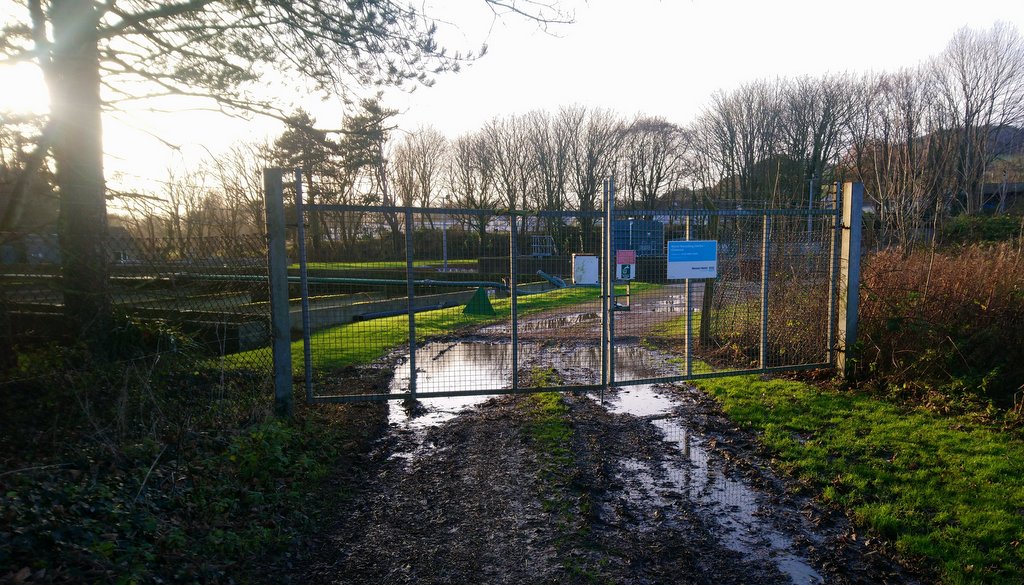
At...er...lunchtime today, I found myself adjacent to Colyton WTW once again, just like old times. The reason I was there was so that I could scan the field across the road, because there are Water Pipits living in it right now. Could I find them? No I couldn't. And to be fair it was hardly a thrilling enterprise, so I wasn't as conscientious as I might have been. Alrighty then, a quick look behind the Treatment Works before I go...

Strewth! It was absolutely jumping with Chiffs. At least 30, maybe 40 or more. Definitely worth some time.

Colyton WTW. If you twitched the Devon Eastern Yellow Wagtail, you've been here. Those filter beds are absolutely crawling with little midgy fly-things, and the prevailing SW breezes push them into (and through) the hedge that runs along the NE border. Guess where all the Chiffies usually are...

Initially it was Treecreepers and Goldcrests that entertained me. Point-blank views of both. And then, among the collybita horde...

Ooh! You're rather pale and interesting, arent you?!

I could see straight away that it looked pretty good for tristis, but would it call for me? No it would not. Anyway, I watched it for quite a while as it moved up and down the hedge, and tried valiantly to get some photos. Here are what amount to the most helpful efforts...


Through bins the ear coverts looked convincingly 'milky tea' coloured to me, but that feature doesn't come across brilliantly in the photos. Even so, I cannot really see anything amiss, and am happy to call this a pukka Siberian Chiffchaff (Phylloscopus collybita tristis). However, I am far from an expert on such subtleties, and welcome comments.

Vive le lunchtime!

Monday, 2 December 2019

A Touch of Early Summer

Our elder son has been working in Zürich all year, and I really miss his infectious enthusiasm for fishing. It was Rob who blew on the embers of my first love just a few short years ago, and rekindled the passion that used to get me out on the bank in all weathers as a lad. But I have struggled in his absense. As I type it is basically freezing outside, so I've just been cheering myself up with a few photos from early summer. Memories of June, early July, and a pretty little lake...

Good coarse fishing is at a premium in this part of the country. It is there, but mostly you have to travel. The Exeter Canal is an hour away. In the opposite direction, the Hampshire Avon or Dorset Stour are at least that and more. Finding something close to Bridport that actually ticks my boxes has been impossible...until this year. There are fisheries nearby, and one or two have produced a few very large perch, for example, but you are far, far more likely to latch into a dozen rabid carp before a decent specimen of another species gets a look-in. Probably I'm fussy, but loads of hungry little carp put me right off. I really do not see the attraction and am so glad that kind of fishing wasn't available when I was young. Anyway, back in May I found myself looking again at one local water which I'd written off for this very reason. Because I discovered that despite what I thought, it isn't actually stuffed with carp at all.

But it is a carp lake. They don't run to huge proportions - the lake record is just over 20lb - but there are just 45 or so in a pool of around an acre, and they are not easy to catch. A few of those carp have been in there more than 30 years and are proper characters, and the stock is occasionally enhanced with younger fish, all of them lookers. It is quiet, extremely well cared for, and very, very pretty. I can fish it all day on a modestly-priced club ticket (and at night for a few quid a time) and it is a mere seven-minute drive away. At the start of June I had a go...

My first visit was a short evening trip. Just a single rod. No bites.

June 5th, around 19:30. Warm. Still at least a couple of hours of light. Mmmmmm...

The next morning I was back again, early, and quickly found some feeding fish bubbling away in the edge. Gingerly I plonked a bait amongst them. The bubbling ceased immediately. They had melted away like seasoned old warriors. Brilliant! I love it when the fishing is a bit tricky. This may sound daft, but believe me, when there's no challenge there's not much fun either. About an hour later, a rod I'd cast out to my left was suddenly being tugged sideways in the reeds, and I was in...

My first one. A golden torpedo of around 9lb.

All my visits were short ones, sometimes just a couple of hours. Once or twice I didn't even cast a line, but just strolled round the lake, peering into the corners, the pads, the margins, looking for a stalking opportunity. The water is not crystal clear, but fish - or signs of fish - were often visible. Sometimes just a tell-tale nudging of reed stems, or wafting lily pad. I absolutely love fringed water lilies. Nymphoides peltata is the species, and this lake is full of it. It only grows in the shallow, marginal water, and the beauty of this particular lily (as opposed to the bigger, brutish beast-lilies that have underwater scaffolding lurking below their deceptively pretty flowers) is that you can fish right in the thick of it with relative impunity. I've caught near 30-pound carp in the stuff. The point is, carp love it too. They like to lurk in its shade on hot days, hiding from the angler and chuckling at their cleverness. One scorching afternoon in early July I found about five or six fish right in this lot...


I sorted myself out a Nash 'Bread Bomb' (which is basically a neat way to fish a lump of floating bread without it falling off your hook) and carefully lobbed it out onto the pads. As it landed, its weight forced the pads sideways slightly so that it floated on the surface, gently oozing its white, sliced, farmhouse pheromones into the lake. I could see at least three carp within about six feet of it in various directions. I waited patiently for the fireworks...

Nothing happened. Ten minutes. Fifteen. Twenty. One of the carp had its back very slightly out of the water, and my eye kept returning to it. That fish remained in the exact same position for at least 45 minutes. On the other hand, one fish was constantly shifting position. Back and forth, closer to my bait...and then away again. It was exquisitely unbearable.

Of course I was constantly checking the bread bomb itself. After an hour it was still just sitting there, totally inert.

And then suddenly it vanished! One second it was there, the next, gone. Sucked beneath the surface without a sign. Not even a ripple.

I struck.

The pads absolutely exploded! My heart was in my mouth like I was a kid again, and after a short, frantic scrap it was mine...

Again, not big (it weighed 13-something) but stuff like this ticks the right boxes for me. Massive fun.

Sunday, 1 December 2019

The Shingle Wasteland

I first became aware of Dungeness through Richard Millington's A Twitcher's Diary, and the illustrations of some birds he saw there on 11th May, 1980: a flock of 8 Pom Skuas, a Roseate Tern and two Med Gulls. Dungeness was clearly a brilliant place. So when Mrs NQS and I first visited in spring '82 we were expecting similar. Obviously. In the event it was dire, and I don't recall a single notable bird. Eventually, and mostly through twitching, I did see some decent birds there. Least Sandpiper, White-winged Black Tern, Booted Warbler and, on a memorable May seawatch in 1990, my own flock of Poms (nine) heading up-Channel.

By the early '90s I was phasing somewhat, but one spring day at that time I drove down with a birding friend who was very ill with motor neurone disease. The day is memorable only for its poignancy, and I can recall nothing about any birds. My waning interest left me wondering if that sad trip might be my last to Dunge.

In truth I didn't like the place at all. I thought it bleak and soulless. During one visit in the '80s a friend and I had trudged across a vast and birdless expanse of shingle only to be accosted by an irate warden on a quad bike. We had inadvertantly wandered onto forbidden land behind the RSPB reserve. Our protests of innocence fell on deaf ears. We should simply have known better, apparently. It all got a bit heated, and the whole experience kind of sums up my feelings about Dungeness in those days. More trouble than it's worth...

Fast-forward a tiny bit, to 1994.

Our eldest son, Rob, is 11 years old and in his final year at primary school. While most of the rest of his class are off on some dubious and expensive trip somewhere we decide to take him out of school for the duration, intent on filling his week with educational, but fun stuff. For some reason Rob's phased-birder dad suggests a few days at a bird observatory. Goodness knows why. He had never even stayed at one himself! "Dungeness is probably the nearest," he added. The idiot. The next thing I know, that same fool is booking us in for three nights. What was he thinking?

We loved it! Even now Rob remembers it with fondness, and the relentless football banter when the obs inmates found out he was an Arsenal supporter. Actually living there for a few days made all the difference for me. Just mooching about in relaxed fashion, doing as much or as little birding as I felt like. Or we could watch the ringing for a while, or join warden Dave Walker and his assistant Dave Okines on the net rounds if we wanted. No pressure at all. Kicking back, chilling out...terrific...

It was mid-May, so the birding was hardly frenetic. But one morning...

Rob and I were up at the crack, and headed for the trapping area. There was a heady freshness to the air, and I can remember having that optimistic feeling of anticipation that borders on excitement at being the first into the field on a morning of promise. In reality I cannot recall us seeing anything special at all, but on our return, passing almost the final clumps of trapping area sallow, a burst of song stopped us. Initially I thought it was a Nightingale. But there was just something a bit off... For example, no piping 'piu-piu-piu' phrases that my memory told me were characteristic of that species. And a really harsh rattle on occasion. We could hear it just fine, but actually seeing the songster was another matter; it was buried in the middle of a clump. I tried poking my head in and got bad views of a silhouette. We needed reinforcements.

Back at the obs nobody was up. We had to knock on Dave Walker's door. The first thing he did was play us recordings. Nightingale? Hmmm. Or could it be this...? Well...Thrush Nightingale sounded good, but phased birders don't find rarities.

During the course of the morning that bird led us a right merry dance. Ray Turley and I squeezed into the sallows and had fairly poor views of it bellowing away at the far end, but both of us saw enough to say its breast looked mottled. It was favouring a particular pair of clumps, so a net was erected between the two. After an endless wait the bird flew across the gap, straight into the net. And bounced straight out again! Obligingly it tried again, and this time Dave Okines was like a sprinter out of the blocks, and it was ours. And it was a Thrush Nightingale...

The very bird. Thrush Nightingale, Dungeness, 18/5/1994  [DBO photo] 

Sleep was sweet that night, and the glowing, throbbing power station just across the shingle almost friendly somehow. That was the first of four or five short stays at Dungeness Bird Observatory over the next couple of years, and I grew to love that shingle wasteland after all. I'd like to think that one day I'll return...