Pages

Tuesday, 8 February 2022

Local Doings

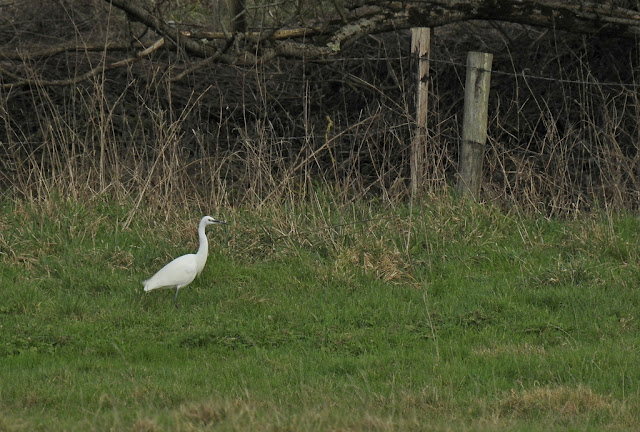
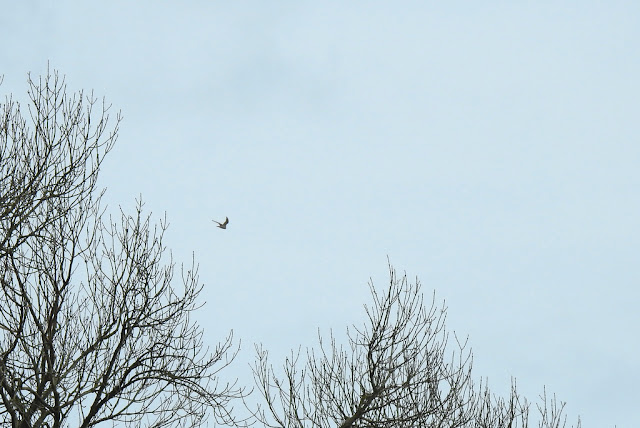
The last few days of local birding have been both fun and pretty rewarding. On Saturday afternoon I took a walk from home, north up the River Asker valley to a picturesque old mill in the middle of nowhere. The highlights were very modest, but included a few Meadow Pipits, 250+ Redwings in two flocks, four Little Egrets and a fly-by Peregrine, my first of the year...

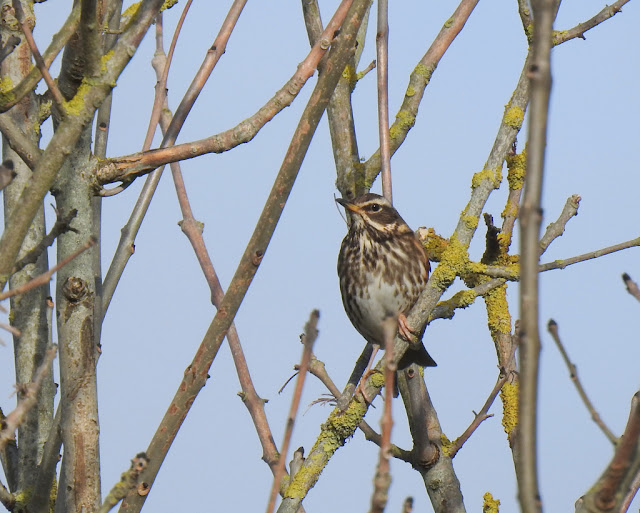
Redwing. 150 of its mates just out of shot.

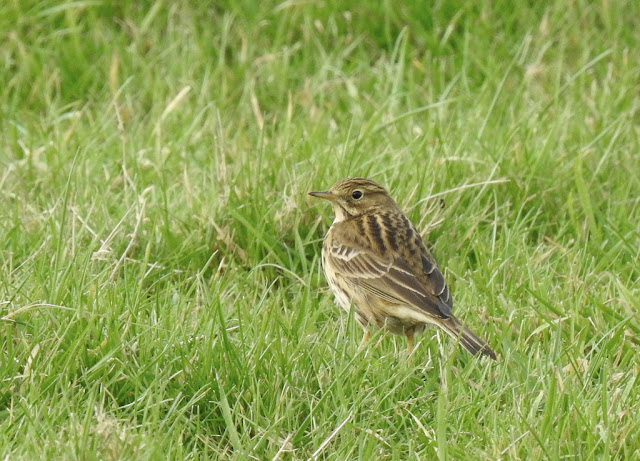
Meadow Pipit

Little Egrets still have a tiny bit of novelty appeal when they're along the local river.

Peregrine in all its miniscule glory.

A single Common Gull was actually quite notable at this location.

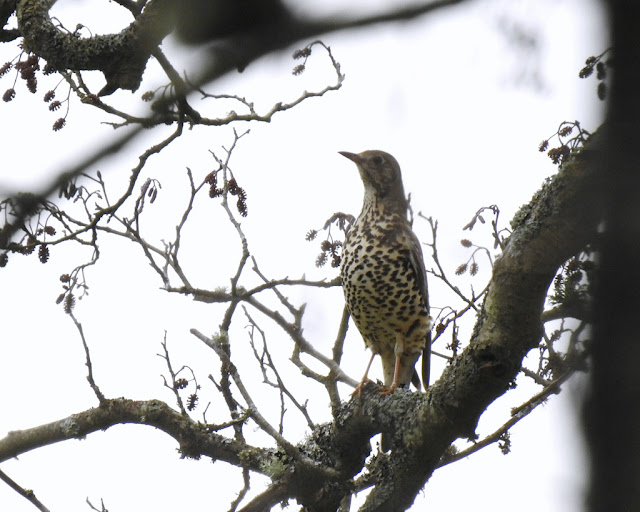
Mistle Thrush at Mangerton Mill Lake

Since then there have been efforts to add Golden Plover to my #LocalBigYear tally (fail), a fourth Marsh Tit and a handful of Corn Buntings...

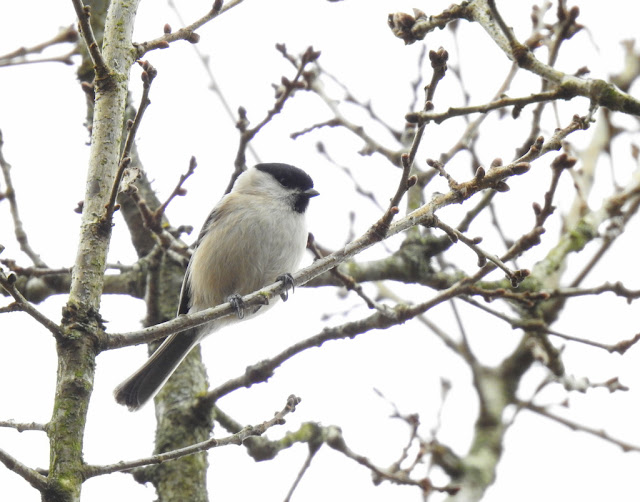
Marsh Tit near Powerstock Common

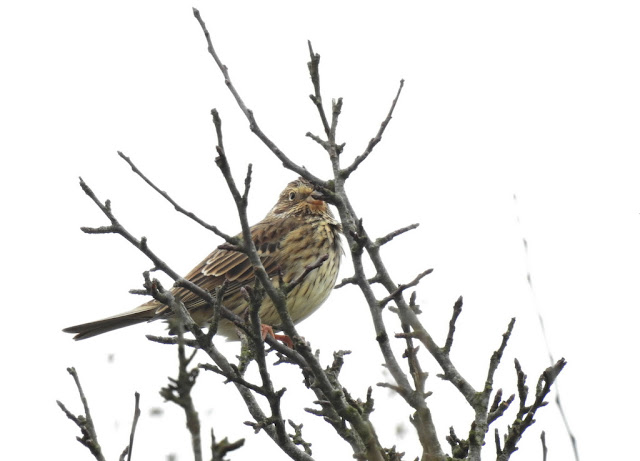
Uncooperative Corn Bunting near Eggardon Hill

Which brings me to today.

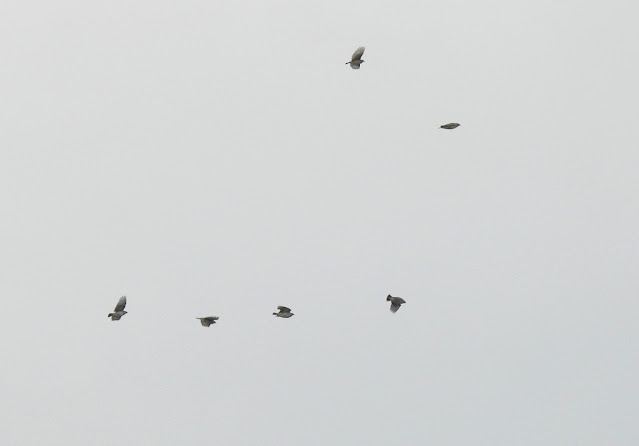
This morning I was kindly invited to accompany a local birder on one of his periodic visits to census a wintering flock of Woodlarks. The count was 18 (there have been as many as 22) and as they flippety-flopped around for a minute or so before resettling, there was a chance to get some ropey flight shots...

Six of the 18 Woodlarks. This shot captures their distinctive jizz quite well. Broad wings and short tails.

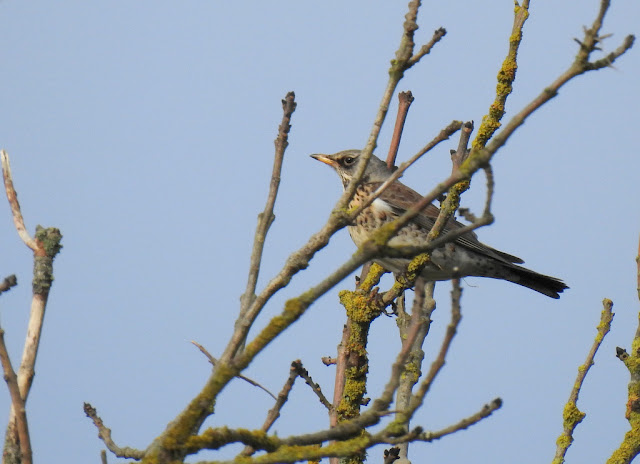
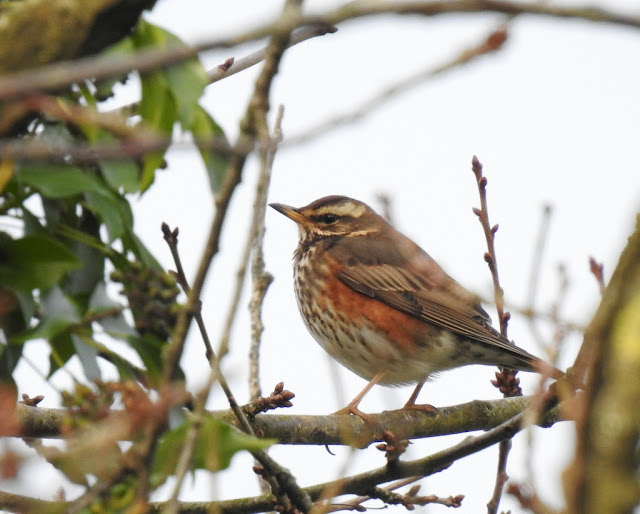
Having a wander nearby for a bit produced a nice flock of c200 Chaffinches - sadly Brambling free - and another opportunity to photograph thrushes badly through gaps and behind twigs...

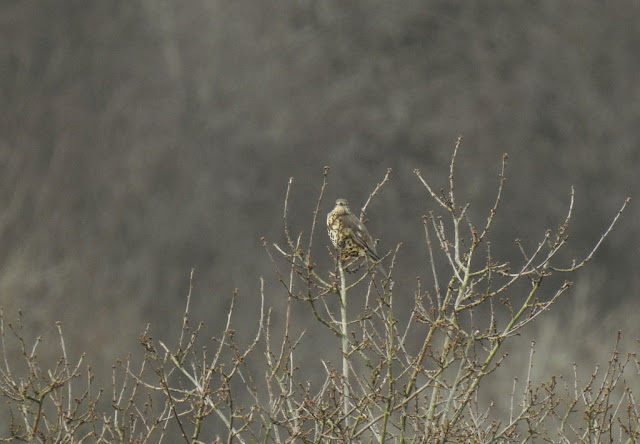
Fieldfare

Redwing

It is fair to say that without assistance I would never in a million years have discovered those Woodlarks for myself, and anyway, they are on private land. I am increasingly coming to appreciate the quality of birding available on my doorstep. The local countryside is not all wonderful by any means, but there are lots of little pockets here and there, if you know where to look. And again, I was kindly pointed towards another in my so-far-unsuccessful search for Woodcock. So this afternoon I tried it...and found FOUR! Winner!

Sunday, 6 February 2022

Sound 'ON'

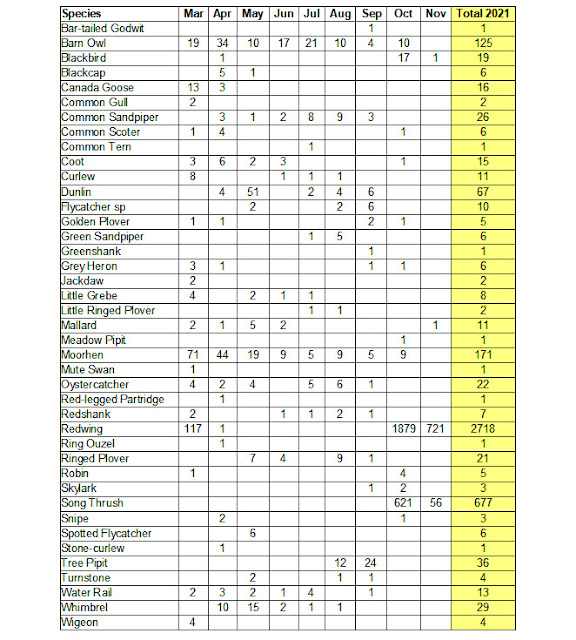
A couple of local birders are making a sterling effort to compile a 2021 local bird report for the Bridport area. This is a lovely idea and it's galvanised me into finishing off my 2021 nocmig data entry so that it can be included. This has involved a dreaded spreadsheet, but yesterday I finally got it done. There is an entry for each night, but here is a summary of the monthly totals...


I had to insert it as a screenshot, so not too sure how legible it will be when embedded in the blog post, but that's the best I can do right now. I only missed one night in March, none in April, four in May and June, three in July, one in August and six in September. October was a bit rubbish, and I recorded only 13 nights. I managed the first five nights in November, and that was it for 2021. Therefore, if my sums are correct, the table shows the results of 213 nights nocmig.

There are some very nice highlights, including Stone-curlew and Ring Ouzel, but my personal favourite thing about nocmig is all the wader action I get here. Being three miles from the sea and a lot further from the nearest pukka wader habbo (there is so little around here) every single wader is a small 'wow' moment.

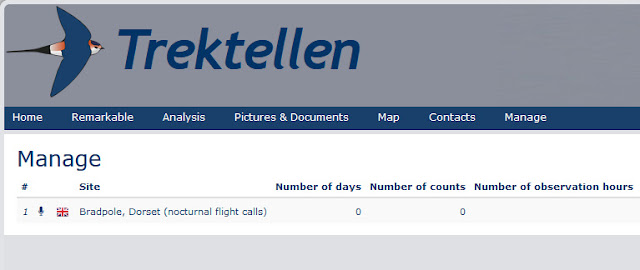
Needless to say, I'm hooked, and plan to do it all again this year. Earlier this evening I deployed the nocmig kit for its first outing of 2022, to the sound of the local church bells loudly wrecking the start of the night's recording! I recently applied for and was granted a Trektellen login, so I'll be trying that platform from now on. Perhaps nocmig spreadsheets are a thing of the past? I hope so!


Yes, I am manager of the official Bradpole nocmig site...

There is a slight problem though. After requesting my Trektellen login, and registering my site as 'Bradpole' I made the surprising discovery that I do not after all live in the civil parish of Bradpole. Rather, I live in what is actually a sneaky part of the parish of Bridport which extends into Bradpole CP like an invasive tongue. Although it was a crushing disappointment to learn that I no longer live in a cosy Dorset village, but a full-blown market town, hopefully Trektellen isn't worried about this trivial factoid.

Thursday, 3 February 2022

#LocalBigYear Listing Ethics for the Unethical

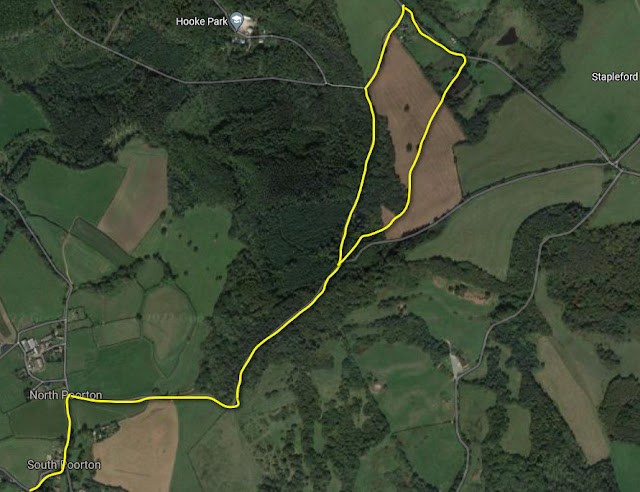
Off the beaten track again this afternoon, and another wander up a quiet back lane. Slightly NW of where I tried yesterday, and a much shorter route. Still, with all the poking around off-piste here and there I still clocked up more than six miles. This map shows the bare bones of it...

A bit of footpath exploration on the top loop, but mostly on the road.

I was hoping to add to the Marsh Tit tally, but that didn't happen. Still, it was great once again to walk roads I've only ever cycled previously, and there was plenty to keep me occupied...

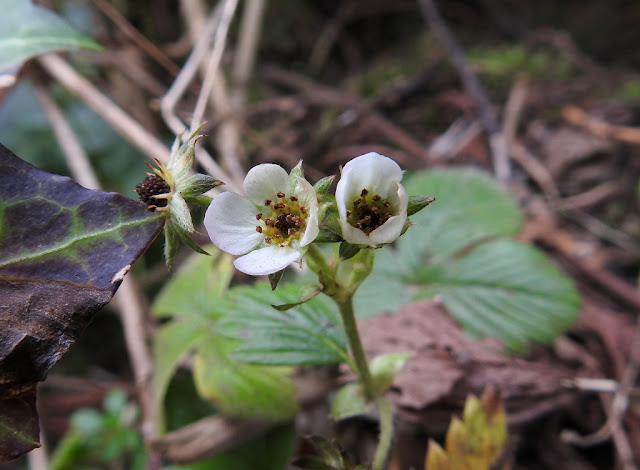
I was surprised to see this Wild Strawberry(?) flowering in a hedge bank in early February, but I don't really do plants and perhaps shouldn't have been?

This Mistle Thrush was one of four seen, but the only one singing.

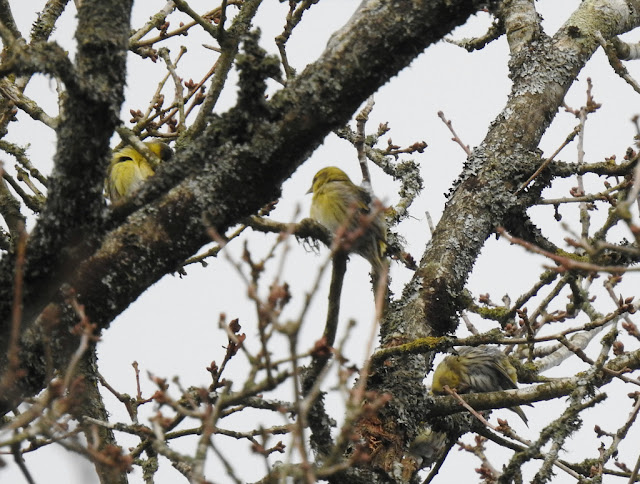
Siskins being very uncooperative

Coming across a little group of Siskins was the surprise of the afternoon [correction: almost the surprise of the afternoon - see below]. There were at least six, and at first I could only hear them. Very faint initially, but I was unexpectedly thrilled at the sound. Wow! Siskins! But that's what happens when you try somewhere largely unwatched and have basically zero expectations. Unfortunately they flew off before I could get a better photo.

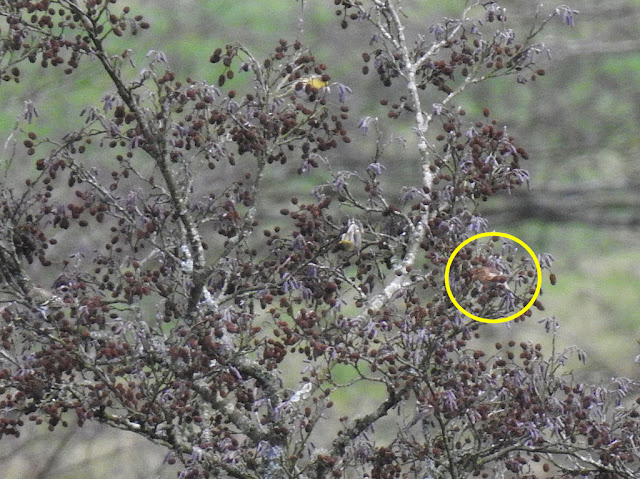
A bit later I found them again, at least a quarter of a mile from the original spot. Or maybe they were a different lot. Anyway, they were feeding in Alders, a good 150m away across an open field. From the road I could see there were 10 or so. I took a couple of full-zoom photos, with the intention of later trying to count them from the pics. And thought no more of it.

So I get home, enlarge the photos and start counting...

One, two, three... Hello, what's this? What's this brown thing?

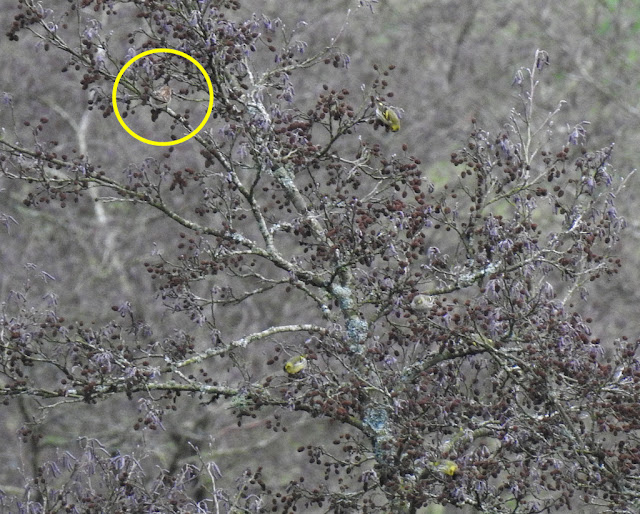
In fact there were two brown things...

Hmmm. That's a Lesser Redpoll right there...

...and that's another one.

Careful scrutiny revealed a total of 10 Siskins with those 2 Redpolls.

I could be wrong, but I guess it's likely that many (most?) other birders would find themselves with a problem right now. A listing-type ethical problem. I mean, there's no doubt that two Lesser Redpolls were present this afternoon, but I didn't actually see them. Well, maybe I saw them, but just as unidentifiable blips that I assumed were Siskins. Can I count them? What would an ethical birder do?

Who cares?!

As a not-very-ethical birder in relaxed pursuit of a #LocalBigYear list I'll tell you what I am going to do. Yesterday's Marsh Tit was species number 90. Today's Siskin, 91, and today's Lesser Redpoll, 92. There, that was easy.

And if you think that's bad, wait until I fire up the nocmig kit...

Wednesday, 2 February 2022

A Walk in the Country

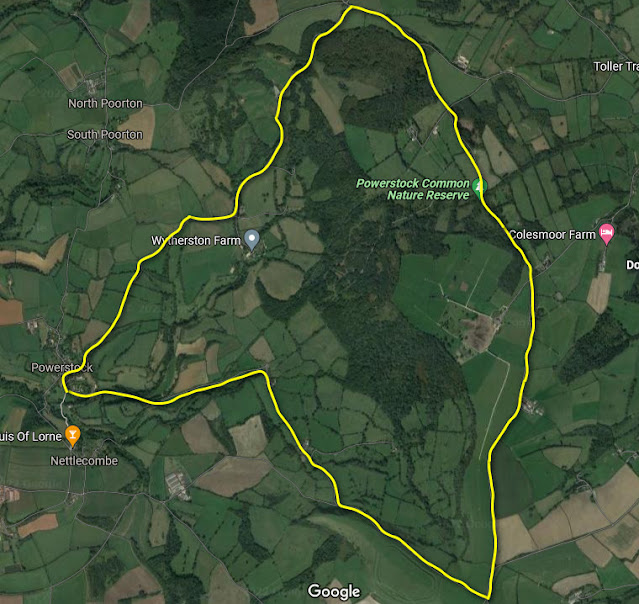
This afternoon I walked a favourite old cycle route - a nine mile, country lane circuit from the nearby village of Powerstock. I've fancied it for a while, and wondered whether Marsh Tit was a possiblity. After all, the circuit passes very close to Powerstock Common, the only place locally I've seen that species. Here's the route...


Well, for several miles I saw very few birds at all. I'm not kidding. Yes, the odd Robin, a few House Sparrows and whatnot around the occasional farmyard, but barely anything in between. Climbing south-east away from Powerstock up King's Lane brings you to the high ground near Eggardon Hill. Turning north from there is like heading into a green desert...

Birdless. Honestly.

The heady whiff of slurry at this point...

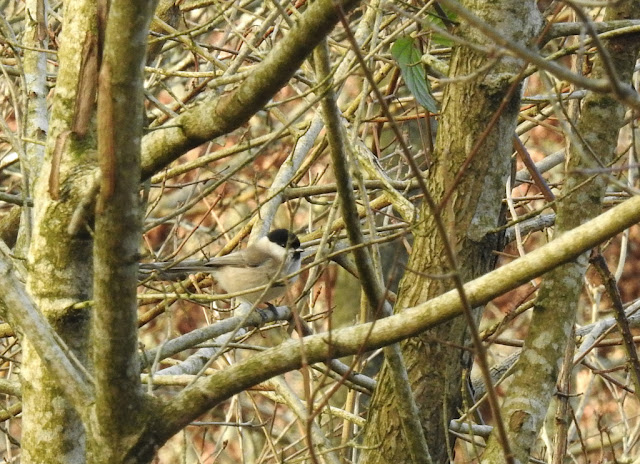
Thankfully the ground slowly drops away towards the edge of Powerstock Common, and birds...

Yesss! My first Marsh Tit for a couple of years, and a lovely species to hit 90 with.

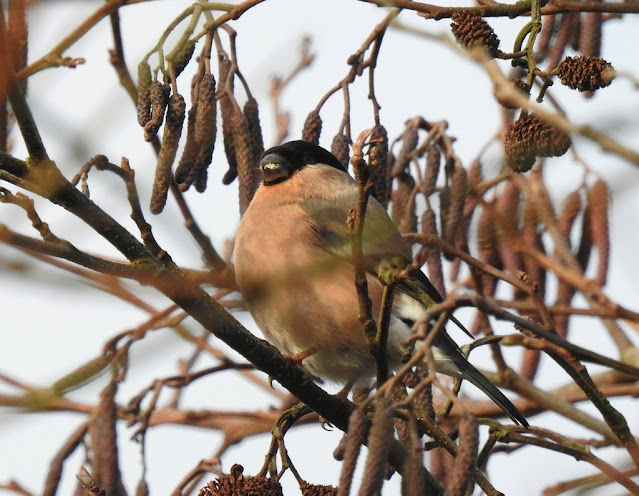
Bullfinch.

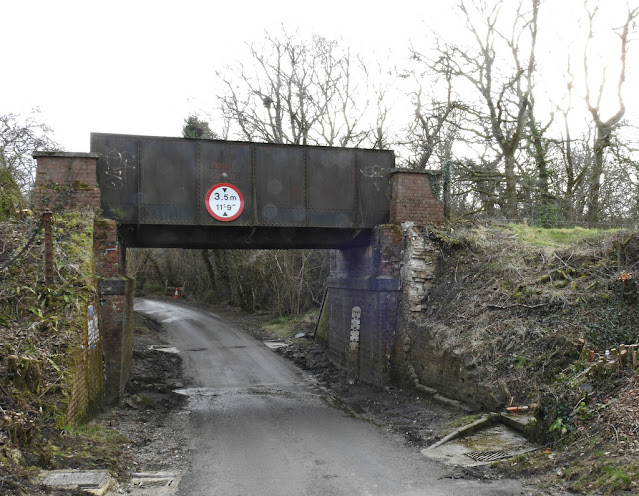
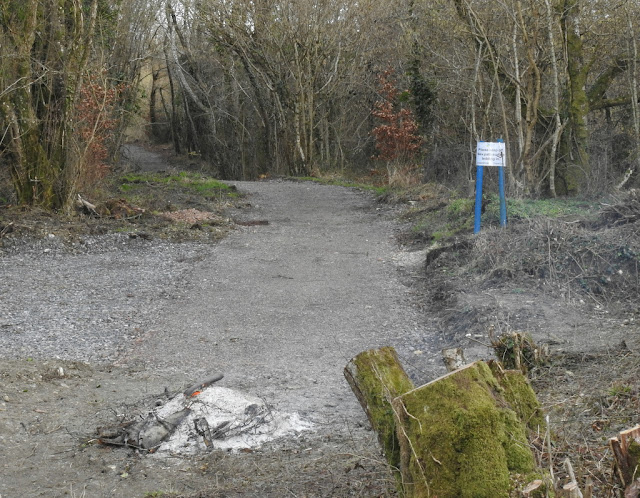
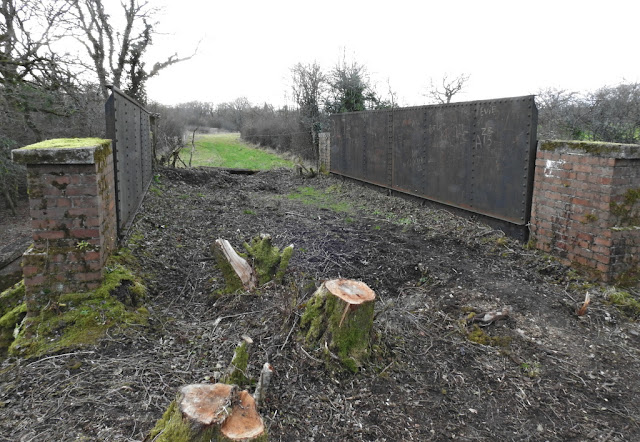
At its lowest point the road passes beneath an old railway bridge, long redundant. In wet weather it floods here, and once I tried cycling through the accumulated water only to find the 'puddle' was in fact a knee-deep lake. It was dry today, and I was interested to see that a load of work was in progress, seemingly to turn the old railway into a path of some kind...

A nice bit of industrial Victoriana there. The line opened in 1857.

Up on top...

Looking east. I've just read that Sustrans have funding to turn this old line (Maiden Newton to Bridport) into a cycle path. Presumably that's what is going on here. The sign says 'Please keep off. New path surface bedding in.' Obviously I kept off.

Looking west. Plenty to do yet...

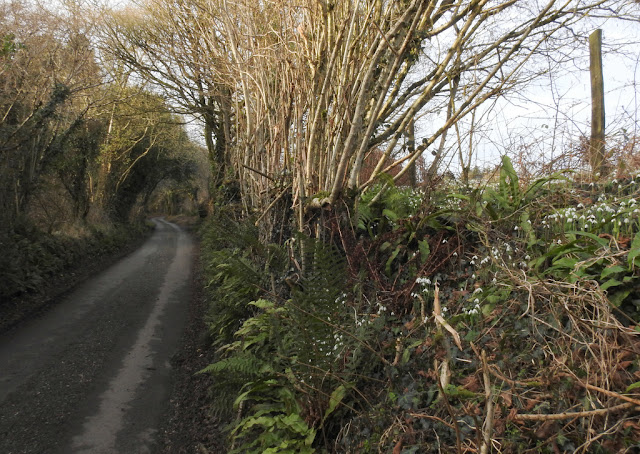
The lane is quite pretty along this stretch, and light drifts of Snowdrops brightened it further...


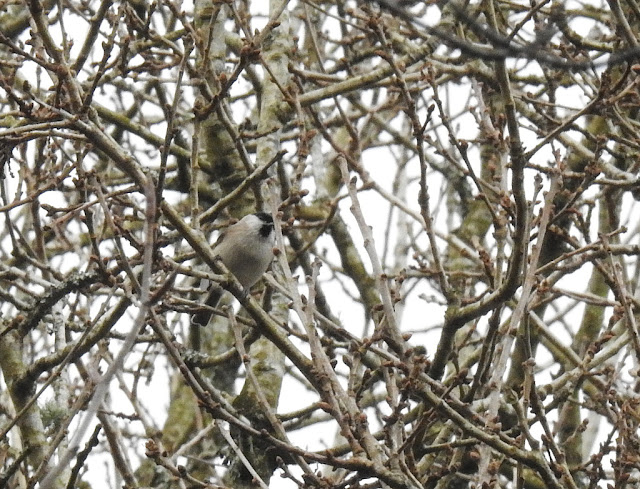
Another uphill trudge here, before turning back towards Powerstock for the home leg. Amazingly I jammed two more Marsh Tits, both together and presumably (hopefully!) a pair. I got a very bad photo of one of them...

One of two. Well over a mile from the first Marsh Tit.

It was dark by the time I was back in Powerstock. Though I hadn't fluked a Woodcock, I did enjoy the delightful sight and sound of a loose flock of 100+ Fieldfares heading over through the gloom to roost. I was kind of doing likewise soon after...

Tuesday, 1 February 2022

BirdTrack or eBird - Which and Why?

On 19th January I asked birdy Twitter a question which basically went like this:

If you want to submit bird records so that they contribute to a 'greater good', which of the following is best, and why: BirdTrack, eBird, Trektellen and/or any others?

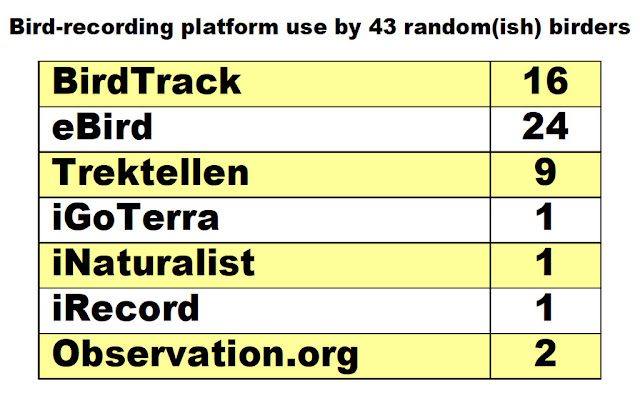
The object of this post is to present a summary and discussion of the answers/comments I received. There were well over 50 respondents and, of those, at least 43 revealed which recording platform(s) they use currently...

Clearly the figures do not add up to 43, and that is because a few birders use more than one platform. Right now I am not going to say anything further about the four minority platforms (which are perhaps of more use to those with multi-taxa interests) or Trektellen (primarily a tool for recording static efforts like seawatching, vis-mig and nocmig) because by far the most fascinating aspect of this inquiry turned out to be the 'BirdTrack or eBird?' question. At least, it was to me, and likely will be to some readers too...

BirdTrack is run by the BTO of course, and eBird by the Cornell Lab of Ornithology in Ithaca, New York. Both have developed mobile apps designed for on-the-go data entry, and that is primarily the feature which interests me. But before I get on to that, a few observations...


BirdTrack

Several of the 16 BirdTrack users have evidently been submitting their records that way for some years. I sensed a measure of loyalty. One said, 'too late to change now'. Another admitted they had looked at eBird and thought it seemed better, but had invested a lot of time in their BirdTrack contributions. Interestingly, two BirdTrack users also input to eBird!


eBird

A few quotes from the 24 eBird users:

'...gets my vote as I can put all of my sound recordings there too.'

'...imo eBird is far superior on most fronts... It's also progressing at a much faster speed.'

'eBird has revolutionised my birding...'

'I really like the functionality and user-friendliness of eBird...'

'...I think [eBird] is more accessible, supports birders' interests better and is generally a joy to use.'

'...eBird is easy to use on the move + has great features.'

'[eBird] has transformed my birding habits and zeal for recording.'

'...eBird was an immediate joy to use, flexible, easy data inputting and great on a global scale with great search functions.'

I think the comments there speak for themselves.


Issues with BirdTrack

Especially telling was this: at least seven eBird users were ex-BirdTrack contributors. For a variety of reasons they had given up on BirdTrack. I shall let them explain:

'I had BirdTrack but didn't get on with it; changed to eBird and I get on very well...'

'...struggled with the site options of BirdTrack.' (echoed by other ex-BirdTrack users)

'I did try to use BirdTrack initially but found it clunky and not that user friendly, particularly in terms of the location/grid system set up.'

'I found eBird very simple to use over BirdTrack, which seemed convoluted in comparison...'

'There was something about BirdTrack that I found a right faff last time I tried, but can't remember what exactly.'

A few years ago I too tried BirdTrack and had problems setting up sites/locations because of a seemingly inflexible grid-based system. So much so that I gave up and ditched the app. Just recently I have tried the app (and the website) once again, and can confirm that this is no longer an issue. In my opinion it is now as easy to set up a birding location on BirdTrack as it is on eBird.


'Greater good'

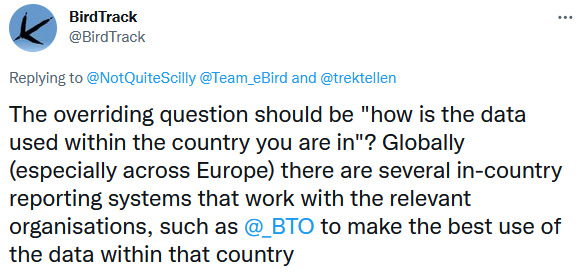
At this point I would like to address an important consideration. Speaking for myself, if I am going to bother submitting records at all, I would like to think they are going to end up somewhere useful. I've just been told that the records I sent to the Dorset recorder on a spreadsheet a couple of weeks back have been uploaded to BirdTrack. Apart from confirming that I definitely need to find a better option than Microsoft Excel, I know that BirdTrack stuff goes straight to the BTO, so that's good, isn't it? Definitely 'somewhere useful'. What about eBird though? After all, eBird is American, right? Touching on this topic, the BirdTrack Twitter account kindly got involved, and answered the question in my original tweet (at the start of this post) thus...

Another respondent made a similar point:

'Regardless of personal preferences being debated here, and respective ease of input, 'greater good' has to be at national/local level, which would be BirdTrack.'

On the face of it these are both fair points, and deserve examination. Although not specifically stated, there is an implication that using eBird rather than BirdTrack is in some way less good. Is that true?

First of all, do eBird records get to the county recorder?

Yes they do. Like BirdTrack records, eBird records are accessible to, and used by, county recorders. At least, from the Twitter thread alone this is evidently the case in Dorset, Northants, Lincs and Kent, so I assume it is (or at least can be) true of any county/region. I also assume that means eBird data can be incorporated in a county database.

Are eBird records able to contribute to conservation initiatives?

Yes they are. For example, according to Alex Lees, eBird data goes to EuroBirdPortal and the GBIF (Global Biodiversity Information Facility). In addition, eBird data apparently is freely accessible to anyone who wants it. Anyone. Excuse my simplistic view, but that surely includes the BTO?

A quote from the Northants recorder:

'As county recorder I download all records from BirdTrack, eBird and iRecord, as well as those [sent] directly to me. All records are saved and sent to the Northants Biodiversity Records Centre - they may be consulted as part of planning applications.'

The Northants Biodiversity Records Centre is one of nearly fifty county-based Local Environmental Records Centres operating accross the UK. This example suggests to me that eBird data is (or can be) used for conservation initiatives at local, national, continental and global level. I cannot help thinking that the BirdTrack = BTO = 'the only way if you want your records to count at local and national level' implication is a big, fat red herring.


Data accessibility

The issue of data accessibility is a bit of a hot topic for some. In a nutshell, eBird records are freely available to all, at no cost; BirdTrack records are potentially available, but rarely without charge, and not with ease. This, from an academic:

'As a researcher, it's much easier to get hold of data which is held by [eBird], which is treated as basically open source data. Other [organisations] tend to require a lot of entering into formal data sharing agreements and admin'

To be honest, as a simple birder this issue doesn't much concern me. However, one respondent made this point:

'...personally...I go with eBird - why? - because eBird is available for others to search fully - BirdTrack is not - eBird helps others find local birds.'


Declaration of disinterest

As mentioned above somewhere, I tried BirdTrack a few years ago but gave up on it because of problems with sites/locations - problems which no longer apply. In 2019 I had a go with the eBird app, made a few entries and likewise gave up. I don't remember why, but it was a time when my enthusiasm for birding was at a low ebb anyway, and any form of record-keeping would likely have been an intolerable chore. Anyway, basically I have no axe to grind. There was no hidden agenda in my Twitter question.


Conclusion

In years past my relationship with birding has been such that simply seeing birds and being happy with that was sufficient for me; I just could not be bothered (or even cope) with submitting records. My relationship with other taxa is like that now. Butterflies, dragonflies, moths, various insects and plants that I am not even fussed about putting a name to - I very rarely submit records for any of these. There is no guilt. Nor should there be. Simply interacting with nature is already a wonderful thing. However, for the last couple of years I have submitted bird records. But spreadsheets are a chore, and I hate them. So if there is a simple, user-friendly way to submit records and get something in return, I am interested. BirdTrack and eBird appear to offer such a facility. In the last couple of weeks I have tinkered with both the BirdTrack and eBird apps and websites. It is early days for me, but there are plenty who have been at it for some time. Forty-odd birders is not a massive sample, but their collective views make for interesting reading.

It isn't for me to say whether one is better than the other, but my brief experience already favours eBird. I'm happy enough that any data I enter into it will end up somewhere useful, despite the implication that a BTO project (BirdTrack) is the only 'proper' way to submit bird records in Britain (which for some reason really rubs me up the wrong way) and it is intuitively simple to use.

Finally, a couple of respondents pointed out that submitting 'complete' lists, breeding records, and all species at sites away from well-watched hotspots, were all more important than which platform is used.


Acknowledgements etc...

I am very grateful to the 55+ birders who troubled to comment in some way on my original Twitter question, and the one or two who got in touch via direct messages. It was an education.

And I should add: if you spot any factual errors in this post, please do let me know somehow. Thanks.
Monday, 31 January 2022

#LocalBigYear - January

Apart from work-related visits to the Axe patch and Kilmington WTW, the whole of January was #LocalBigYear birding. While I wasn't too fussed about chasing down tricky species I did make some effort for one or two. A generous tip-off gave me an easy Dipper, while Purple Sandpiper succumbed to sheer persistence. My first Lesser Scaup for 35 years was an unexpected rarity, and a local-tick Bearded Tit was an unexpected find. And that is pretty much how birding so often goes: some effort, some reward, a little gen, a little jam. My final outing of the month involved a couple of hours at West Bexington yesterday afternoon. Descending the slope to the bunting hedge I was thrilled to spot a jagged bunch of pointy feathers in twisty-turny pursuit of a Skylark high overhead. A female Merlin. I saw just one last year, a passage bird at West Bay on 2nd November, and it is a long time since I last watched a Merlin do that relentless, never-give-up pursuit thing. The protagonists eventually went out of view and I didn't get to witness the outcome. Merlin is my 89th species for 2022.

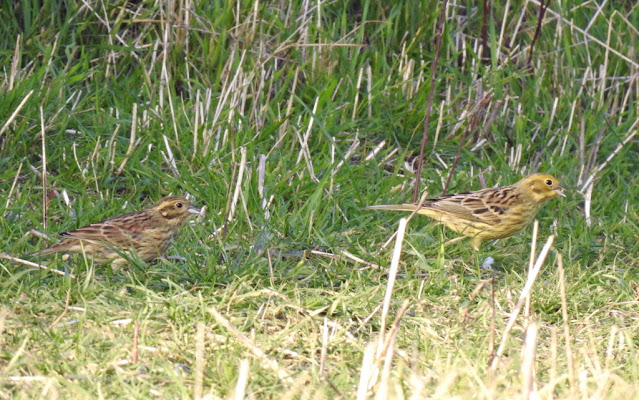
Shortly after the Merlin I got this instructive photo of a female Cirl Bunting with a female Yellowhammer...

Cirl on the left.

And just to complete the month's gallery...

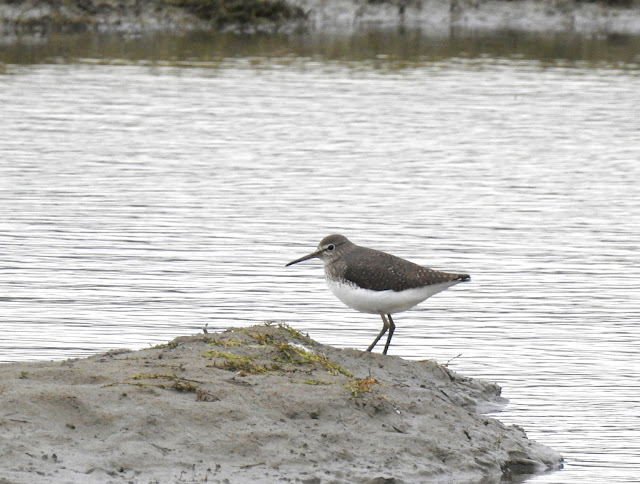
Local Green Sandpiper on Saturday afternoon. One of two.

January was great. Here's to February...

Friday, 28 January 2022

Small Rewards

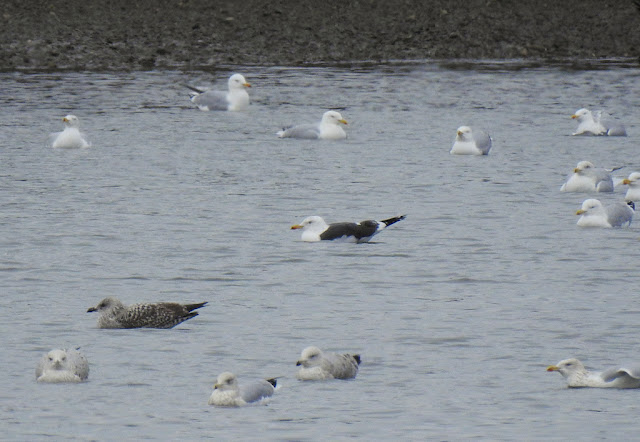
Lunchtime by the Axe Estuary and a leisurely pick through the gulls is a regular winter thing whenever I'm working in the area, and today was no exception. Lesser black-backed Gulls have been very few and far between, so a smart adult this afternoon was welcome, and reminded me that passage birds should be turning up in two or three weeks. And then I realised this bird looked really dark...
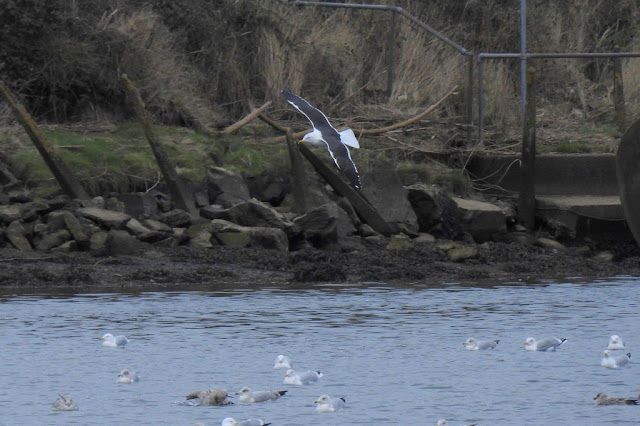
A lovely intermedius Lesser Black-backed Gull

A typical intermedius has a very crisp look, and makes a standard graellsii seem rather insipid. And when they take to the air, even better...


Like GBBG, not much contrast between the very dark slate-grey upperparts and black primaries.

I wonder what it's doing around here? Wintering, or an early migrant? Whatever, a pleasing reward for the ritual gull sifting. Nothing else stood out among the big 'uns, nor among the Commons and BHGs, so I spent a little more time with the intermedius...
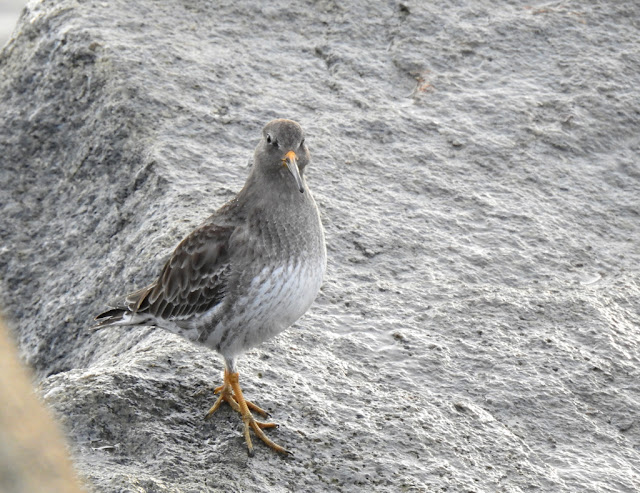

The gull put me in a good mood. Good enough for another pop at the West Bay Purple Sandpiper before heading home. What's the worst that could happen? Another rebuff? Bring it on...

Approaching the end of the pier I could almost see the rock I photographed it on last year. January 27th that was, and likewise my umpteenth try. Today is January 28th; appropriately it was on the rock next door!

What a little cracker! I assume it's the same bird as last winter. Billy no-mates.


So there we go. Nothing fancy, just a nice bit of part-time birding...