Pages

Sunday, 15 January 2023

A Change in the Weather

With the forecast predicting one, maybe two, sub-zero nights this week, I wonder if the brief chill will be enough to stir things up a bit? Golden Plover perhaps? Woodcock? A massive influx of Smew at least? I must get around to fleshing out the PWC 2023 page on this blog, but the current tallies are 60 species (73 points) on the West Bay & Eype patch, and 41 species (43 points) for Bridport North. Apart from the West Bay Leach's Petrel, nothing too unexpected. An afternoon walk around Bridport North today added Bullfinch, Dunnock (must have missed that off by accident previously), Long-tailed Tit, Goldcrest and Sparrowhawk. One of the Bradpole Firecrests showed nicely too...

Eye candy.

On Friday I happened to be working near the Axe Estuary when two Avocets turned up at Colyford Marsh. A quick look from the Axmouth road, and some classy pics from 600m...

Avocets on the Colyford Marsh scrape.

When it comes to waders the Axe is in a different league to the Bridport recording area, which apparently has a wader list of about 26. And at least one of those (Stone-curlew) has occurred only as noc-mig records. All I've managed so far in 2023 are Snipe and Lapwing. Meanwhile, the Axe wader list stands at 44, I think. Not jealous. Not frustrated that the Brit Valley at West Bay is a load of scrape-less fields and wasted potential. No, of course not.

On the other hand, I am beginning to wonder if the seawatching on offer at West Bay might turn out to be much better than I expected. Time will tell.

So much to learn.

In the meantime, better wrap up warm this week...

Thursday, 12 January 2023

Admin

Just lately there's been a great deal of this...

Wet and wild. West Bay at 08:30 today.

So far, this kind of weather has produced an improbable January Leach's Petrel and a Little Gull. My PWC list is very happy, but the novelty has worn off now and I wouldn't mind a change. Across the window depicted above flew 6 Red-throated Divers, 3 Med Gulls, 13 Kittiwakes, c50 Gannets and a billion gallons of airborne water. Pretty soon it was time to go home and stay there. And do some admin...

In the end I plumped for eBird last year. At the click of a mouse you can request all your eBird records, which are then emailed as a spreadsheet. Already I have extracted a load of West Bex and Cogden records from it for Mike Morse, who compiles the annual report for his patch. I did likewise with Bridport recording area birds for Pete Forrest, again for a local report. This was easy, though I did remove several superfluous columns of data first. In practice the eBird app was very user-friendly. I would happily have carried on with it, but this year decided to give the updated BirdTrack app a fair trial. And already I prefer it, but that's for a future post maybe. Initially I was concerned that BirdTrack might not make my records available to me in spreadsheet format as per eBird, but actually it does. Perfect.

So, for once I haven't needed to compile my own spreadsheet. Fa-a-a-a-ntastic! Mind you, there have been a few past years where I haven't compiled a spreadsheet either. Not so fantastic; basically I have no records for those years. Oops.

On to rarity descriptions then...

I don't find BB rarities, but a busy year might see me jam a few local ones. In 2022, as far as I can recall, Dorset description species were just a noc-mig Pink-footed Goose, Barred Warbler and a few Leach's Petrels. Writing them up as minimally as I can get away with is a chore tailor-made for a wet day, and is now done.

BirdTrack has already prompted me to write a description for the January 3rd Leach's Petrel, and even provided an online form for the purpose. I couldn't resist such helpful spoon-feeding, and complied immediately. It has automatically forwarded my submission to the county recorder and emailed me a copy. Neat. I quite like having my hand held.

Another recent job on the agenda was the book review I mentioned a few posts back. A lot of fact-checking, many notes, and way too much sighing and groaning, but the task is now completed. And strewth, what a can of worms it was. I've never been asked to write a book review (and wonder now if such a request will ever come my way again!) so wanted to do it properly. If a book is good, I can imagine the reviewer's task is rather joyful; giving deserved praise is always a pleasure. All I can say right now is that the author is unlikely to be rushing to buy me a grateful pint. Hopefully the review will be published in due course without too much editorial emasculation. In which case I will post a link here. Or maybe the whole thing.

There is just one admin task outstanding now. I need to write a short personal bio describing my birding- and nature-type 'qualifications'. This is to be posted on a company website in connection with a lovely little guiding job I've kindly been invited to take on. Sorry to be cryptic again, but as soon as that's done and dusted I shall feel comfortable to say more.

In the meantime, tomorrow's forecast is dry. Which means...sigh...that I shall have to get out there and earn some money...

West Bay Kittiwake on Monday afternoon. The ghastly weather has at least produced a wonderful crop of these beauties.

Sunday, 8 January 2023

Small Gulls and Wagtail Sonograms

It has come as a pleasant surprise to discover that West Bay can hold a small flock of feeding gulls in certain conditions. So when Pete Forrest found a Little Gull with Kittiwakes at the west end of the prom this morning I was moderately hopeful of seeing it, despite being out of circulation until late afternoon. It was nearly 4pm by the time I arrived, but a few Kitts were still present...

Lingering gulls - a sight to gladden the heart.

Back in November the West Bay Sabine's Gull that Tom Brereton found in the morning was good enough to wait for me, and Pete's Little Gull was equally well-mannered...

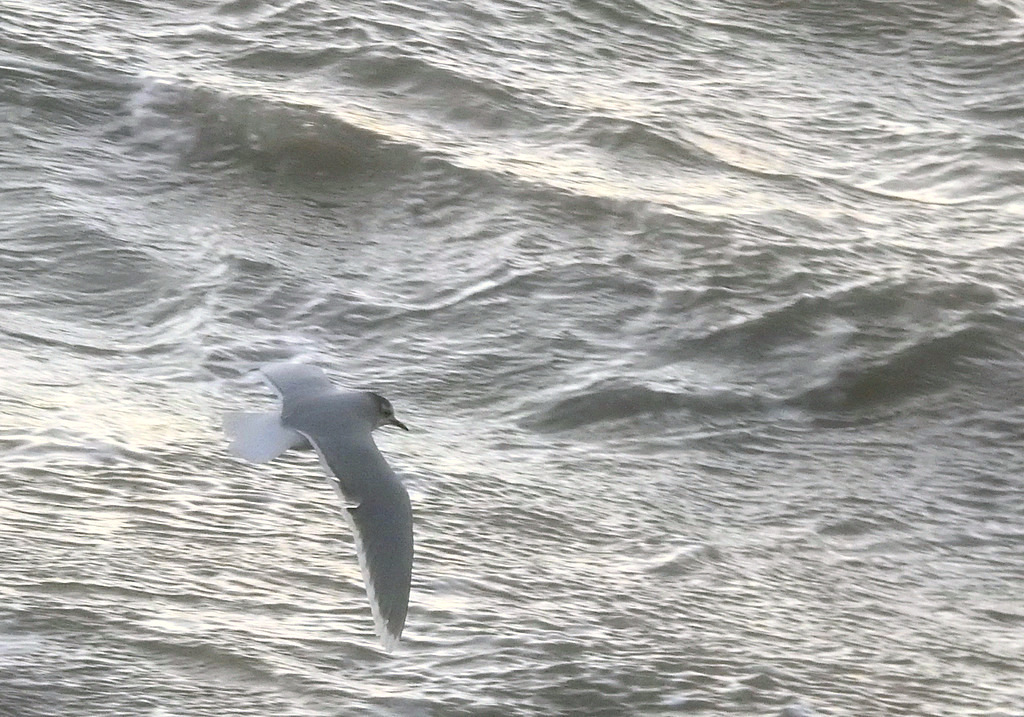
Today's lovely adult Little Gull, my 9th of the autumn/winter period, but first for 2023. I did struggle to get a reasonable photo, and in this one it was only just in the frame.

Little Gull is one of those species that you can almost expect to see locally each year, but not quite. Great to have it in the Patchwork Challenge bag nice and early.

A couple of days ago I stumbled across a 2014 Dutch Birding paper on Eastern Yellow Wagtail identification. You can find it HERE. Especially useful is a section on vocalisations, including sonograms of calls of a whole range of Yellow Wagtail taxa. Discovering this paper encouraged me to revisit my recordings of the Colyford Common EYW candidate. Here they all are, collected together on one image. Please note the point re the pair of 'rising' lines on the left-hand side (or first part) of each call...

This image contains just about every call note I recorded on 5/1/23. The three separate groups of calls (of 4, 7 and 5) represent the three occasions that I managed to capture in-flight vocalisations.


I have tried my best to render the above sonograms to the same proportionate horizontal and vertical scale as those in the Dutch Birding paper, which are set out below. Hopefully Dutch Birding (and/or the authors) won't be too upset at my copy & paste antics...

The 'north-western' Yellow Wags. Note how the two rising lines start wide apart and get closer together as the pitch increases.

EYW (tchutschensis and plexa). The two left-hand lines start close together and widen as they rise.

M. f. beema - similar to 'north-western' type.

The paper also covers 'south-western' Yellow Wags (cinereocapilla and feldegg) and two other eastern types (macronyx and taivana) plus Citrine Wagtail. I have no idea whether that 2014 paper has been superceded by new knowledge*, but based on what it says I would hesitate to claim that the calls I have so far recorded are clear evidence of the Coly Common bird being an Eastern Yellow Wagtail. It might well be, but on some of those calls it is pretty obvious that the rising pair of lines start wide apart and get closer together as the pitch increases. So, exactly what those 16 vocalisations tell us I do not know.

I really hope there is some helpful DNA in that poo!

It is also worth noting that hind claw length is a red herring. The paper makes it clear that there is too much overlap for this feature to be useful. Worth a read.

All good fun...


*Update - Just been sent a link to a more recent (2021) Dutch Birding paper on Eastern Yellow Wagtail ID by the good folks at Rare Bird Alert (find it HERE). Not sure if it will necessitate a complete revision of the above, but watch this space...

Friday, 6 January 2023

Poop in Post

First, a little jig of joy from me this afternoon. My second go at the Bridport North patch and, more specifically, for Dipper. I tried a different river this time, and had almost reached the northern limit of my patch when...

Yessss!!

A pretty ropey photo, but so far the local Dippers have exclusively chosen distant, dark holes from which to reveal themselves to me. Still, do I care? No.

And now, to the main subject of this post...

Professor Martin Collinson is such a helpful chap. I sent a quick note his way yesterday, received a prompt and positive response, and a blob of bird excrement is now en route to Aberdeen. He did mention that poop can be a bit hit and miss, but I'm pleased he is happy to try. I understand that there needs to be genetic material in the sample, so let's hope the Coly Common wagtail parted with a tiny bit of its alimentary canal, or whatever. Nice. Of course, if I did make an error yesterday, there will be nothing more exciting in it than Pied Wag DNA anyway.

So, on to its other end. Vocalisations...

As I mentioned in the last post, the bird's call didn't sound particularly raspy to my ear. However, having spent some time listening through headphones, to both the Coly Common bird and some Eastern Yellow Wagtails recorded in Mongolia, as well as some Western Yellow Wagtail recordings I made locally over the last two or three years (ie. M. f. flavissima), I am in a better position to say stuff. And what I can say is this: all the calls I have so far heard from the Coly Common bird sound, at best, a little more raspy than flavissima, but fall a bit short of some of the unequivocal Eastern Yellow Wags recorded in Mongolia. Not that this necessarily means a lot. For two reasons:

  1. I suspect there is massive variation between individuals, and even between calls made by the same bird in different circumstances, etc.
  2. What do I know?! I am certainly no expert.

Have a listen yourself. In the following spectrovid are a bunch of calls from the Coly Common wagtail (the first two recorded by Kev Hale on his phone), then a gap, followed by a couple of flavissima recordings from my sound library, another gap, and finally another flurry of Coly Common calls. Interestingly, through headphones the penultimate flavissima call has a noticeably raspy tone. Anyway, see what you reckon...


I thought it might be instructive to compare some sonograms too. In the next pic we have some super-raspy EYW calls from Mongolia, a few from the Coly Common bird, a different (less raspy) Mongolian EYW, and the raspiest flavissima call from the spectrovid above...


The 'raspiness' appears to be imparted on the downstroke. The thicker and more fuzzy/blurry it is, the raspier the call sounds. Having said that, the so-called 'raspy' flavissima note (number 8) is actually thinner and 'cleaner' than all the other notes except number 4.

It's reassuring to see how closely number 3 matches Eastern Yellow Wagtail note number 7.

Lastly, what an interesting exercise that was. I do like a bird that provides a challenge.

Thursday, 5 January 2023

Wag Tales

Work today. But first, a quick visit to West Bay. Predictably quiet, but a single Red-throated Diver W and three Guillemots on the sea added another two species to the Patchwork Challenge tally.

I had deliberately left a little birding slack in today's schedule. Also I had packed the scope, camera and sound recorder. Late yesterday afternoon there was news from Colyford Common, scene of recent Isabelline Wheatear reappearance. Apparently the putative Eastern Yellow Wagtail had put on a bit of a show too, perching on overhead cables, calling a lot, that kind of thing. There were some photos but, as far as I was aware, no actual recordings yet.

So, with my last job conveniently situated in Colyford, I was all set...

Except there was no sign of it all day. Still, you never know.

Yep. As I was walking down the track, Tim White refound it. Per-r-r-r-fect!

I have never seen an Isabelline Wheatear being so blatently ignored. The EYW (okay, putative EYW, but I cannot keep using that word) performed very well indeed for the few of us present...


Isabelline Wheatear and Eastern Yellow Wagtail. A typical January combo in East Devon.

The Isabelline Wheatear tried flaunting its little black alula at us, but it was on to a loser today...

A photo-bomb then? Nope, that didn't work either.

I have fond memories of Devon's only previous Eastern Yellow Wag, at Colyton WTW (probably less than a mile away) in 2010, and this looks very similar.

Very nice.


It perched up on the boardwalk here for a couple of minutes at least, and I got a short video. The following is just a clip, but three or four seconds in you will see the bird deposit a small, [possibly] Siberian poo, followed by me panning down a bit so I can memorise the exact spot, and then a Pied Wag drops in, a bit further away. What I didn't notice at the time was what the Pied Wag did next...


So, when I trotted up the boardwalk and carefully collected a bit of bird poo, the question is: did I get the right one? Or is the tiny dollop currently residing in my fridge actually from the cloaca of a Pied Wag?

Anyway, I got some nice recordings of the call. In life it wasn't as obviously raspy as I was expecting, though I have always known that I do not have the most discerning ear. But that will all have to be for another post...

In the meantime, a couple of bits from yesterday...

The Eype Firecrest showed again, and this time I was ready.

West Bay birds are very obliging if you have cake.

Tuesday, 3 January 2023

A Three-pointer

A damp, windy morning in winter would not normally get me hurrying to the West Bay shelter for a seawatch. But these are not normal times. Firstly, Patchwork Challenge is a galvanising thing right now. Secondly, a Leach's Petrel flew past Portland Bill on January 1st; and another yesterday, despite the benign conditions. One or two are still about. And you never know...

I ventured out at 08:00, into what felt like the middle of the night. It was blowy alright, a vigorous SSW which bashed me around as I tried to focus on the distant, interesting duck on the river upstream of Rise restaurant. The Stygian gloom didn't help. Kneeling to rest my bins on the bridge railing did the trick. As I suspected, it was a/the Goosander. Nice. Hopefully it will do the decent thing and revisit the Asker too, so I can add it to both PWC lists.

At the shelter it quickly became apparent that an epic seawatch was not on the cards. A few Gannets and little else at first. I wasn't surprised. After all, the wind didn't get up until shortly before dawn. Got to be worth an hour though, surely? Actually, half an hour was enough...

A slow seawatch is a dull way to pass the time. When visibility is too poor to bother much with a scope, you simply scan back and forth with bins, marvelling at the infinite variety of shapes that a birdless sea can fashion itself into. Eventually it is almost hypnotic, and the occasional Gannet or Kittiwake a welcome novelty. And then, out of the blue, a tiny dark speck pops up from behind a wave...

It was like being zapped with a cattle prod, and suddenly I was very awake! In and out of view every couple of seconds, but a bit too distant for bins, I quickly got the scope on it. Yes! A Leach's Petrel, very slowly moving east. This morning's wind was a notch or two down from the gales of November, and the bird looked in total control, almost stalling at times, and foot-pattering in classic style. Scope views were terrific.

Optimistically I gave it another hour but, apart from a couple of Brent Geese, the Gannet/Kitt theme persisted throughout. Still, I was well chuffed to bag my first PWC scarcity, worth a big, fat three points. Also, as the finder I get a further three bonus points.

Behold! Leach's habbo. It first appeared on a line roughly halfway between the rocks and the red post.

This afternoon the rain was heavier, the wind stronger, and greedy thoughts of Little Gull hard to resist. Nothing ventured...

Ninety minutes later, with 34 Kittiwakes, 4 Med Gulls and just 2 Gannets noted, I called it a day. Actually I called it an excellent day.

Monday, 2 January 2023

Not a Sprint

Yesterday was a birding write-off, so today was precious. Sunny, very little breeze, not too cold, an absolute delight to be out and about. Morning on the West Bay patch, home for lunch and then out again, this time into the wilds of Bridport North. Loved it!

Although the aim of Patchwork Challenge is to see as many species as possible, I decided ages ago not to get hung up on numbers. A 12-month effort is not a sprint. I had a few target species in mind today, but promised myself to be happy with whatever came along. How did it go?

The major part of a 110-strong Lapwing flock just N of West Bay.

The harbour's resident Wigeon still here, apparently paired with a female Mallard now.

A Rock Pipit on a rock.

A single, very welcome Kittiwake remaining from recent stormier times.

The female-type Black Redstart relishing a bit of sunshine.

I walked over to Eype, and this is the view W from the car park. I'm told that the clifftop chalet there was the location of a murder in the original edition of Broadchurch.

An old friend. Hadn't seen this 2nd-winter Med Gull for a long time, so it was a pleasure to encounter it on the river today.

West Bay at 12:45. Cogden Beach, it is not. Yet there are birds a-plenty...

I couldn't find any Purple Sandpipers, but my two other target species - Black Redstart and Cetti's Warbler - were present and correct. According to eBird I walked 9 miles for my 48 species this morning. A few of those miles were contributed by my visit to Eype, a small village strung along a valley running down to the coast about a mile west of West Bay. My plan was to dig out a Firecrest. As I have seen just one Firecrest there, ever, this was a bit optimistic, to say the least. Still, nothing ventured...

I checked out every promising bit of habitat I came across, and amazingly a Firecrest popped out at the second spot I checked. A bit brief, so no photos, but wow! Encouraged by this, I tried the same trick this afternoon, and found two together just a few minutes walk from home! I really was not expecting to get Firecrest on both Patchwork Challenge lists quite so easily...

Well, hello...

According to Google Maps, this spanking Firecrest was just 460m from my front door.

Of course, this success has got me wondering just how many Firecrests might be in residence locally. Obviously I will have to find out.

I tried one of the spots where I recently saw Dipper, but no sign. Still, a very enjoyable 5.5 miles for 27 species. Apart from the Firecrests, no surprises.

This attractive old building featured in this afternoon's amble around Bridport North. And, right there on the apex, four beautiful Feral Pigeons...

One issue I have always had with listing of any kind is the murky depths which it forces one to plumb. I mean, Feral Pigeon. Yuk. I'm not sure if they are countable in the Patchwork Challenge, and will have to check, but in truth I hope not. Mind you, I feel pretty much the same about Pheasant. Thankfully I didn't have to tick Pheasant today, as I saw none on either patch. This winter's shooters must have been thorough...

So it's been a lovely day. That there are more local Firecrests about than I imagined is just one lesson of three that I have learned recently. The other two are connected with one of my other hobbies: writing.

Firstly, if you aim to pen a candid memoir of your antics in birding and life, consider very, very carefully how you word it. Twitter has recently been quite clear on how not to do so.

Secondly, if an authoritative avifauna is your intention, bear in mind that posterity will be your judge, and do it properly. I currently have a brief to review one (recently published) and my disappointment is off the scale. Not sure how I am going to write something that will be fair, honest and...er...kind.

If some of that was a bit cryptic, I'm sorry. More anon...