Pages

Tuesday, 11 January 2022

Weather

There is progress on the #LocalBigYear front. On Sunday afternoon I failed to see Brambling at my Brambling spot, but did glean some Barn Owl gen from a friendly farmer, and followed that up with two Green Sandpipers at the Green Sandpiper spot. Swings, roundabouts. And today there was a Coot, which gets me to 75.

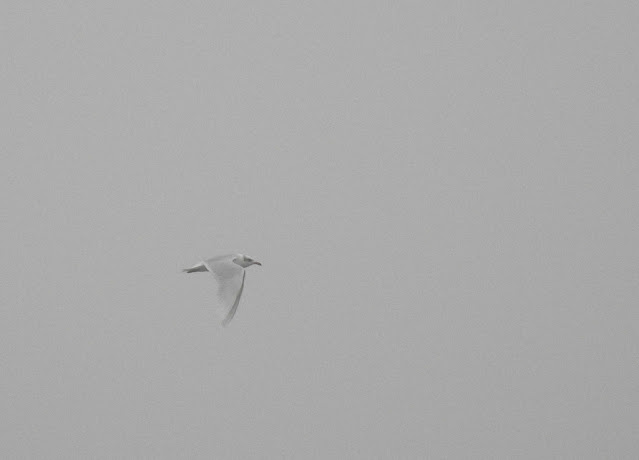
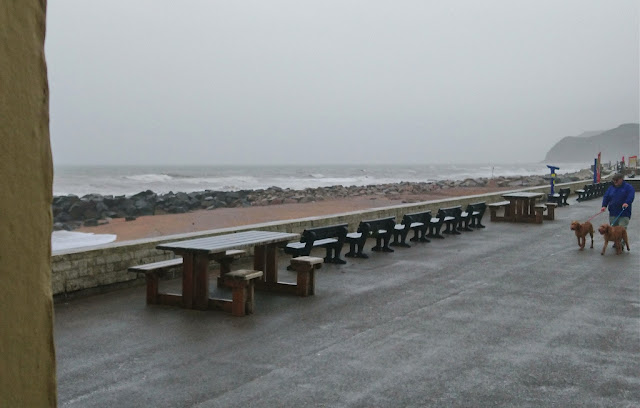
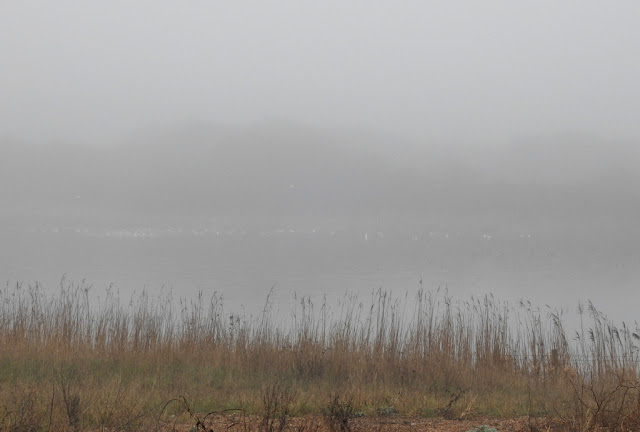
The weather has been a pain though. Yesterday was too wet for work and, because I'm a wuss, too wet for birding. This morning it wasn't raining per se, but damp and foggy. The air was just sodden. I went to West Bex for a walk on the beach. Visibility was frequently less than 200m...

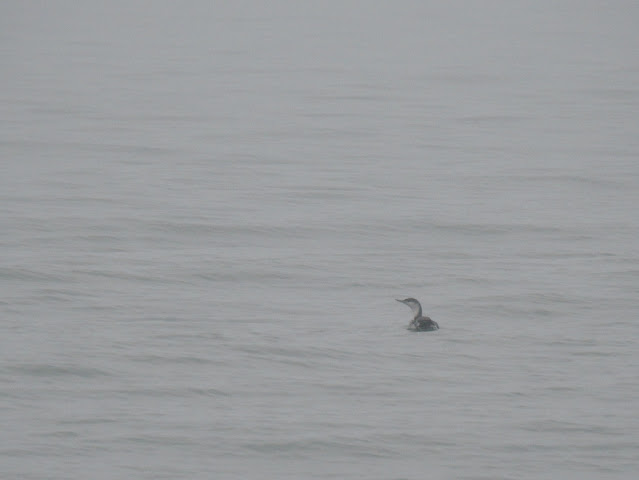
A single Red-throated Diver was about it on the sea.

Gulls showing well on the West Bex Mere

When the weather is grim I guess you just have to take what you can get. If that includes a gull or two, I shan't moan...

Murky Med

Possibly the shortest NQS post ever.

Saturday, 8 January 2022

Listing for Dummies

What exactly is listing?

Listing is simple enough. For example, on January 1st I tried to keep a list of all the species I encountered that day, writing each down as it came my way.

You mean, as you saw each species, you wrote it down?

Well, yes and no. Some species I didn't actually see at all. Like Water Rail, which I only heard.

So it's okay to count a species you didn't see?

Yes. Hearing it counts.

Does that mean some birders' lists might include birds they've never actually seen?!

Er...well, that probably depends which list you're talking about. And what you mean by 'never'...


And so the rabbit hole beckons...

Listing is only simple when you don't keep any. The moment you decide otherwise, welcome to a world of pain. On January 1st I just couldn't help myself. I kept a list. In fact, throughout 2021 I couldn't help myself either. I kept a list. I am actually a hypocrite. For all my talk of eschewing the very idea of list keeping, I keep lists.

Lists used to be very important to me. I once knew my British List exactly, but not now. Mind you, I could still tell you my biggest London Year List, and well remember the grief involved in getting it. Nowadays I keep lists simply out of idle curiosity. Yes, idle curiosity informs me that on January 1st I tallied 51 species, and throughout last year, 165. And therein lies a fundamental truth about lists...

A list is not a list

A list is actually a number. When someone asks what your British List is, they are not expecting a roll-call of bird names - they want to hear a number. Ditto every other list. A list is only a list when it is totted up to produce a number. Fine, so when someone asks what my 2021 list was, and I say '165', they're happy now, yes?

No. Because the number needs context...

Do you mean 165 in Britain? In Dorset? On your patch?

Actually, none of those. I mean 165 locally.

Well, that's your patch then. You must mean your patch.

No, locally.

Okay Mr Pedantic, so what boundary do you use? Five km? Ten? Five miles? Your 10km square?

None of those. I don't have a boundary.

You have to have a boundary!

Well, I don't. Also, I counted White-tailed Eagle.

Not one of those Isle-of-Wight birds?!

Yes. And I counted a couple of species that I didn't actually see and didn't actually hear.

??????

Nocmig.


At which point I am written off as a complete loser.

Well, against the sage advice of the sensible bloke who usually writes NQS, this loser is going to keep a 2022 list too. Another local one. It's the #LocalBigYear challenge what made me do it guv. And unlike the super-relaxed idle curiosity type list I kept in 2021, I plan to make a bit of an effort this year. Let's see how it goes...

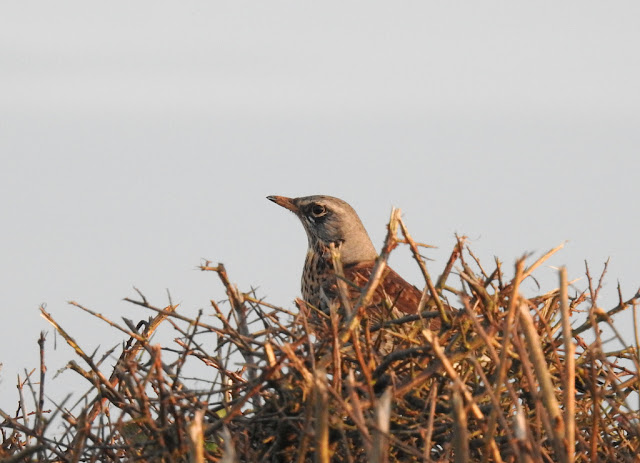
Fieldfare - in at number 65

Thursday, 6 January 2022

Bird News - Part 7: BIRDLINE - THE ORIGINS by Roy Robinson

NQS has been a pleasurable way to keep mentally active, and it is nice when I get feedback that suggests others enjoy it too. Once in a while though, I get more than I bargained for...

The recent series of NQS posts relating the development of the bird news industry introduced a chap called Roy Robinson. Roy appeared in this post, as the friendly warden of Walsey Hills Info-Migration Centre, situated near the start of the East Bank at Cley, Norfolk. I did say that Roy would feature again later in the series, but in fact that never happened. The reason for this omission was my unreliable memory. I had a feeling that Roy was the first to set up an answerphone system for bird news, that it was initially located in the Walsey Hills bunker, and that he called it Birdline...but I wasn't completely sure, so skipped it. Well, I shall skip it no longer.

Out of the blue, Roy got in touch. He had read the blog, liked it, and offered to send an account of how Birdline really began. Here it is, in Roy's own words...


BIRDLINE - THE ORIGINS

In Spring 1980, on a days birding trip from March in Cambridgeshire, I called into Holme Bird Observatory. In a chat with  Peter Clark, the warden and leading light of the Norfolk Ornithologists Association (NOA), I talked about  my interest in birds, nature and desire to work in this field. He said he might have some seasonal work later in the year.

I kept in touch and later applied for wardenship of Walsey Hills. Moving to Norfolk was very tempting, so I moved to Melton Constable before being offered the post, not so silly in those employment times! All went fine and I reopened Walsey Hills Information Centre and Migration Watch Point on 1st September 1980.

During the following six years, many visiting and local birders, and members, would call in before or during their visit to the great Cley reserve and surrounding areas. There were queues out of the door for rarity photos etc on holiday weekends.

I was now phoning around fifty telephone numbers with special local news. Memory fails me now (well it was around 35 years ago) - did I get an answerphone to save phoning all those numbers, or was I planning Birdline? The answerphone, powered by a car battery - as there was no power supply - was set up early in August 1986 and Birdline was in operation a little later.

I had decided to develop Birdline as I was already experienced in bird news, liked the idea of my own business and earning a fair living. I was not looking to earn a fortune, having been on very low income at Walsey hills, but where I had had some of the best years of my life.

I was gaining subscribers at £10 a year and so I decided to offer Birdline to the NOA, who turned down the idea but kindly wished me luck. The answerphone was now struggling to cope with so many callers, not helped by some subscribers giving out the number to non-subscribers, and even telling me so. A basic flaw, showing my naivety.

Help was at hand in the form of Adline, based at a BT research and development facility at Martlesham Heath in Suffolk. Again, I forget how I discovered this. I think it might have been a BT employee who visited Walsey Hills. Adline could handle 30 simultaneous calls and be updated remotely. I had no choice if I was to continue Birdline and signed the rental agreement. I then sent a letter to all subscribers to inform them of Adline and asking them to keep the number to themselves or the system might not cope. I also raised the subscription to £12 a year, just £1 a month, to help cover extra cost. I think it was the end of October when I left Walsey Hills and started to operate Birdline from my third floor bedsit flat in Cromer, where I had installed a second phone line, one for incoming information, the other as a backup to Adline.

ADLINE

Week Ending 3/10: 4 CALLS.

Week Ending 10/10: 264 CALLS

WeekEnding 17/10: 1299 CALLS

Week Ending 24/10: 1520 CALLS

Week Ending 31/10: 1514 CALLS

[Does not include number of calls to the established answerphone.]

I was kept busy updating news, correspondence, membership, even TV, radio and newspaper articles, keeping an eye on Cromer from the third floor. Unfortunately no Peregrines then. I found it was impractical to update Birdline except from my flat.

It was some time in the following January that I learnt there was now a competing service (Bird Alert) with a companion magazine - Twitching - run  by Richard and Hazel Millington, Steve Gantlett and Lee Evans.

This of course added to my costs and workload, more advertising, monitoring their service etc.

They approached me later in the year, with the  offer of joining the partnership. 

Much soul searching, for many reasons, but Birdline joined the partnership on 20th May 1987, about 10 months after I launched it on the birding world. It was not a totally new idea as there were USA bird news services, but a first I believe anywhere else.

I left the partnership mid 1997

Many thanks to those who helped along the way.

All Best Roy Robinson


I am very grateful to Roy for delving into old paperwork and putting this account together. For birders of my generation it provides a nostalgic glimpse of an era long gone. Roy was always really helpful with gen when Sandra and I used to visit Walsey Hills in those early days, and it is nice to know that Birdline was begun in such a relatively innocent way by a bloke who had happily dispensed bird news at no cost for several years already. Its development into a grasping, premium-rate money pit came later...
Wednesday, 5 January 2022

#LocalBigYear

When it finally rose above Portland, the sun blazed beautifully throughout this morning's walk from Burton Bradstock to the West Bex Mere and back. Two Shelduck were new for the year, and an adult Lesser Black-backed Gull my first of that age, but otherwise it was uneventful. A quick look at the buntings failed to deliver a Cirl.

Typical local birding: a couple of hours out, the odd notable thing. Yesterday afternoon this was one of the notable things...

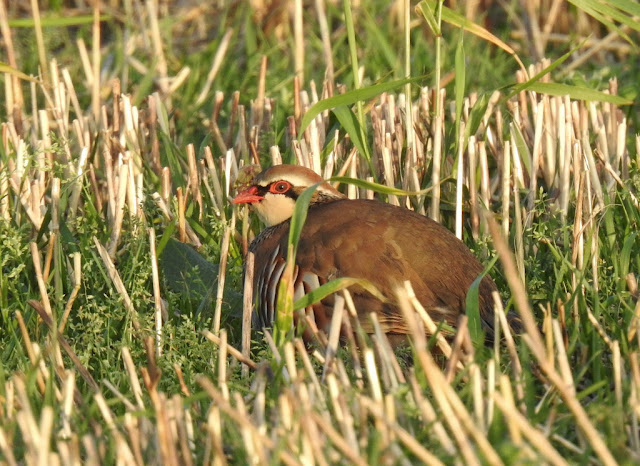
Roadside Red-leg, from the car

Yep, a rare Red-legged Partridge photo-opportunity was a modest highlight. Normally they are naked-eye dots running for the horizon. This bird followed some 90 minutes in a local woodland, where my tally was 1 Treecreeper, 2 Coal Tits, 3 Nuthatches, 2 Bullfinches, 2 Ravens, and one each of Green and Great Spotted Woodpeckers. It felt pretty birdless.

Four outings so far in 2022, for 62 species or thereabouts. In coastal West Dorset. Many inland birders will have notched up 62 by lunchtime on the 1st. Still, I love birding my local area even though the species count can often be a bit thin. Hopefully you will never catch me moaning about about that aspect, because it is more than compensated by lovely scenery and a lot of space.

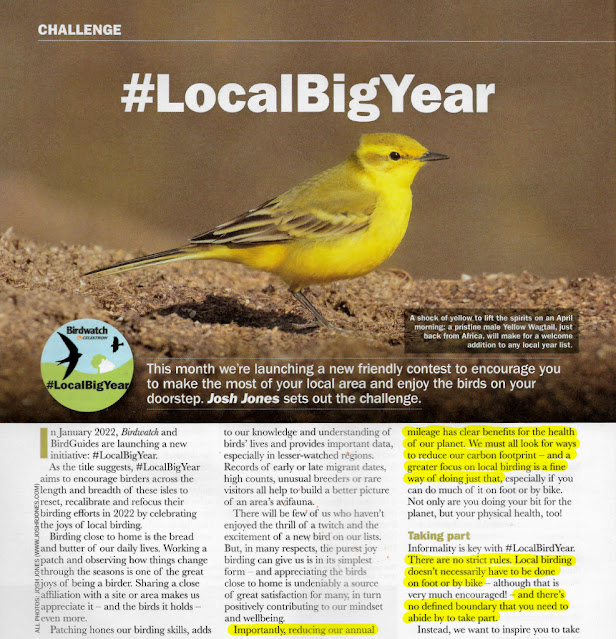
A few posts back I referred to Birdwatch magazine's #LocalBigYear challenge in positive terms. My personal take is that anything which promotes local birding rather than 'firing up the Quattro' every weekend is a good thing, and that is exactly what I felt this challenge was doing. Since then I have read all sorts of comments about it, ranging right across the spectrum from 'excellent idea' to 'hypocritical greenwashing'. Re the latter...

I think I'm right in saying that Birdwatch is owned by Warners Group Publications plc, so yes, part of a commercial enterprise which aims to keep its shareholders happy. Like any magazine it is full of adverts. So do the sources of its advertising revenue undermine the #LocalBigYear challenge, announced with such fanfare just before the new year? Is the magazine just paying lip-service to low-carbon birding in order to pacify a mildly radical little cadre of irritating birders?

'We must all look for ways to reduce our carbon footprint...'
No doubt about it, Birdwatch is talking the talk.

Including the front and back covers, the January issue comprises 64 pages. Approximately 18.25 pages are ads. A breakdown reveals that 13.75 of those are optics ads, a page each for Birdwatch and Birdguides ads, 0.5 for books, 0.5 for accomodation, 0.5 for the World Land Trust charity, and just 1.0 for potentially high-carbon travel ads. Interesting.

One could argue that the 8 pages of rarity news and 3 pages on Colombia's birds are hardly low-carbon friendly, but personally I think that would be a bit nit-picky. Anyone is free to see the #LocalBigYear thing as greenwashing if they choose of course, but it strikes me as a positive thing to promote, so I will. Judging by birdy Twitter there has been plenty of enthusiastic uptake. Great. Potentially a few birders might become newly smitten by the potential of their local area, and consequently go on fewer twitches. Why knock it?

Sunday, 2 January 2022

Time For an Upgrade

Recently I reread Seventy Years of Birdwatching by H.G. Alexander, and realised I had forgotten that he began his birdwatching career sans binoculars. Can you imagine? The notion of birdwatching without bins seems crazy in 2022, but at the turn of the 20th century I imagine they were both expensive and rare. How different things were when I began birdwatching. Even as a young boy I owned a pair of bins*. They were ancient, ex-military 7x50s with individually-focusing eyepieces, and they weighed roughly 10 kilos. I was still using them in the early 1980s when I started birding properly, but the need for an upgrade was quickly obvious.

With Sandra I visited Opticron, which I think was based in St Albans back then. We came away with brand new Opticron 8x30s for Sandra and second-hand Swift Audubon 8.5x44s for me.

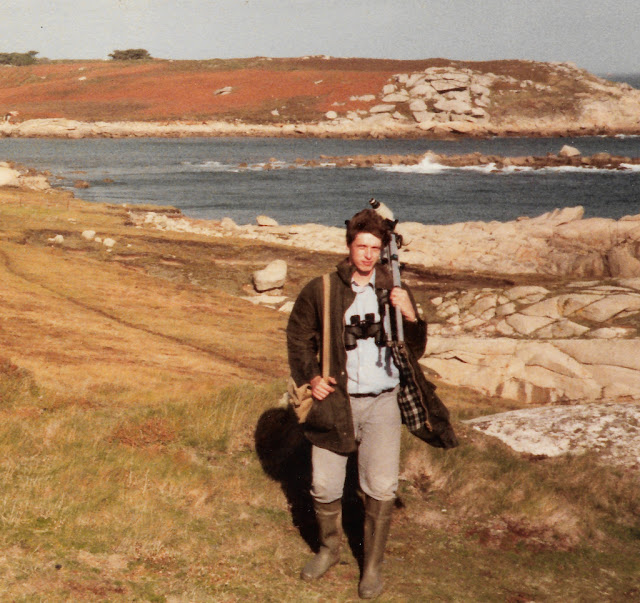
Swift 8.5x44s in action on St Mary's in 1984. I wonder when I last went birding in a collared shirt?

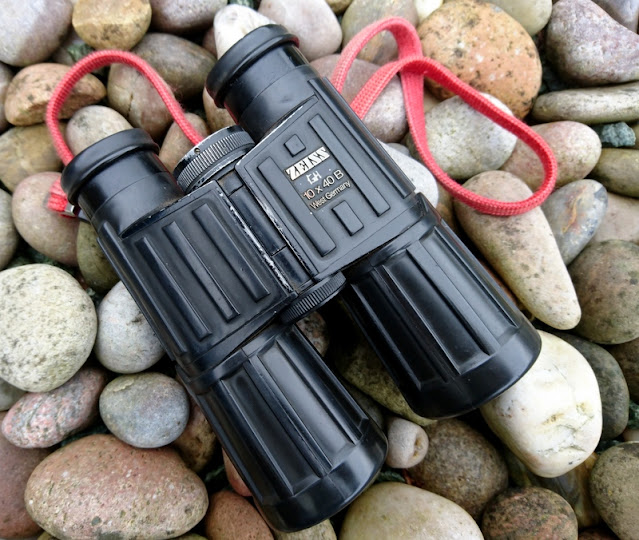
They were great bins. At least, I thought so. Or I did until they started misting up inside after a rainy day in the field. In 1987 I upgraded to what were then considered the best bins on the market: Zeiss Dialyt 10x40 BGAT. This is what they look like...

This photo was taken in October 2015

In 2019 they had become a little hazy internally, so I had them cleaned and serviced. It made a difference, but in 2022 the haziness has returned with a vengeance, the rubber armour has come slightly unstuck by the bridge on one side, the calibration plate has fallen off the dioptre adjusting wheel, and so on. My bins are basically knackered, and need retiring. Which means I am obliged to consider my options...

I have to be realistic. First, I do not have a bottomless wallet. If that were not the case I would have upgraded long ago. Second, I am quite old. It's an unwelcome thought, but at 62 I am not expecting to require the 34+ years I got from my Zeiss Dialyts. Third, I do love a bit of quality. The idea of owning the best bins on the market appealed to me in 1987 and still does today. So where does this lead me?

Research suggests that the best bins right now are Swarovski's NL Pure range, Zeiss' Victory SF and Leica's Noctivid. No offence to Leica but I've never been a fan, so it is actually a two-horse race. Also, I really fancy the idea of diddy little 10x32 bins rather than the usual 10x42, and both brands offer that option. Why lumber myself with weightier bins if optically I don't have to? The only drawback is the two-grand price tag...

Or there is the second-hand route, and maybe an older model. Still amazing optics no doubt, and equally as likely to...er...see me out, but cheaper. I have just sold a couple of bikes, and some careful domestic 'negotiations' have resulted in my being able to convert income gained from one hobby into expenditure on another. Or so I am led to believe. Anyway, the upshot is that I have some money earmarked for new bins. So I'd better hurry up and spend it while the going is good.

PS. If any readers have experience of NL Pure or Victory SF 10x32s I would be glad of your opinions. Likewise any suggestions for second-hand options.


* Note for the screaming pedant: 'pair of bins' is the acceptable - but technically incorrect - name given to a binocular (singular) by the shoulder-shrugging writer of this blog and countless other birders who don't care.

Saturday, 1 January 2022

A Green Day

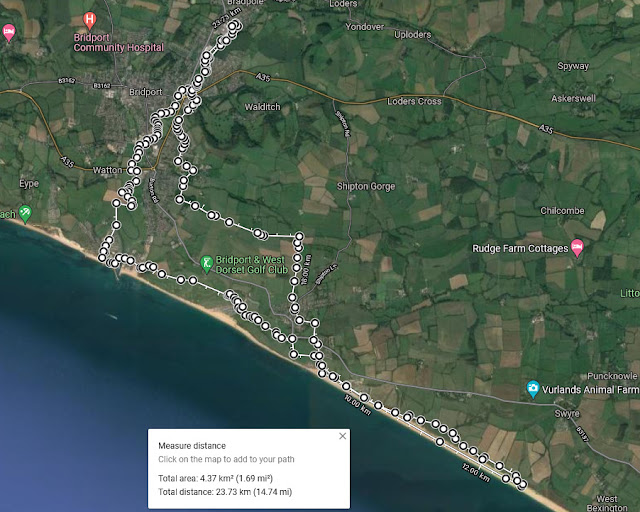
A personal record Welly Walk today. According to Google's clever mapping tools (and rounding up a touch) a cool 15 miles or 24 kilometres. I don't think I've managed a walk that long for at least 18 months. My legs hurt.

Home to West Bay, then to the West Bex Mere, and back again via Burton Bradstock and North Hill

Most of my local birding involves a short drive first, but somehow it felt right to kick off the new year with a totally green effort. I'm glad I bothered...

I arrived at West Bay with the first of the rain, so plonked down in the shelter and got the flask out. A bit earlier than planned - and for longer than planned - but hey ho. A flock of 5 Brents W was an unexpected bonus from the enforced seawatch. Apart from singles of Teal and Gannet, nothing else but the odd gull.

West Bay 09:45

The next bonus bird flew E over Freshwater Holiday Park as I walked across it towards Burton Bradstock - a 1st-winter Kittiwake. Locally, almost certainly the only one I've seen comfortably inland of the nearest beach, and the only Kittiwake of the day. It was quickly followed by another surprise...

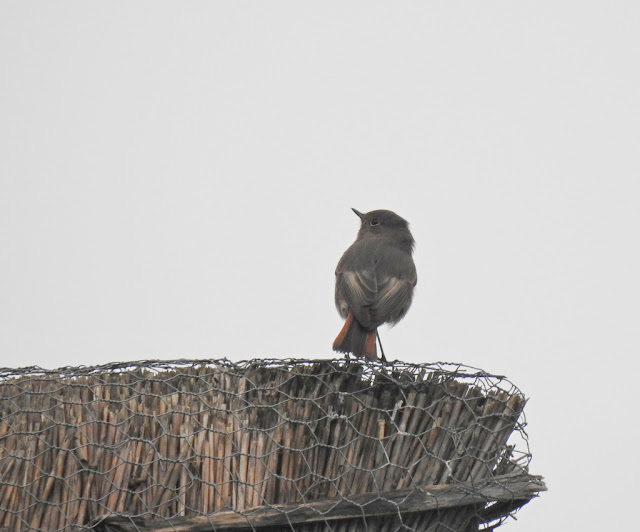
Black Redstart in Burton Bradstock

My first local Black Redstart for ages, and I definitely would not have seen it under normal circumstances. I never visit this spot in winter. From here it was a steady plod all the way to my shingle seat by the West Bexington Mere...

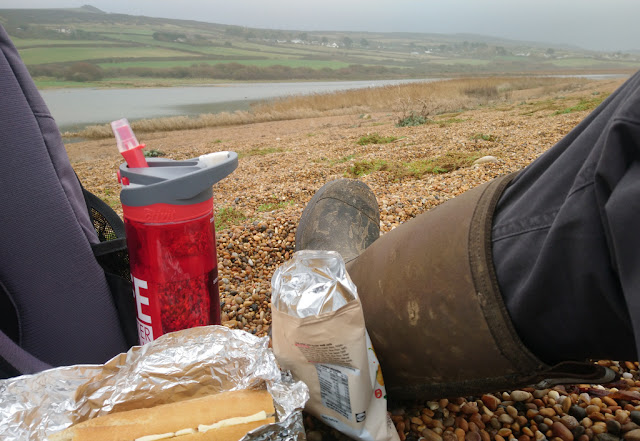
Lunch. The gulls and ducks are very, very small, and far, far away

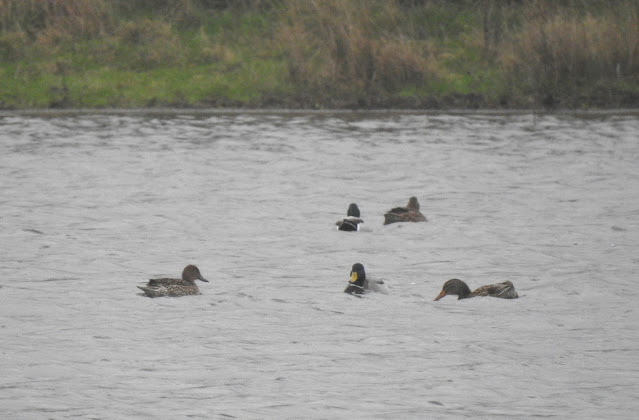
I sat here for a while, with my hood up to keep the spray off my specs, and waited for a classy gull to drop in. There was a reasonable turnover of gulls, with 50-100 on view most of the time, but 4 Meds together was the best of it. No jam today. I did see a nice duck though...

A very distant female Pintail on the left there.

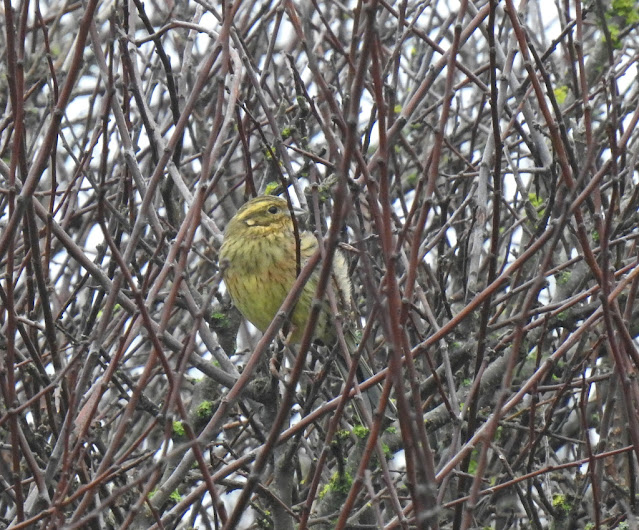
Next, off to the only stake-out of the day: Cirl Bunting. At least, I hoped so. Approaching its favoured hedge I was pleased to see 20-odd buntings and finches flitting up and down from hedge to field and back. But before I was anywhere near, the whole lot upped and flew. Closer now, I could see that just one bird was left, tucked in the hedge a bit. It looked vaguely promising, but a little too far and obscured to clinch with bins. Out with the camera...

Female Cirl - the only bunting in the hedge!

That was handy.

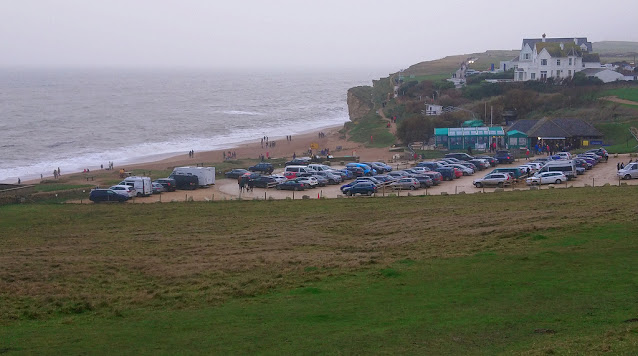
Heading homewards I was amazed to see how many people were now out and about. Maybe they'd waited for the morning rain to ease? Whatever, I counted 80+ at Cogden Beach, which is possibly more than you might see on an average summer afternoon. A little further on, this was the Hive Beach car park at 15:00...

Hive Beach at Burton Bradstock

I cut inland at this point, and a Chiffchaff in Burton Bradstock village was the final addition to the day's tally, which is 51 if I've counted correctly. There are loads of silly gaps, but I really wasn't looking for a big count.

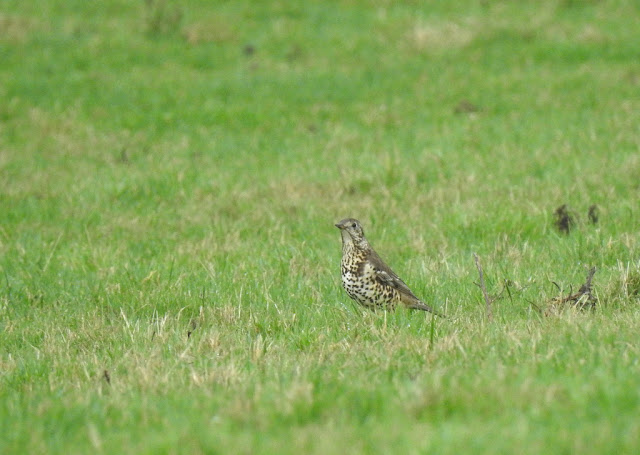
Mistle Thrush is not a species I would have predicted...

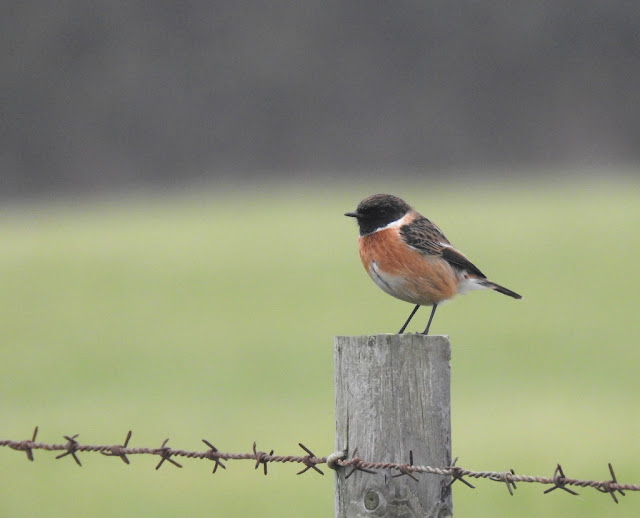
...but Stonechat is.

Heading up North Hill out of Burton Bradstock I had one of those slapstick moments that are miles better when suffered by other people. On the wettest, thickest, slipperiest patch of mud so far (and there had been plenty) my right foot slid rapidly sideways to the left and took my other foot with it, dumping me on the deck with a mighty splat. I managed not to lie down completely, but I cannot think of anything else that might put a positive spin on the event. Oh, wait - I didn't break anything! There you go...

Wiping my specs for maybe the hundredth time, I squidged home.

It felt good to see all these local birds just by walking. When time allows I will probably do something similar again. In the meantime I can feel all virtuous and low-carbon for a few hours. Which reminds me...

On Twitter I came across a link to an article written exclusively by young birders, in which 19 of them talk about local, low-carbon birding, and why they do it. In the face of so many youngsters haring all over the country exactly like my generation did (and does) and apparently seeing no need to do any different, it is a delightfully refreshing read. Find it HERE.

Friday, 31 December 2021

2021 - Lazy Review

I went fishing today (3 small Grayling) and this evening had a catch-up scroll through Twitter. It is stiff with end-of-year birdy tweets. Lots of 2021 highlights/summaries, and plenty of 2022 statements of intent. I am too lazy to follow that lead, so here is a quick blog post instead.

Favourite Bird

Er...probably this one...

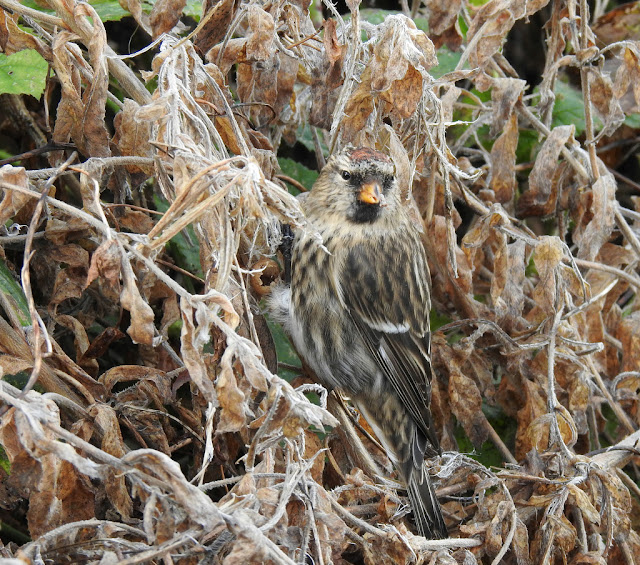
Cogden's Greenland Redpoll

Confiding, tricky, and massively under-appreciated. I loved it. I can think of several other birds which for different reasons were also favourites, but if I had to pick one...

Favourite Find

No contest: Tree Cricket! Discovering a little colony of Tree Crickets at West Bexington was brilliant fun. Also tricky; also massively under-appreciated.

Melodious Warbler was great, but too brief and uncooperative. Caspian Gull was great, but - to my shame - identified after the fact. Stone-curlew was simply great - excellent adrenaline rush, and stayed long enough for Mike and Alan to enjoy too, but Tree Cricket still topped it.

Favourite Cock-up

Again, no contest: Peregrine Falcon. A serious dose of the shakes with that one. And I wonder how many other birders in 2021 managed to turn a Peregrine into a BirdGuides Mega-Alert for a few hours?

Favourite Non-Orthopteran Insect Find

Female Lesser Emperor. Tough competition from Cogden Chalk Hill Blue, Lulworth Skipper and Southern Migrant Hawker, but the Lesser Emperor wins it. Insects were an unexpected delight throughout the summer, and three of that lot were lifers. I hope insects feature again in 2022.

Favourite Wheeze

A clear winner...

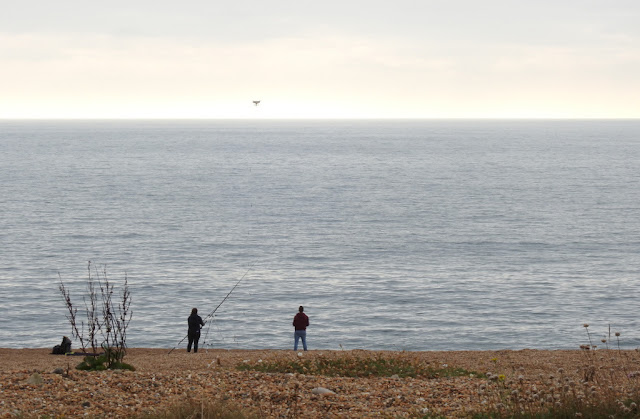
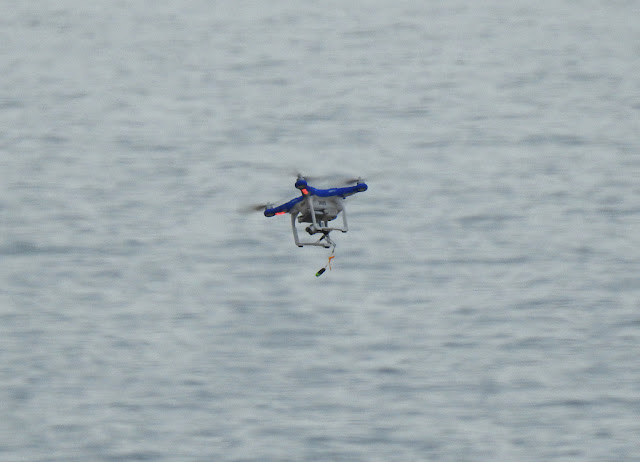
Just a couple of sea anglers going about their everyday angling business, right? Look closely.

I see a lot of sea anglers along the Chesil Beach, but this is the first time I've seen anyone do this...

Why bother risking a pulled muscle from that pendulum cast with triple salchow and flip, when there is a far more relaxed way?

Yep, she held the rod and spooled out line while he piloted the bait out towards the French coast.

Favourite Plan

The one for tomorrow. Tomorrow I will step out of the door and walk. I will take my bins, my camera, some refreshments, and I will look at birds all day. And that's it.

If you have got this far, thank you for reading. Throughout 2021 this blog has been a pleasure to write, and knowing that people read it is surprisingly gratifying. All the best for 2022...