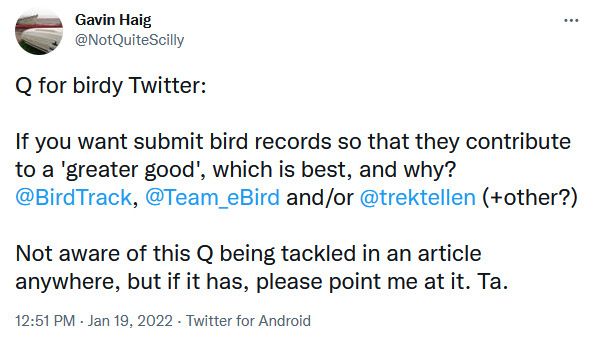
On 19th January I asked birdy Twitter a question which basically went like this:
If you want to submit bird records so that they contribute to a 'greater good', which of the following is best, and why: BirdTrack, eBird, Trektellen and/or any others?
The object of this post is to present a summary and discussion of the answers/comments I received. There were well over 50 respondents and, of those, at least 43 revealed which recording platform(s) they use currently...
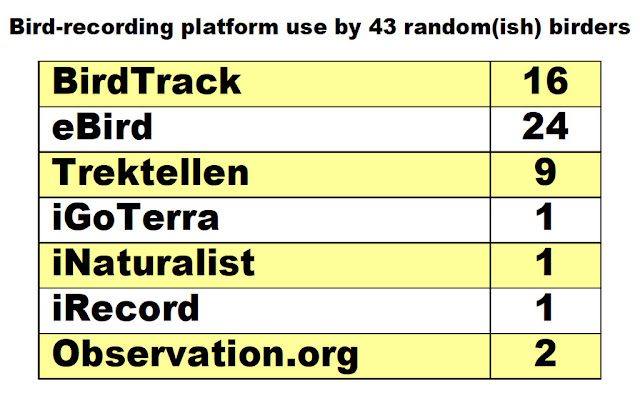
Clearly the figures do not add up to 43, and that is because a few birders use more than one platform. Right now I am not going to say anything further about the four minority platforms (which are perhaps of more use to those with multi-taxa interests) or Trektellen (primarily a tool for recording static efforts like seawatching, vis-mig and nocmig) because by far the most fascinating aspect of this inquiry turned out to be the 'BirdTrack or eBird?' question. At least, it was to me, and likely will be to some readers too...
BirdTrack is run by the BTO of course, and eBird by the Cornell Lab of Ornithology in Ithaca, New York. Both have developed mobile apps designed for on-the-go data entry, and that is primarily the feature which interests me. But before I get on to that, a few observations...
BirdTrack
Several of the 16 BirdTrack users have evidently been submitting their records that way for some years. I sensed a measure of loyalty. One said, 'too late to change now'. Another admitted they had looked at eBird and thought it seemed better, but had invested a lot of time in their BirdTrack contributions. Interestingly, two BirdTrack users also input to eBird!
eBird
A few quotes from the 24 eBird users:
'...gets my vote as I can put all of my sound recordings there too.'
'...imo eBird is far superior on most fronts... It's also progressing at a much faster speed.'
'eBird has revolutionised my birding...'
'I really like the functionality and user-friendliness of eBird...'
'...I think [eBird] is more accessible, supports birders' interests better and is generally a joy to use.'
'...eBird is easy to use on the move + has great features.'
'[eBird] has transformed my birding habits and zeal for recording.'
'...eBird was an immediate joy to use, flexible, easy data inputting and great on a global scale with great search functions.'
I think the comments there speak for themselves.
Issues with BirdTrack
Especially telling was this: at least seven eBird users were ex-BirdTrack contributors. For a variety of reasons they had given up on BirdTrack. I shall let them explain:
'I had BirdTrack but didn't get on with it; changed to eBird and I get on very well...'
'...struggled with the site options of BirdTrack.' (echoed by other ex-BirdTrack users)
'I did try to use BirdTrack initially but found it clunky and not that user friendly, particularly in terms of the location/grid system set up.'
'I found eBird very simple to use over BirdTrack, which seemed convoluted in comparison...'
'There was something about BirdTrack that I found a right faff last time I tried, but can't remember what exactly.'
A few years ago I too tried BirdTrack and had problems setting up sites/locations because of a seemingly inflexible grid-based system. So much so that I gave up and ditched the app. Just recently I have tried the app (and the website) once again, and can confirm that this is no longer an issue. In my opinion it is now as easy to set up a birding location on BirdTrack as it is on eBird.
'Greater good'
At this point I would like to address an important consideration. Speaking for myself, if I am going to bother submitting records at all, I would like to think they are going to end up somewhere useful. I've just been told that the records I sent to the Dorset recorder on a spreadsheet a couple of weeks back have been uploaded to BirdTrack. Apart from confirming that I definitely need to find a better option than Microsoft Excel, I know that BirdTrack stuff goes straight to the BTO, so that's good, isn't it? Definitely 'somewhere useful'. What about eBird though? After all, eBird is American, right? Touching on this topic, the BirdTrack Twitter account kindly got involved, and answered the question in my original tweet (at the start of this post) thus...
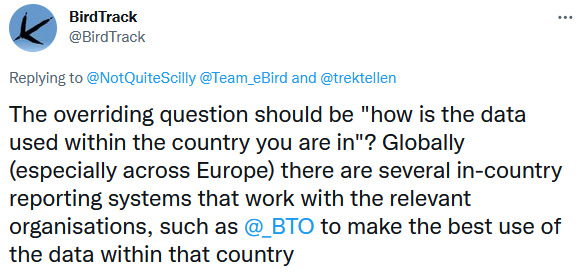
Another respondent made a similar point:
'Regardless of personal preferences being debated here, and respective ease of input, 'greater good' has to be at national/local level, which would be BirdTrack.'
On the face of it these are both fair points, and deserve examination. Although not specifically stated, there is an implication that using eBird rather than BirdTrack is in some way less good. Is that true?
First of all, do eBird records get to the county recorder?
Yes they do. Like BirdTrack records, eBird records are accessible to, and used by, county recorders. At least, from the Twitter thread alone this is evidently the case in Dorset, Northants, Lincs and Kent, so I assume it is (or at least can be) true of any county/region. I also assume that means eBird data can be incorporated in a county database.
Are eBird records able to contribute to conservation initiatives?
Yes they are. For example, according to Alex Lees, eBird data goes to EuroBirdPortal and the GBIF (Global Biodiversity Information Facility). In addition, eBird data apparently is freely accessible to anyone who wants it. Anyone. Excuse my simplistic view, but that surely includes the BTO?
A quote from the Northants recorder:
'As county recorder I download all records from BirdTrack, eBird and iRecord, as well as those [sent] directly to me. All records are saved and sent to the Northants Biodiversity Records Centre - they may be consulted as part of planning applications.'
The Northants Biodiversity Records Centre is one of nearly fifty county-based Local Environmental Records Centres operating accross the UK. This example suggests to me that eBird data is (or can be) used for conservation initiatives at local, national, continental and global level. I cannot help thinking that the BirdTrack = BTO = 'the only way if you want your records to count at local and national level' implication is a big, fat red herring.
Data accessibility
The issue of data accessibility is a bit of a hot topic for some. In a nutshell, eBird records are freely available to all, at no cost; BirdTrack records are potentially available, but rarely without charge, and not with ease. This, from an academic:
'As a researcher, it's much easier to get hold of data which is held by [eBird], which is treated as basically open source data. Other [organisations] tend to require a lot of entering into formal data sharing agreements and admin'
To be honest, as a simple birder this issue doesn't much concern me. However, one respondent made this point:
'...personally...I go with eBird - why? - because eBird is available for others to search fully - BirdTrack is not - eBird helps others find local birds.'
Declaration of disinterest
As mentioned above somewhere, I tried BirdTrack a few years ago but gave up on it because of problems with sites/locations - problems which no longer apply. In 2019 I had a go with the eBird app, made a few entries and likewise gave up. I don't remember why, but it was a time when my enthusiasm for birding was at a low ebb anyway, and any form of record-keeping would likely have been an intolerable chore. Anyway, basically I have no axe to grind. There was no hidden agenda in my Twitter question.
Conclusion
In years past my relationship with birding has been such that simply seeing birds and being happy with that was sufficient for me; I just could not be bothered (or even cope) with submitting records. My relationship with other taxa is like that now. Butterflies, dragonflies, moths, various insects and plants that I am not even fussed about putting a name to - I very rarely submit records for any of these. There is no guilt. Nor should there be. Simply interacting with nature is already a wonderful thing. However, for the last couple of years I have submitted bird records. But spreadsheets are a chore, and I hate them. So if there is a simple, user-friendly way to submit records and get something in return, I am interested. BirdTrack and eBird appear to offer such a facility. In the last couple of weeks I have tinkered with both the BirdTrack and eBird apps and websites. It is early days for me, but there are plenty who have been at it for some time. Forty-odd birders is not a massive sample, but their collective views make for interesting reading.
It isn't for me to say whether one is better than the other, but my brief experience already favours eBird. I'm happy enough that any data I enter into it will end up somewhere useful, despite the implication that a BTO project (BirdTrack) is the only 'proper' way to submit bird records in Britain (which for some reason really rubs me up the wrong way) and it is intuitively simple to use.
Finally, a couple of respondents pointed out that submitting 'complete' lists, breeding records, and all species at sites away from well-watched hotspots, were all more important than which platform is used.
Acknowledgements etc...
I am very grateful to the 55+ birders who troubled to comment in some way on my original Twitter question, and the one or two who got in touch via direct messages. It was an education.
And I should add: if you spot any factual errors in this post, please do let me know somehow. Thanks.