Pages

Tuesday, 18 October 2022

Barred Warbler et al...

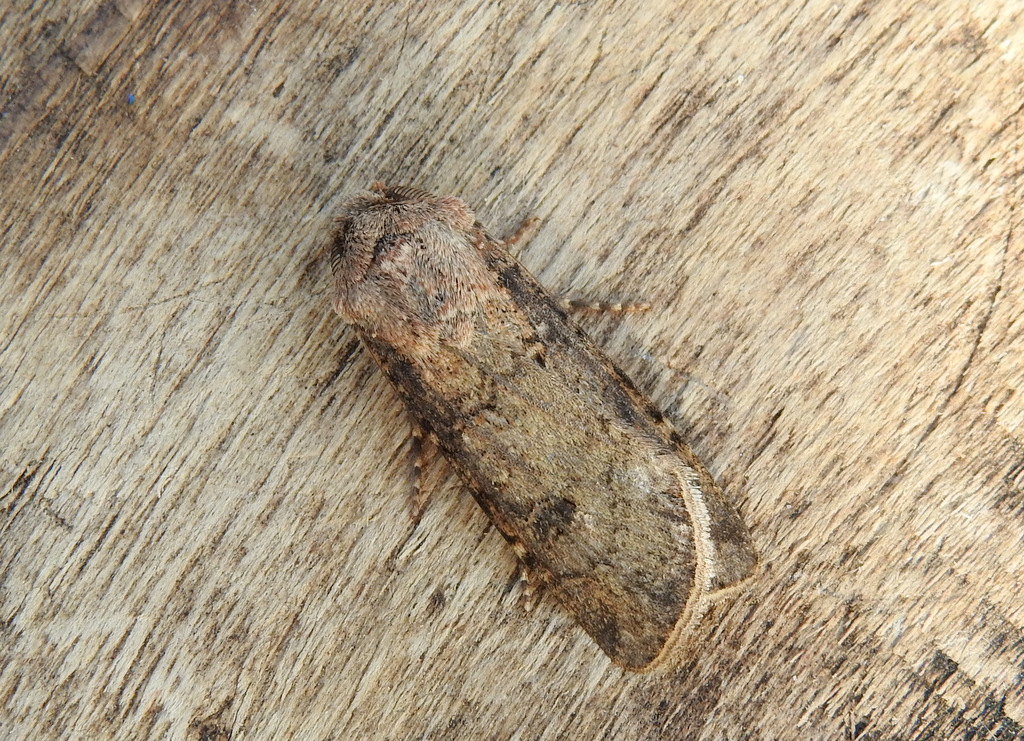
The moth trap didn't take long this morning. Six moths, none new. Breakfast done, and out at first light. I reckoned on a couple of hours birding at West Bay before needing to head for work. A Kingfisher on the river was nice, then a pleasant but fruitless walk along the harbour wall. It felt good though. The wind had changed. An easterly, blowing offshore at an angle. 'Maybe it bodes well?' I thought. Plus a clear sky. Some good vismig potential too...?

Heading uphill towards the West Cliff vismig spot takes you across an open area of rank growth running back from the cliff top. I spied two small birds flying across it, into the breeze. One was a Stonechat; the other was not. The Stonechat's mate had a long, scraggy tail.

Ha! I know what you are...

Right of centre (and up a bit) - a quick record shot in case I never saw it again. Dartford Warbler.

Quickly I phoned Tom, who I guessed would be at the vismig spot, roughly 100m further ahead. Sure enough, he was, and we had decent views together before it went to ground. There have been a few Dartford Warblers along the coast just lately, but this is my first for many years, and a local tick.

It showed again a bit later. I say that, but wouldn't rule out a second bird. Anyway, here it is...
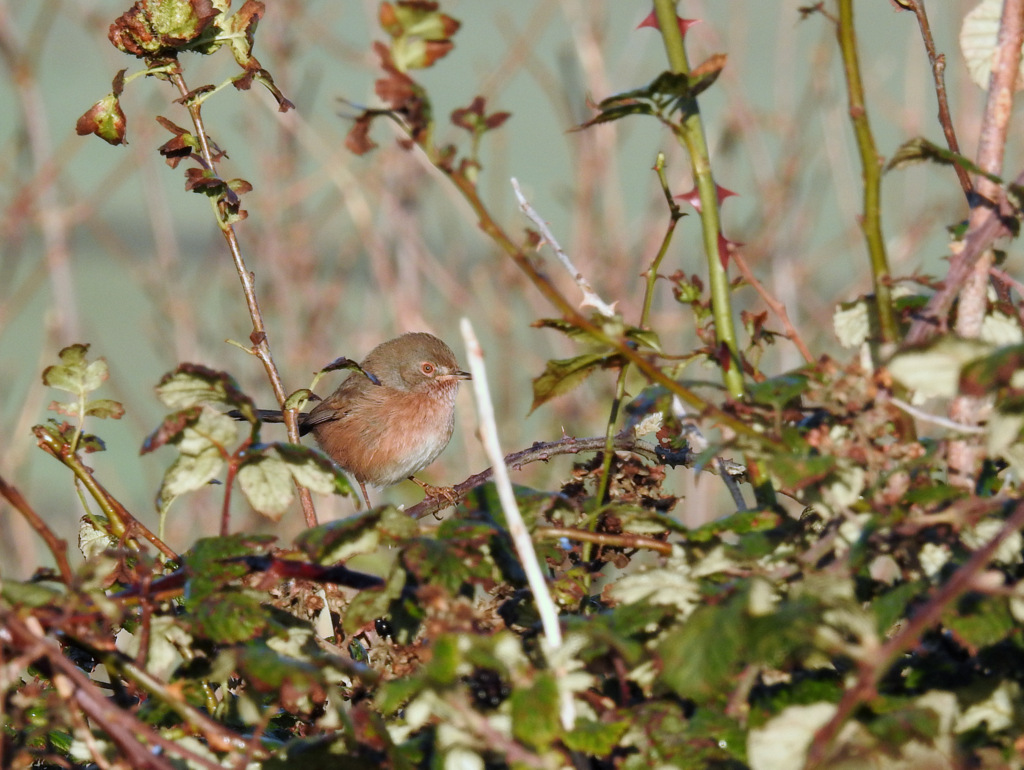
Always the annoying twig!

Lovely to see these dispersing autumn birds along the coast.

I joined Tom at the vismig spot and set up my digital recorder. It is my hope that any unusual vismig birds are nicely captured for posterity in audio format. Like Woodlark, say.

'Woodlark!' said Tom, with some urgency.

I didn't hear a thing. It is audible on the recording, but only just. I am completely in awe of Tom's hearing. Thankfully both birds - for it was two - showed well, with their short-tailed, bouncy flight. Unusually for West Bay, they went east, or maybe north-east.

Moments later...

'Brambling!' Tom again.

I heard that one okay, but literally no more than 0.2 seconds before Tom called it. Astonishing! Here is proof of Tom's uncanny reaction times...


The Brambling was close enough to see lots of orange on it. A smart male.

While Tom is busy counting flyovers and scribbling numbers into his notebook, I am free to relax, gaze around and have my socks blown off. Like this...

A dog walker coming east towards us along the coast path flushed a small bird from low down by the path up into the leafless twigginess of a small Elder bush. I raised my bins and looked at it. I know exactly what I then said, because the words are etched onto the memory card of my recorder, and I've just listened to them. I shan't transcribe it all here, just the first bit...

'Ooh, a Barre... Flippin' 'eck!... Looks like a Barred Warbler...'

Tom sounds very calm as I point out where the bird is, and amazingly I can detect in my voice absolutely no hint of the utter disbelief that I know I felt! Barred Warbler is a very scarce bird in this neck of the woods. In the three Dorset Bird Reports I possess, records as follows: 2020 (0), 2019 (0) and 2018 (1). Suffice to say, Barred Warbler has never really been on my radar.

Barred Warbler, West Bay. Photo taken 08:36, when first seen.

Unfortunately, despite some really excellent views subsequently, the bird never really gave itself up for the camera. At one point I watched it preening, at close range, but deeply buried in a bush. Here it is, reaching for a blackberry...

Barred Warbler in typical pose.

Tom got a few shots of it in the open after I left for work...

West Bay Barred Warbler  ©Tom Brereton

West Bay Barred Warbler    ©Tom Brereton

Perhaps the most satisfying aspect of this morning's jammy find was the fact that the bird involved wasn't a subliminal flyover, but rather an obliging stayer. As I ambled back down the hill towards my car, and work, I met local birder Steve Crimp heading towards me. And I know that he and others later had great views of this classy Dorset rarity.

Excellent.

Sunday, 16 October 2022

Moths, McLarens, Megas

Autumn moths continue to fall, one by one. Some recent lovelies...

Green-brindled Crescent. An absolute belter, and right up there with some of the best-looking moths we've yet encountered.


Feathered Thorn, presumably named after its spectacular antennae.

Last night's new moth, the Red-green Carpet.

Our third Beaded Chestnut, a beautifully caramel-coloured individual.

A migrant which we've had a few times, but this is our first Turnip Moth since August.


For some reason I completely forgot to mention in the last post a recent successful seawatch. Exactly one week ago today, 59 Balearic Shearwaters flew east past the West Bay shelter. That compared favourably with my thus-far 2022 total of zero Balearic Shearwaters, so was...er...noteworthy, to say the least. Factor in a Bonxie, 24 Common Scoters, 15 Kitts and at least 37 Med Gulls, and you have what was - for me at least, in this year of largely dire seawatches - a pretty epic event.

I was out again this morning for a potter around, and encountered this at West Bay...


Across the harbour, what appears to be a small gathering of the McLaren Owners Club.

Is there such a thing as Rare Car Alert? Flock of eight must surely be unusual?


Anyway, I am whatever is the polar opposite of a petrol-head, so was happy with distant views. Curiosity got the better of me later though. Googling 'McLaren sportscar' taught me that at least some of these practical, everyday runabouts were (I think) the McLaren 720S, which retails for a cool £220,000 plus. So, had they all been brand spankers, we are talking the fat end of two million quid's worth of tin and plastic right there. Funny old world...

Skylarks were heading west in good numbers this morning. In the 45 minutes I hung around the West Cliff vis-mig spot I reckon a few hundred went through, and I almost wished I had bothered counting. I heard - but didn't see - Siskins too, and a smattering of other common migrants. Nowt in the bushes though. The only other thing which made me get the camera out was this...

Clouded Yellow. One of a few seen this morning.

Which reminds me. Another recent photo that deserves inclusion...

Taken on October 8th, I'm not sure I've ever seen a Wall butterfly quite this late. And no, I couldn't get any closer!

Finally...

For some reason I was absolutely delighted to see news of this beautiful little beastie light up my Twitter feed this week...


Scilly has long been my (or should I say 'our') favourite holiday destination. It's been a while since the last October visit (2015) but I always find myself subconsciously rooting for that lovely archipeligo every autumn. As mega after mega is coaxed from the scant cover of Shetland's vast acreage, I feel for the ever-loyal Scilly regulars who spend a week or two of their holiday time there each year, hoping to have their retinas melted by just such a creature. And this year it has happened. Good for them.

Friday, 14 October 2022

Early October Thrills

Last night was quite chilly, and I wasn't surprised at the meagre moth tally. Yet among the 13 caught, three were migrant species: Rush Veneer, Rusty-dot Pearl, and this pretty little Vestal...

A subtly pink-blushed Vestal.

New moths have been hard to come by in the last couple of weeks, but I'm hanging in there in the hope of a Merveille du Jour. Here's why...

What a stunner! A real Merveille du Jour laughs at its washed-out image in our old field guide. This beauty was supplied (for photographic purposes) by fellow blogger Karen Woolley back in 2009. I've yet to see another.

Some highlights...

Our first Large Wainscot. Love the line of dots and dusting of fine black pepper.

The one and only Beaded Chestnut so far. Its superficial resemblance to the common Lunar Underwing almost caught me out.

Box-tree Moth. Had a couple recently.

A pleasing nocturnal find in the garden's new wildlife hedge: Brimstone Moth caterpillar.

Another magnificent Black Rustic - our fourth now I think. I really struggle to capture the colour in a photo. Almost looks like a purple tint here.

Plutella xylostella. This poorly-marked one not really living up to its vernacular name of Diamond-back Moth.

That's about it on the moth front, and there isn't a lot to say about birds either. Nocmig has been ticking over gently, with just enough interest to keep me hopeful. Grey Wagtail was a surprise new species on Tuesday night, but otherwise it has been the usual suspects. Max counts of Redwing and Song Thrush in the mid-thirties so far, but it is early days.

In order to give a feel for what it might look like when you come across the various blips and squiggles generated by the audio software in response to bird's nocturnal call, here is a spliced-together selection from various recent nights, exactly as they appeared at the time...

The scale (28 seconds' worth on the screen) is what I use when going through a night's recording, and each example is unedited. Note differences in background noise. For example, Redwing and Song Thrush both during quiet moments on a still night.

Experience is a great teacher. Even a very faint Barn Owl usually leaps off the screen at me these days (this example is not faint) and many of the above were instantly identifiable to species before I even listened to them. The single Snipe call, though, looks very non-birdy, and I'm not sure what made me stop to check it out. Glad I did. Snipe is a nice prize here.

The month of October is famously excellent for assorted migration events, so any self-respecting birder is obviously going to ignore all that thrill potential and photograph Cormorants...

Cormorant on the river at West Bay. Its gular pouch angle looks pretty good for sinensis.

A different bird. It too has a gular pouch, and an angle, but those vaguely reptilian good looks are far too distracting, and I cannot be bothered to ponder for even a second longer the topic of its subspecific identity.

No protractors were harmed in the production of this post.

Thursday, 6 October 2022

Reality

A very nice #LocalBigYear tick early this morning, on the river at West Bay...

Yep. A humble Kingfisher.

The fact that it has taken me until October to see this species probably says more about me than it does about the local status of Kingfisher. A nice surprise though, and the second time in recent days that this very spot has produced a decent local bird...

Yep. A humble Gadwall.

That was Monday morning. Apart from winter birds on the West Bexington Mere, and a couple of spring seawatch records, I cannot think of any other local Gadwall I've seen this year.

So, Kingfisher and Gadwall. Common enough birds, but here, not common. With future birding intentions being even more locally focused, the value of both species is going to appreciate.

Quite often, when certain birders (sometimes me) bang on about the joys of keeping local - and especially when they reference that inflammatory term 'low-carbon birding' - a common retort goes something like this:

'Yes, it's alright for you, living on the coast, with terrific birding on your doorstep. Try inland birding, pal, and see how you like that.'

Okay, how do you quantify 'terrific birding'?

Number of species? Last year I tried pretty hard and notched up 165, including a plastic eagle. This year I'm on 159 so far. And that's a pretty extensive stretch of coast I've included. Next year it will shrink. I suspect there are a fair few inland areas of similar size that can match or beat those numbers.

Numbers of rare and scarce birds? Last year I saw Laughing Gull and Tawny Pipit. Those are the BB rarities. Plus a handful of scarcities. In the last 21 months I can think of Lesser Scaup, Woodchat Shrike, Melodious Warbler, Quail, Stone-curlew, Yellow-browed Warbler (does that even count these days?), Caspian Gull (does that?) and...er...I'm struggling now. West Dorset is not Spurn. Admittedly it is not suburban London either, but again, I would imagine a few inland sites can trounce that collection.

Aesthetic appeal of surroundings? Fair enough, you've got me there.

Surely the real measure of what is 'terrific birding' is whatever keeps you happy and content? As I get older I am finding it easier and easier to be satisfied with my birding lot. That doesn't mean I don't frequently wish there were more and 'better' birds - like we all do - rather that I am not constantly subject to the pull of so-called greener grass. It is a very nice place to be, but I have no idea how I got here. Is it an age thing? Experience? Pitiful lack of ambition? Don't know. Don't care. But I do recommend it.

Yesterday's NQS post comfortably notched up several times the usual number of views. All credit for that must go to birding Twitter's version of car-crash TV. What a ruckus! As the dust settles, will the scene look any different? I doubt it. The show will go on, I'm sure. Perhaps the stage will lose some players though. I wonder how many of those involved in (or witness to) recent Shetland shenanigans will rue the day...

Also, I suppose we can expect a lot more reticence re ill-judged Twittery. Sadly.

Wednesday, 5 October 2022

Flushing

It is autumn 1996, and I am standing on the side of a wet meadow in the Lea Valley. Looking around I see many familiar faces among the murmuring crowd, all here for the same reason as me: the chance of a London tick. In my case, a lifer too. I check my watch. It is almost time...

Two men slowly make their way across the meadow in front of us, several yards apart. The chatter has stopped; all eyes are on the pair out there, the flushers. A bird explodes from the grass! The collective sigh of disappointment says it all. Snipe, just a Common Snipe. But look, two more birds up! One is bigger, darker... And yes, much, much rarer. That rubbish, rather distant flight view of a Great Snipe is exactly what we all came for, and now the show is over. The chatter resumes, a little more animated now, and I cannot get away fast enough.

My one and only Great Snipe. It is hard to convey effectively what a massive anticlimax that all was. And of course, I knew it would be. How could it not? An organised flush, for a load of tick-hungry listers happy to make do with tenth-rate views of a bird that someone else had the thrill of finding. I do not (and never did) have mates delusional enough to help me talk up such a scenario into something to get excited about.

An 'organised flush', did you say?

Yes. Standard practice for such a skulker. Agree a time. Kick the bird out for all to see. Everyone happy.

Couldn't you all just wait for it to show itself?

Ha ha! In umpteen acres of wet meadow, that ain't gonna happen!

But it might fly of its own accord, surely?

Yeah. So might a pig.

To be fair, some birds are so secretive that flushing is sometimes the only way you find one. Any Jack Snipe in that boggy bit on your local patch? You probably won't know unless you get in there.*

Anyway, I don't plan to debate the ethics of flushing birds. After all, we all do it, all the time. Walk along a hedge, through a wood - anywhere really - and you'll be kicking up birds that were quite happy in their little world, until you came clumping along. And away they go. Oh, wait, what was that? Looked really interesting! So you creep along, and flush the Robin again.

Gently trying to chivvy a poorly-seen bird into view is par for the course in everyday birding. But I wonder how it looks to a non-birder? How would I explain myself if challenged? I am well aware that persistently hassling a small bird which is trying to stay hidden would not look good. Which is why I was pretty gobsmacked at one of the offerings on my Twitter feed this morning.

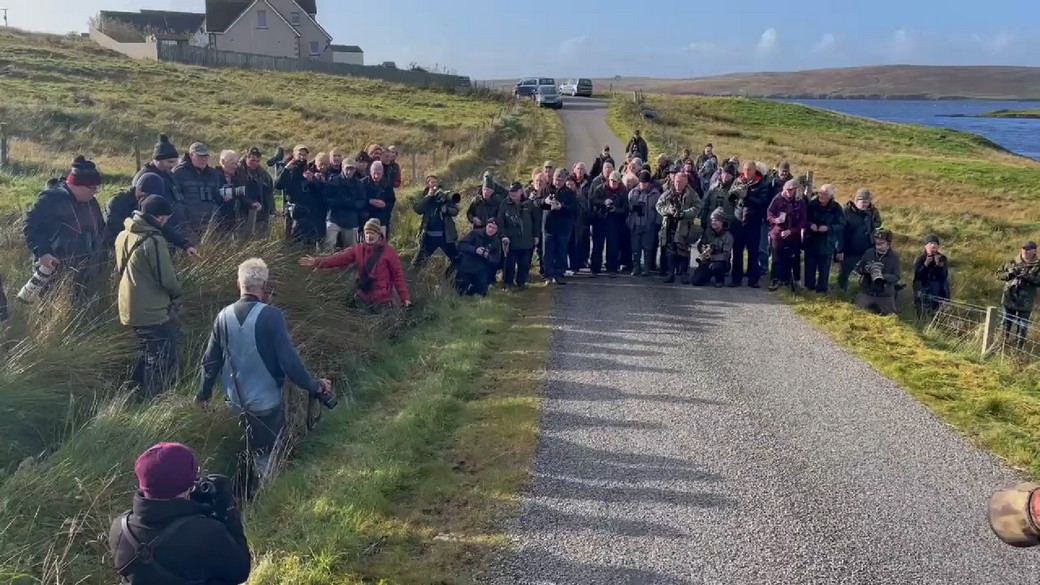
It was a video. A short video taken on Shetland. A small crowd is strung across a road, while a number of individuals converge slowly upon a hidden Lanceolated Warbler, pishing and clapping in order to drive it out of cover. The outcome is predictable. A rapid flight across the road to the field beyond. Crippling views for all, no doubt.

The video has been taken down now, but here is a still from it...

Pre-flight. Guess where it is at this point. I suppose I ought to credit the original videographer, @BrittenKit.

Other tweets suggest this was just one of several times that the Lancey was flushed. As I said earlier, I don't plan to debate the ethics of all this, but what struck me was the seeming lack of awareness of how it looks. Amazingly the tweet had 28 'likes'! Seriously? What is to like? Mind you, it had been viewed well over a thousand times, and attracted multiple retweets and comments which roundly condemned the behaviour.

A bit of context for anyone unfamiliar with all this. Lanceolated Warbler is a small brown warbler that creeps about in the grass like a mouse. Hailing from Siberia, it really should not be on Shetland, but is one of a number of that archipeligo's Sibe specialities, and a sought-after rarity. Birders go to Shetland in autumn hoping to find such birds. Or failing that, just to see one. Even to see one really, really badly as it zips from one patch of cover to the next, showing no diagnostic features whatsoever.

It's a shame the video was taken down really. It ought to be required viewing for every would-be lister. With perhaps an accompanying question:

Is this what you want to get involved with?


*Or fork out for a thermal imaging camera.

Tuesday, 4 October 2022

The Bike

When I am foolish enough to think about it, I remember that my presence has registered in eight decades of our Common Era. Which horrifies me. However, that slap of harsh reality is eased by the knowledge that I have also been a cyclist in seven of them. Which makes me smile.

It wasn't always two wheels. A present from grandparents, I would imagine this Rolls Royce of trikes must have cost relative mega-bucks in the early 1960s. Note the capacious boot. Brilliant for the retrieval of interesting roadkill.

In my adult years cycling has been a means of pleasure and fitness of course, but latterly a sense of vulnerability has eroded my confidence when it comes to riding on the road. So much so that I have sold all my road bikes. The last one went today. But, when one door closes...etc...

In February last year I received a surprising invitation. Would I like to write an essay for a forthcoming book on low-carbon birding? Short answer: yes. It has recently been published, and two or three weeks back my complimentary copy arrived. I am a slow reader, and easily distracted, but have managed a number of chapters now. They have made me think, as I knew they would. At some point I shall write some words about this book and shape them into an opinionated NQS post, but for now I shall just say: why not buy a copy, and read it? This is what it looks like...


Anyway, some of the contributors use bikes for their birding. This is something I have long wanted to do but felt was out of reach. My usual haunts are a little too far for comfort, and reached via roads which are absolutely no fun to ride. Also, skinny, lightweight road bikes with drop bars and a million gears never felt like the right kind of tool for such a task.

Enter number two son.

Baz and family moved from London to Lyme Regis in February 2021. Languishing in their garage ever since has been his old single-speed bicycle. You cannot cycle ten feet in Lyme without going seriously uphill. It is no place for a single-speed. So last week Barry's bike found a new home...

It needs a bit of fettling, but this Charge Plug - my colourful new friend - looks quite at home in the West Bay shelter this afternoon.

The bike's arrival could not have been better timed. Slowly, slowly, I am realising that my birding needs have become far less demanding of the scarce and unusual, and more easily satisfied by simple, everyday stuff, and the occasional quirky 'project'. So I intend to focus increasingly on the Bridport recording area, much of which I would feel comfortable doing by bike.

The Plug is equipped with a 16-tooth rear sprocket, which gives a gearing slightly too high for my knackered old legs, especially when faced with an incline, so an 18-tooth replacement is on order. Plus I need to work out a way to fit my scope and tripod securely...

Yes, already I can sense a renewed zeal for the game. Watch this space...

The view from West Bay's prime seawatching spot.

As I sat there this afternoon, 40+ Med Gulls flew west in under five minutes. The sea was lively enough to look interesting, and I promised myself another visit in the morning. With a scope. The forecast is predicting strong wind, and rain quite early.

Despite the big talk, on this occasion the bike will be staying at home.

Sunday, 2 October 2022

Autumnal Stuff

On Thursday night the autumn's first few nocmig records of Redwing (6) and Song Thrush (3) were a reminder that 2022 is hurrying on rapidly. And thus ended a very quiet September for me, bird-wise. As if to drive the meagreness home, several miles of coastal walk last Wednesday bagged just a handful of Chiffs. The scenery between West Bay and Stonebarrow is quite spectacular, but the only obvious migrants were a small number of hirundines...

Looking west from the slope of Golden Cap, with Charmouth and Lyme Regis in the distance.

Thank goodness for moths. Without them I would be forced to write an opinion piece...

Our first Black Rustic.

There are a number of so-called autumn moths which have been featuring on my Twitter feed recently, and of course I've been hoping some will put in an appearance here. Black Rustic looked like a smart one, and boy, it did not disappoint! As you can see, not black exactly, rather a velvety mix of almost-blacks with a buff scratch in the kidney mark. Lovely. One hundred percent Goth moth.

Here's another new one...

Barred Sallow, in the same catch as the Black Rustic.

Last night was our 107th night of moth recording, and saw yet another two new species...

Grey Pine Carpet, not uncommon locally I think.

Very few Bridport records (<5 on Living Record) but common enough in the county. First UK record was in Essex, as recently as 1989 apparently.

Just 4mm long.

And some others that were worth a snap...

The very lovely Angle Shades.

A couple of Common Marbled Carpets from last night's catch. A variable species, though these two look rather similar.

Our second Barred Sallow, far more contrasty than the first.

Our second Feathered Ranunculus, a male, showing the feathered antennae.

With every night's moth-trapping comes the possibility of interesting by-catch. Last night it was this lumpy beast...

Necrodes littoralis, or Shore Sexton Beetle.

Fascinating creatures like this are always a bonus. I find myself looking them up, learning new stuff, etc. Before I know it there will be a list...

Yesterday we were in London, attending the first Amateur Entomological Society exhibition since pre-Covid. It was our first since the late 1990s, but all seemed very familar...


Richard Lewington's illustrations are simply amazing. It was impossible not to buy something. We came home with a caterpillar field guide and a Painted Lady print.

It was great to see so many young folk there - including lots of children - as well as old fogies like us. I wonder if the Birdfair attracts as many? Anyway, it was good to get back to Dorset yesterday evening, switch on the moth trap and soak up the silence...